
3.1 Applied Yoga · Education
Education: drawing out what is already within
In one line
Education is more than information. Its Latin roots say it nourishes and draws out; its Sanskrit names say it disciplines and brings knowing; and the Indian ideal says its highest form sets a person free.
What the word means
The English word comes from Latin. IGNOU gives three roots: educare, to nourish or bring up; educere, to lead forth or draw out; and educatum, the act of teaching. Read together, education brings a child up, leads them from ignorance to knowledge, and helps them express what is inside. Source NCERT’s B.Ed. textbook gives the same roots. Source
Sanskrit has two words for it. Śikṣā comes from the root śās, to discipline or to control. Vidyā comes from vid, to know, the same root as Veda. So education gives knowledge and also makes a person disciplined. NCERT adds that in ancient India learning was sought as a means to the final goal of life, liberation. Source
Knowledge that sets free
तत्कर्म यन्न बन्धाय सा विद्या या विमुक्तये । आयासायापरं कर्म विद्यान्या शिल्पनैपुणम् ॥tat karma yan na bandhāya sā vidyā yā vimuktaye | āyāsāyāparaṁ karma vidyānyā śilpa-naipuṇam ||
Real action is action that does not bind; real knowledge is knowledge that sets you free. Any other action is only toil, and any other learning only skill in a craft. Viṣṇu Purāṇa 1.19.41, as cited by NCERT’s Journal of Indian Education
The short form, sā vidyā yā vimuktaye, “that is knowledge which liberates”, is one of the best-known lines on education in India. NCERT uses it to say that education should make a student able to earn anna, food, and also give ānanda, happiness. Source Sources differ on where the idea first appears: the NCERT journal cites the Viṣṇu Purāṇa verse above, while an IGNOU unit traces it to the Upaniṣads. NCERT · IGNOU
How Indian thinkers defined it
Swami Vivekananda
Manifesting the perfection within
“Education is the manifestation of the perfection already in man.” He wanted the education “by which character is formed, strength of mind is increased, the intellect is expanded, and by which one can stand on one’s own feet.” Source Indian textbooks often quote the first line as “divine perfection”.
Mahatma Gandhi
Head, heart and hand
“Education is the all-round drawing out of the best in child and man: body, mind and spirit,” as IGNOU quotes him. Source His Nai Talim, basic education, joined learning and work; President Pranab Mukherjee summed up its parts as the 3-H: heart, hand and head. Source
Rabindranath Tagore
In harmony with all
“The highest education is that which does not merely give us information but makes our life in harmony with all existence.” Source
The Upaniṣads
Education is for liberation
IGNOU lists this as the Upaniṣadic definition. The same unit quotes the Gītā: nothing on earth purifies like wisdom (Bhagavad Gītā 4.38). Source
The goal, and human excellence
Put together, the goal is the whole person. NCERT: training the mind alone is proving dangerous; “the head, heart and hand, all three need to be coordinated for the fullest development of human potential”, which needs attention to the physical, intellectual, moral and spiritual sides of a child. Values are not an extra subject; the process of education carries them. Source
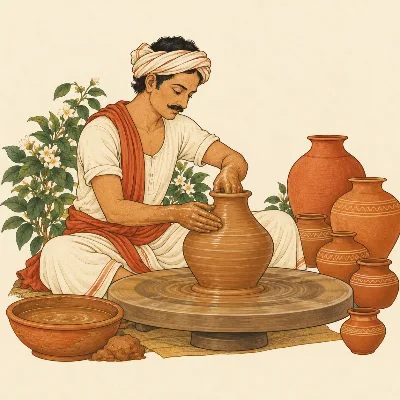
Where does excellence come in? The Gītā gives yoga a one-line definition: yogaḥ karmasu kauśalam, yoga is skill in action (Bhagavad Gītā 2.50). Source In the same verse the skill belongs to one whose understanding stays even (buddhi-yukta), so excellence here means doing the work well without being shaken by success or failure (compare 2.48: samatvaṁ yoga ucyate, evenness is called yoga). That is the excellence a yoga education aims at. See kauśalam in the class notes of 27 September.
Vivekananda’s line suits a yoga teacher well. The perfection is already there; the teacher does not pour it in, but helps clear away what hides it: stiffness, restlessness, a scattered mind.
3.2 Applied Yoga · Yoga in education
Yoga in education, and the guru–śiṣya paramparā
In one line
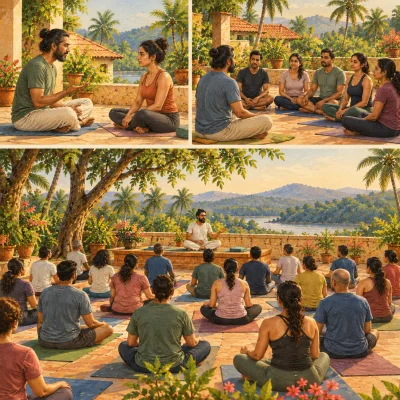
Yoga is learned the way it has always been passed on: by doing, under a teacher’s eye, with values lived rather than lectured. Three things meet in every class: the teacher, the student and the teaching.
Salient features of yoga education
- Experiential. You learn it in the body and the breath, not only from a book.
- Holistic. It works on the body, the breath, the emotions, the intellect and inner joy: the five kośas.
- Individual. In the Upaniṣadic view, as IGNOU explains it, knowledge cannot be handed over from outside; each learner gains it by their own effort and at their own pace, though the teacher’s guidance is essential at the start. Source
- Non-competitive. Each person works to their own capacity, as the Common Yoga Protocol (CYP) asks. Source
- Regular. Results come from steady practice over a long time (Yoga Sūtra 1.14).
- Values in action. Yama and niyama are practised on the mat, not only discussed (below).
- Preventive. The Yoga Certification Board (YCB) describes the Yoga Wellness Instructor’s role as teaching yoga for the prevention of illness and the promotion of wellness, in schools, studios, workplaces and wellness or primary health centres. Source
Three factors: teacher, student, teaching
Teacher
Knows, practises, shows
Knowledge of the subject, a personal practice, and the eye to see what each student needs. The teacher is the living example.
Student
Ready and willing
Health, age, goals, motivation and attitude. The old word is adhikāra, fitness to receive a teaching.
Teaching
Content and method
Content is what is taught: kriyā, āsana, prāṇāyāma, dhyāna, theory. Method is how: demonstration, explanation, practice and correction.
The three must fit each other. A good method with the wrong content, or the right content for the wrong student, does not work.
Guru–śiṣya paramparā

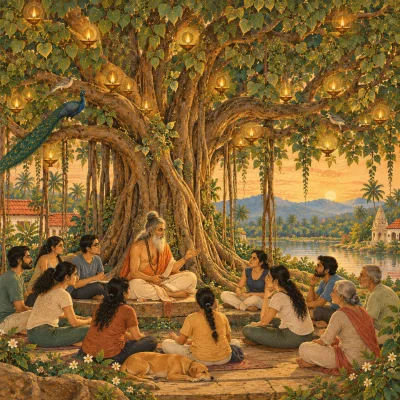
Guru is the teacher, śiṣya the student or disciple, and paramparā an unbroken line, one to the next. The student learns, lives what was learned, and in time teaches. NCERT: the gurukulas and the guru–śiṣya paramparā developed in India thousands of years ago, and the student lived in the guru’s āśrama, the gurukula, to be taught. Source
The word Upaniṣad itself carries the picture: IGNOU explains it as sitting (sad) near (upa) devotedly (ni), and almost every Upaniṣad is a dialogue in which a student brings doubts to a teacher. Source
Oral transmission. Before writing, the Vedas were learned by hearing and chanting: see the Vedas in the class notes of 18 October. IGNOU describes the Upaniṣadic teaching as handed from a competent guru to a deserving disciple, who heard it and retained it, and names the three stages of learning: śravaṇa, listening; manana, reflecting; and nididhyāsana, meditating on it. Source
Examples of the line
- Muṇḍaka Upaniṣad. It opens with its own lineage: Brahmā taught Atharvan, Atharvan taught Aṅgir, Aṅgir taught Satyavāha Bhāradvāja, who taught Aṅgiras. Then Śaunaka came to Aṅgiras in the proper way and asked what that is, knowing which everything is known (Muṇḍaka Upaniṣad 1.1.1–3). Source
- Haṭha Yoga Pradīpikā. It begins by bowing to Ādinātha, Śiva, and lists the siddhas, the masters through whom haṭha yoga came down, Matsyendra and Gorakṣa among them (HYP, chapter 1). See the haṭha texts.
- The prescribed books. B.K.S. Iyengar, author of Light on Yoga, was introduced to yoga by his guru T. Krishnamacharya, who sent him to Pune to teach. Source Swami Satyananda Saraswati, a disciple of Swami Sivananda, founded the Bihar School of Yoga at Munger in 1963. Source He wrote Asana Pranayama Mudra Bandha, and the prescribed commentary on the Hatha Yoga Pradipika, by Swami Muktibodhananda, comes from the same school: two of the books come down one line of teachers.
Qualities of the guru
तद्विज्ञानार्थं स गुरुमेवाभिगच्छेत् समित्पाणिः श्रोत्रियं ब्रह्मनिष्ठम् ॥tad-vijñānārthaṁ sa gurum evābhigacchet samit-pāṇiḥ śrotriyaṁ brahma-niṣṭham ||
To know that, let the seeker go, fuel-sticks in hand, to a guru who is learned in the scriptures and established in Brahman. Muṇḍaka Upaniṣad 1.2.12 (second half) Source
Two qualities, then: śrotriya, learned in the tradition, and brahma-niṣṭha, settled in the truth the teacher speaks of: someone who lives it, not only knows it. The Gītā adds that the teachers are jñānin, wise, and tattva-darśin, people who have seen the truth (4.34, below). In a yoga teacher this looks like knowledge, a steady personal practice, patience, compassion, and no hunger for money or fame from the student.
Qualities of the śiṣya
तद्विद्धि प्रणिपातेन परिप्रश्नेन सेवया । उपदेक्ष्यन्ति ते ज्ञानं ज्ञानिनस्तत्त्वदर्शिनः ॥tad viddhi praṇipātena paripraśnena sevayā | upadekṣyanti te jñānaṁ jñāninas tattva-darśinaḥ ||
Learn it by bowing down, by sincere questioning and by service. The wise who have seen the truth will teach it to you. Bhagavad Gītā 4.34 Source
Three marks of a good student: praṇipāta, humility; paripraśna, real questions asked to understand, not to test; and sevā, service. The fuel-sticks in the Muṇḍaka verse say the same: the student comes ready to serve. Add trust (śraddhā), regularity and self-discipline. IGNOU notes that Upaniṣadic teachers tested a student’s interests, motivation and attitude before accepting them. Source
The teacher’s parting advice
वेदमनूच्याचार्योऽन्तेवासिनमनुशास्ति । सत्यं वद । धर्मं चर । स्वाध्यायान्मा प्रमदः ।vedam anūcyācāryo ’ntevāsinam anuśāsti | satyaṁ vada | dharmaṁ cara | svādhyāyān mā pramadaḥ |
Having taught the Veda, the teacher instructs the student who lived with him: Speak the truth. Live by dharma. Never neglect your own study. Taittirīya Upaniṣad 1.11.1 Source
मातृदेवो भव । पितृदेवो भव । आचार्यदेवो भव । अतिथिदेवो भव ।mātṛ-devo bhava | pitṛ-devo bhava | ācārya-devo bhava | atithi-devo bhava |
Treat your mother as divine, your father as divine, your teacher as divine, your guest as divine. Taittirīya Upaniṣad 1.11.2 Source
This is the Upaniṣad’s “convocation address”. IGNOU notes that at Banaras Hindu University the Vice-Chancellor reads it to students on convocation day, and that it asks them not to leave the world but to live well as householders and serve the community. Source NCERT lists these same instructions as the values a student carried out of the old Indian system of education. Source
Why it still matters for yoga
- Someone has to see you. A book or a video cannot watch your breath or catch a strain. The CYP booklet says only a guru can advise the right mix of paths for each seeker, and that the old commentaries all stress practising under a guru’s direction. Source
- Subtle practices need supervision. Kriyās, prāṇāyāma with retention and meditation are best learned in person (see ṣaṭkarma safety).
- Not blind obedience. The Gītā asks the student to question. NCERT warns that passing on values must not mean passive conformity or blind obedience. Source
- A modern form. Certification, such as the YCB’s, checks that a teacher is competent. The relationship of trust, example and follow-up is still what teaches most.
3.3 · 3.4 Applied Yoga · Value education
Values: caught, not taught
In one line
A value is something we hold worth living by; it guides our choices. NCERT says values are “caught and not taught”: students absorb them from how a class is run. Yoga’s yama and niyama are values you practise on the mat and off it.
Meaning
Values are the ideals and standards that guide how we think, feel and act: what we think is good, right and worth doing. NCERT’s B.Ed. textbook makes two points worth remembering for the exam. Values are part of education itself, not something added on. And they are “caught and not taught”: students imbibe them through the concrete activities of the class, not from abstract talk about them. Source
Types of values
| Type | What it covers | In a yoga class |
|---|---|---|
| Personal | What matters to one person | Punctuality, self-discipline, a daily practice |
| Social | What a society needs for harmony | Respect, sharing space, helping a neighbour |
| Moral | Right and wrong conduct | Truthfulness, non-harming, honesty about limits |
| Spiritual | Inner growth, the deepest aims | Self-awareness, equanimity, surrender of results |
| National | The values of the Constitution | Equality of all students; justice, liberty and fraternity, as the Preamble names them |
| Universal (core) | Values prized by all people, everywhere | Satya, dharma, śānti, prema, ahiṁsā |
NCERT gives a simple classification (personal, social, and core or universal) and says plainly that there is no single classification of values; others include Spranger’s six types and Rokeach’s terminal and instrumental values. It also reports that a Parliamentary Standing Committee (its 81st Report) named truth (satya), righteous conduct (dharma), peace (śānti), love (prema) and non-violence (ahiṁsā) as core universal values, and that the four puruṣārthas form an Indian scheme of values: dharma moral, artha economic, kāma pleasure, mokṣa spiritual. Source See the four aims of life.
Value-oriented education and the five kośas
Value-oriented education builds the whole personality, not only the intellect. IGNOU’s unit on the aims of education in Indian traditions uses the five sheaths, pañcakośa, of the Taittirīya Upaniṣad (2.1–2.5) as the map: “progressive development of the five sheaths of human personality constitutes the aims of education.” Source Yoga has a practice for each sheath:
| Kośa (sheath) | Layer of personality | Yoga practice | Values that grow |
|---|---|---|---|
| Annamaya, of food | The physical body | Āsana, kriyā, sāttvic food | Cleanliness, discipline |
| Prāṇamaya, of vital energy | Breath and energy | Prāṇāyāma | Balance, calm |
| Manomaya, of mind | Senses and emotions | Pratyāhāra, chanting, relaxation | Self-control, patience |
| Vijñānamaya, of intellect | Judgement, discernment | Svādhyāya, reflection, dhyāna | Truthfulness, right judgement |
| Ānandamaya, of bliss | Inner joy | Meditation, selfless service | Contentment, compassion |
More on the kośas: the five kośas in practice (11 October) and the kośas in yoga therapy.
What yoga contributes: values in action
Patañjali’s first two limbs are values. The five yamas (Yoga Sūtra 2.30) and the five niyamas (2.32) come before any posture. Source Iyengar’s Light on Yoga likewise explains each yama and niyama in its introduction before it reaches the āsanas. In a class they look like this:
| Value | Meaning | How it shows in a class |
|---|---|---|
| Ahiṁsā | non-harming | No forcing a body into a pose; kind words; no competition |
| Satya | truthfulness | Honest about what yoga can and cannot do; never promise a cure |
| Asteya | non-stealing | Start and end on time; give credit to your own teachers |
| Brahmacarya | continence; moderation, the right use of energy | No overdoing; clear professional boundaries |
| Aparigraha | non-grasping | No greed; share knowledge freely; no possessiveness about students |
| Śauca | cleanliness | Clean hall, mats and body; the CYP includes cleanliness of mind |
| Santoṣa | contentment | Accept today’s body; no comparing with the neighbour |
| Tapas | disciplined effort | Practise every day, at the same time |
| Svādhyāya | study, and study of oneself | Read the texts; notice your own habits |
| Īśvara-praṇidhāna | surrender to the highest | Do your best and let go of the result; humility |
तपःस्वाध्यायेश्वरप्रणिधानानि क्रियायोगः ॥tapaḥ-svādhyāyeśvara-praṇidhānāni kriyā-yogaḥ
Disciplined effort, self-study and surrender to Īśvara are the yoga of action. Yoga Sūtra 2.1 Source
Spiritual growth. These last three niyamas are the bridge from good conduct to inner growth. Patañjali says that from self-study comes communion with one’s chosen ideal (2.44), and from surrender to Īśvara comes samādhi (2.45). 2.44 · 2.45 In class terms: effort, reflection, letting go. The full eight limbs are in Aṣṭāṅga yoga; see also yama and niyama on the concept map.
3.5 Applied Yoga · The ideal yoga teacher
The ideal yoga teacher
In one line
An ideal yoga teacher practises what she teaches, knows the subject and the person in front of her, keeps everyone safe, speaks clearly and kindly, and never stops learning. Students copy her example more than her words.
What the certification board looks for
The YCB’s Yoga Wellness Instructor syllabus lists the personal attributes the job needs: good communication skills, time management, the ability to understand the body language of the trainees, self-discipline, confidence, maturity, patience, compassion, active listening, empathy and language proficiency. Source
Salient features
Personal practice
Teaches from experience
A daily sādhana of her own. You cannot pass on what you have not tasted.
Knowledge
Knows the why
Texts, anatomy, the effects and limits of each practice, and who should avoid it.
Compassion
Meets each person where they are
Patience with the stiff, the anxious and the slow; no favourites.
Communication
Clear, simple, kind
Short cues, a calm voice, good body language. See the class notes on public speaking: 27 September and 11 October.
Ethics
Yama and niyama at work
Truthful about results, never says “cures”, respects privacy, touches only with consent.
Humility
Still a student
Credits her own teachers; says “I don’t know, I will find out”.
Observation
Sees every student
Notices breath, faces and strain, and remembers names: see a teacher’s memory (20 September).
Safety
First, do no harm
Asks about health, knows contraindications, offers easier versions, keeps the space safe.
Continuous learning
Svādhyāya
Reads, attends workshops, studies her own classes and improves them.
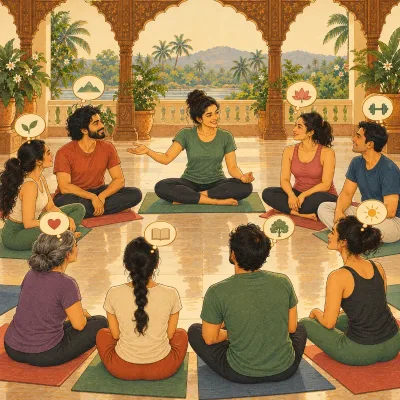
Role in value-oriented education
यद्यदाचरति श्रेष्ठस्तत्तदेवेतरो जनः । स यत्प्रमाणं कुरुते लोकस्तदनुवर्तते ॥yad yad ācarati śreṣṭhas tat tad evetaro janaḥ | sa yat pramāṇaṁ kurute lokas tad anuvartate ||
Whatever a leading person does, others do the same. Whatever standard such a person sets, the world follows it. Bhagavad Gītā 3.21 Source
If values are caught, the teacher is where they are caught from. Arriving on time teaches punctuality; a clean hall teaches śauca; a calm answer to a rude question teaches more about ahiṁsā than a lecture. Patañjali gives four attitudes that keep the mind clear, and they fit a teacher’s day well: friendliness towards the happy, compassion towards those who suffer, gladness for those who do well, and equanimity towards those who do wrong.
मैत्रीकरुणामुदितोपेक्षाणां सुखदुःखपुण्यापुण्यविषयाणां भावनातश्चित्तप्रसादनम् ॥maitrī-karuṇā-muditopekṣāṇāṁ sukha-duḥkha-puṇyāpuṇya-viṣayāṇāṁ bhāvanātaś citta-prasādanam
The mind becomes clear and calm by cultivating friendliness, compassion, gladness and equanimity towards the happy, the suffering, the virtuous and the non-virtuous. Yoga Sūtra 1.33 Source
Yoga in building a healthy society
One teacher reaches dozens of people, and through them their families. The Ministry of Ayush builds on this in several ways. Every year on 21 June, the International Day of Yoga, people across India practise the 45-minute Common Yoga Protocol together. Source For offices there is Y-Break, a five-minute protocol for working professionals, launched as an app in September 2021. Source And the YCB trains instructors for schools, workplaces and primary health centres, for prevention and wellness. Source The prayer at the end of class, sarve bhavantu sukhinaḥ, “may all be happy”, states the aim: see the prayer.
Yoga for personality development
उद्धरेदात्मनाऽऽत्मानं नात्मानमवसादयेत् ।uddhared ātmanātmānaṁ nātmānam avasādayet
Lift yourself up by your own effort; do not let yourself sink. Bhagavad Gītā 6.5 (first half) Source
Personality, in yoga, is the whole of the five kośas. Āsana gives strength and steadiness, prāṇāyāma calm energy, relaxation and pratyāhāra emotional control, svādhyāya clear judgement, and meditation inner contentment. The teacher’s job is to make that growth possible and then step back: the student lifts themself.
4.1 · 4.2 Teaching Skills · Methods of teaching and evaluation
Methods of teaching, and how to evaluate
In one line
Teach a skill by showing it and then guiding the practice; teach ideas by explaining and discussing. Evaluate all the way through (formative), not only at the end (summative).
General methods of teaching
| Method | What it is | Best used for in yoga |
|---|---|---|
| Lecture | The teacher explains; mostly one-way | History, philosophy, anatomy. Keep it short and break it with questions. |
| Demonstration | Teaching by showing and explaining | Every practice: kriyā, āsana, prāṇāyāma |
| Lecture-cum-demonstration | Talk and show together | Introducing a new practice with its benefits and cautions |
| Discussion | Students and teacher talk it through; the teacher guides | Yama and niyama, lifestyle, what students felt in meditation |
| Question–answer | Questions in both directions | Checking understanding; viva practice |
| Project | Students learn by doing a task: a survey or an experiment | A study of local yoga classes, like the Goa market study on this site |
| Self-practice | The student practises alone, regularly | Building the habit: the golden rule |
IGNOU’s teacher-education unit describes the lecture as one of the most used and a largely one-way method, discussion as a democratic method in which the teacher facilitates, and the project as learner-centred. On demonstration it is clear: it is “the most effective method for the development of skills”, a method of teaching by exhibition and explanation, followed by a return demonstration and practice under supervision. Source The YCB syllabus gives lecture-cum-demonstration its own item. Source
Methods special to yoga
- The teaching cycle. Demonstrate, explain, let them practise, observe, correct, evaluate, then go round again. Watch it in the animation below.
- Whole, parts, whole. Show the finished pose, teach it step by step, then put it together again.
- Verbal cues. Action words, one at a time, said positively: “lengthen the spine” works better than “don’t slouch”.
- Mirror demonstration. Facing a group, show the left side when you say “right”, so they see it on their right. See class sizes.
- Counts and breath. Tie each movement to a breath and a count: “breathing in, raise the arms… two… three”. The CYP pairs every movement with its breath. Source
- Simple to complex. Easy variation first, the full form later; known to unknown; short holds before long ones.
Animation · The teaching cycle
Six moves, every pose, every class
Step 1 of 6
Demonstrate
Choose a step, or watch the light travel round.
Presenting each kind of practice
The YCB syllabus asks the candidate to present lessons in four kinds of practice, and to assess a class by detecting and correcting mistakes. Source
| Practice | How to present it | Watch for |
|---|---|---|
| Kriyā | Explain purpose and hygiene; demonstrate; first attempts one-to-one | Contraindications, discomfort, clean equipment. See ṣaṭkarma safety |
| Āsana | Demonstrate, then steps with breath: into the pose, hold, release, counter-pose | Held breath, locked joints, strained faces |
| Prāṇāyāma | Settle the seat first; teach the count; begin without retention | Forcing, dizziness, raised shoulders. See prāṇāyāma |
| Dhyāna | Guide by voice, slowly, with long silences | Restlessness, sleep; keep instructions few. See dhyāna |
Evaluation: formative and summative
| Aspect | Formative | Summative |
|---|---|---|
| When | During learning | At the end of a course or unit |
| Purpose | To improve learning while it happens | To sum up what was learned; grade or certify |
| Yoga examples | Watching and correcting in class; asking how a pose felt; a weekly check of Tāḍāsana alignment | The final practical exam and viva; a written theory paper |
IGNOU quotes a popular saying: when the cook tastes the soup, that is formative; when the guest tastes it, that is summative. It advises balancing the two rather than relying on summative tests alone. Source
Practical and viva. In a practical exam you demonstrate practices and teach them; in a viva you answer questions aloud. In the YCB’s Yoga Wellness Instructor syllabus, theory carries 60 marks and practical 140: demonstration skills 80, teaching skills 40, application of knowledge 10 and field experience 10. Source The split differs between YCB levels; each level’s syllabus gives its own.
4.3 Teaching Skills · Factors influencing yoga teaching
What shapes a yoga class
In one line
The same lesson works differently with a different teacher, learner, room, hour or group size. A good teacher reads these factors before the class and adjusts.
Teacher
Knowledge, health, mood
Her preparation, voice and energy that day. A tired teacher teaches a rushed class.
Learner
Age, health, goals
Children need play and short holds; older students need care with balance and joints; beginners need simple versions. Ask about health first.
Environment
Place, air, floor
Calm and quiet, clean, well ventilated, an even non-slip floor, soft light, no strong draught.
Time and meals
Empty stomach
Early morning is traditional. Practise on an empty or light stomach; the same time each day builds the habit.
Equipment
Mats and props
Mat, durrie or folded blanket; blocks, belts, cushions and chairs make poses possible for more people.
Culture and language
Teach in their words
Use the language the students understand best; give Sanskrit names with their meanings; respect dress and customs.
Guidelines from the Common Yoga Protocol
| When | Guideline |
|---|---|
| Before | Cleanliness (śauca) of surroundings, body and mind. A calm, quiet place. Empty or light stomach; a little honey in lukewarm water if you feel weak. Bladder and bowels empty. A mat, durrie or folded blanket. Light, comfortable cotton clothes. |
| During | Begin with a prayer or invocation. Move slowly, relaxed, aware of body and breath. Do not hold the breath unless told to; breathe through the nose unless told otherwise. No tight holding or jerks. Work to your own capacity. End with meditation, deep silence, saṅkalpa or śānti pāṭha. |
| After | Bathe or eat only 20–30 minutes after practice. |
Summarised from the CYP booklet’s general guidelines. Source
Take care
- Do not practise when exhausted, ill, in a hurry or under acute stress (CYP).
- With a chronic disease, pain or a heart problem, consult a physician or a yoga therapist first (CYP).
- During pregnancy and menstruation, consult yoga experts before practising (CYP); in pregnancy, check with your doctor too. See yoga in pregnancy.
- Every practice has contraindications; know them before you teach it (CYP).
- Yoga complements medical treatment; it does not replace it. Students with a medical condition should work with their doctor.

4.4 Teaching Skills · Teaching practice and the lesson plan
Teaching practice and the lesson plan
In one line
You learn to teach by teaching: short, observed sessions with feedback. A lesson plan is the map: aim, sequence, timing, cues, safety, and how you will check learning.
Why practise teaching?
Doing a pose well and teaching it well are different skills. Teaching needs timing, voice, observation and calm when a student struggles, and these come only from teaching, being watched and hearing feedback. The YCB syllabus lists the “need of teaching practice and its use in yogic practice” as a topic of its own and gives teaching skills 40 of the 140 practical marks for the Yoga Wellness Instructor. Source S-VYASA’s Yoga Instructors’ Course, for example, builds a daily “Teaching Technique & Practice session” into its timetable. Source
स तु दीर्घकालनैरन्तर्यसत्कारासेवितो दृढभूमिः ॥sa tu dīrgha-kāla-nairantarya-satkārāsevito dṛḍha-bhūmiḥ
Practice becomes firmly grounded when it is kept up for a long time, without a break, and with devotion. Yoga Sūtra 1.14 Source
Patañjali says it of practice in general; it is just as true of learning to teach.
What a lesson plan contains
- Heading: date, place, group, level, number of students, any health notes.
- Aim and objectives: what students should be able to do by the end.
- Sequence with times: each practice, in order, with minutes.
- Teaching points: the cues, counts and breath for each practice.
- Safety: contraindications and easier variations.
- Aids: props, charts or music needed.
- Evaluation: how you will know they learned it.
- Reflection: after class, what worked and what to change.
The YCB syllabus asks for a lesson plan for an individual and one for a group. Source For one person the plan follows their health and goals; for a group it follows the least experienced, with harder versions for the others.
A sample plan: 60 minutes for beginners
| Minutes | Part | What happens |
|---|---|---|
| 0–3 | Prayer | A short prayer or Om; sit quietly; ask about injuries and health |
| 3–13 | Warm-up | Sūkṣma vyāyāma: neck, shoulders, wrists, trunk, knees, ankles |
| 13–35 | Āsana | Standing, then sitting, prone and supine; easy versions; a counter-pose after each bend (āsana) |
| 35–43 | Prāṇāyāma | Breath awareness, sectional breathing, slow Anuloma-Viloma; no retention |
| 43–51 | Relaxation | Śavāsana with a guided body scan |
| 51–57 | Meditation | Breath awareness and a few rounds of Om |
| 57–60 | Closing | Śānti mantra; a question or two; one thing to practise at home |
This is my own sample, not an official template. The official reference is the Common Yoga Protocol, which runs 45 minutes: prayer 1, loosening practices 4, yogāsanas 25, then kriyā, prāṇāyāma, dhyāna and saṅkalpa 14, and the śānti mantra 1. Source Both follow the same logic: settle, warm up, move, breathe, rest, sit still, close. The CYP also lets leading institutions add 15 minutes of their own practices, such as prāṇāyāma, yoga nidrā or dhyāna, before the saṅkalpa. Source
Animation · Lesson plan timeline
One class, minute by minute
Beginners · 60 minutes
Choose a plan and watch the hour fill, or tap a part for details.
4.5 Teaching Skills · Teaching aids and presentation
Teaching aids, language, voice and body language
In one line
Aids make ideas visible and practices possible. But the teacher’s own voice and body are the first aids: what you say, how you say it, and how you stand.
Meaning and need
A teaching aid is anything that helps students learn: a chart, a model, a prop, a recording. IGNOU’s unit on teaching-learning resources says visual and audio-visual materials make ideas concrete, and groups resources by the senses they engage: audio, visual and audio-visual. Source In yoga, aids also make a pose possible for a body that cannot yet do it alone.
| Type | Engages | Yoga examples |
|---|---|---|
| Audio | Hearing | The teacher’s voice, a bell, a recorded yoga nidrā, chanting |
| Visual | Sight | Charts (such as the CYP chart), a skeleton or spine model, a whiteboard, pose cards |
| Audio-visual | Both | Video demonstrations, projected slides with narration, online classes |
| Props | Touch and body | Blocks, belts, blankets, bolsters, chairs, a wall |
Language
- Simple words and short sentences. One instruction per breath.
- Give the Sanskrit name with its meaning: “Vṛkṣāsana, the tree pose”.
- Positive cues: say what to do, not what not to do.
- Speak to the whole class; correct one person quietly, by name.
अनुद्वेगकरं वाक्यं सत्यं प्रियहितं च यत् । स्वाध्यायाभ्यसनं चैव वाङ्मयं तप उच्यते ॥anudvega-karaṁ vākyaṁ satyaṁ priya-hitaṁ ca yat | svādhyāyābhyasanaṁ caiva vāṅmayaṁ tapa ucyate ||
Speech that does not upset, that is true, pleasant and helpful, together with regular study, is called the discipline of speech. Bhagavad Gītā 17.15 Source
A fine test for every cue: is it true, is it kind, does it help?
Voice
- Volume: enough for the last row to hear clearly, without shouting.
- Pace: slower than conversation, matched to the breath; the movement happens in the pause.
- Pitch: vary it to keep attention; lower and softer for relaxation and meditation.
- Pauses: silence gives students time to act and to feel.
- Fluency and clarity: know the sequence so well that words come without searching; pronounce Sanskrit names carefully.
Body language
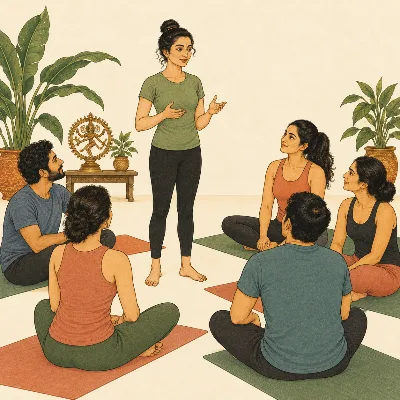
In my class we learned five rules for speaking to a group (27 September): stand straight with your weight on both legs, like Tāḍāsana; keep hand movements above elbow level; make eye contact; modulate your voice; and add something unique to catch attention. Then came the three parts of a speech (4 October) and how to open one (11 October). A yoga class is a speech with movement: the same rules hold.
Animation · Voice and body language
Same words, two teachers
Poor.
Good.
Choose an aspect to compare.
4.6 Teaching Skills · Individual, small group, large group
One student, a small group, a large group
In one line
The more students there are, the less you can do by hand and the more you must do by planning: where the mats go, where you stand, how you demonstrate and who helps you correct.
Animation · Class formation planner
Where do the mats go?
Small group
A semicircle
- Teacher
- Student who can see the teacher
- Hidden, or copying the wrong side
- Assistant teacher
- Line of sight
- Within reach to help
Choose a class size, or turn on the mirror demonstration.
| Aspect | Individual | Small group | Large group |
|---|---|---|---|
| Planning | Built around one person’s health, goals and pace | For the least experienced, with easier and harder versions | A simple, safe, fixed sequence, like the CYP |
| Positioning | Beside the student, facing the same way | Mats in a semicircle; teacher at the open side | Rows with an aisle; teacher on a raised platform |
| Demonstration | Close up, the true side; the student can copy exactly | Mirror demonstration from the front | Mirror demonstration from the platform; microphone; counts |
| Correction | Immediate; hands-on only with consent | Walk round; one person at a time | Group cues from the front; assistants correct individuals |
| Safety | Full health history | Health check at the start of class | Health notice beforehand; no risky practices; helpers watch for distress |
The largest class of all. On the International Day of Yoga, groups across India practise the CYP together from 7:00 to 7:45 a.m. Source A simple, fixed protocol is what makes that possible: it can be led from a stage for thousands, with no hands-on correction.
Mirror demonstration, in words. When you face the class, your right hand is on their left. If you say “right arm” and lift your own right, some will copy the side they see. So face them, say “right”, and lift your left: they see it on their right, as in a mirror. Side by side with one student, facing the same way, you simply use the true side.
4.7 Teaching Skills · Audio-visual aids, ICT and online resources
Audio-visual aids, ICT and teaching online
In one line
Screens, videos and apps carry yoga to people who cannot come to a hall. They cannot see the student for you, so online teaching needs more care: camera, light, sound, safety and privacy.

ICT in yoga teaching
ICT means information and communication technology: computers, phones, the internet and the media they carry.
- Projector and screen: anatomy diagrams, slides for theory classes.
- Video: demonstrations to watch again; record your own teaching to evaluate it.
- Audio: recorded relaxation and yoga nidrā, chants for practice at home.
- Apps and messaging: reminders, practice logs, sharing the week’s sequence.
- Online classes: live teaching over a video call.
Ayush resources
- CYP booklets and videos. The CYP booklets in English and Hindi are on the Ministry of Ayush’s Yoga Portal, and CYP training videos are on the portal, on the MDNIY website, and online in Hindi, English and 21 regional languages. The IDY handbook suggests that yoga professionals run 15-day online CYP trainings of one hour a day. Source
- Y-Break. An app with a five-minute protocol of āsana, prāṇāyāma and dhyāna for working professionals, launched on 1 September 2021. Source
- M-Yoga. An app developed with the WHO and launched on the International Day of Yoga 2021, with training and practice videos based on the CYP. Source
- Charts and booklets from MDNIY on yoga.ayush.gov.in, usable as visual aids.
Teaching online: a checklist
Camera
Whole body, right angle
Landscape frame with your whole body in view. Side-on for standing poses and forward bends, front-on for symmetry. Ask students to set their cameras so you can see them too.
Light
In front of you
Light falling on you, not a bright window behind you, so students see your shape clearly.
Sound
Clear voice
A clip-on or close microphone, a quiet room, music low or off while you cue.
Safety
You cannot catch them
A health form before the first class; a clear note that students practise within their limits; a safe, clear space and a non-slip mat at home.
Privacy
Ask first
Get consent before recording; never share screenshots of students; use secure meeting links.
Engagement
Names and words
Call students by name; give more verbal cues, since you cannot adjust by hand.
Take care online
- With no hands-on help, teach beginners simpler practices online. A cautious rule of thumb: teach kriyās, inversions and breath retention in person first.
- Keep the health-check habit: ask before class about injuries, pregnancy, blood pressure and heart problems.
- Know what you will do if a student feels unwell on camera: have their emergency contact.
Exam practice
Quick revision
Give the Latin and Sanskrit roots of “education”.
Latin: educare, to nourish or bring up; educere, to lead forth or draw out; educatum, the act of teaching. Sanskrit: śikṣā, from śās, to discipline; vidyā, from vid, to know.
Quote the definitions of education by Swami Vivekananda and Mahatma Gandhi.
Vivekananda: “Education is the manifestation of the perfection already in man.” Gandhi: “the all-round drawing out of the best in child and man: body, mind and spirit”; his Nai Talim joined head, heart and hand.
What does “sā vidyā yā vimuktaye” mean, and where is it cited from?
“That is knowledge which liberates.” NCERT’s journal cites it as Viṣṇu Purāṇa 1.19.41; an IGNOU unit traces the idea to the Upaniṣads.
What is the guru–śiṣya paramparā? Name the student’s three approaches in Bhagavad Gītā 4.34.
The unbroken line of teaching passed from teacher to student, orally and by example. The student approaches by praṇipāta (humility), paripraśna (sincere questioning) and sevā (service).
What does the teacher tell departing students in the Taittirīya Upaniṣad?
In 1.11.1–2: satyaṁ vada, speak the truth; dharmaṁ cara, live by dharma; do not neglect your own study; treat mother, father, teacher and guest as divine. It is read at convocation at Banaras Hindu University.
Name the types of values, and explain “values are caught, not taught”.
Personal, social, moral, spiritual, national and universal (core). There is no single classification. Values are absorbed from the example and activities of a class rather than from lectures about them.
How does the pañcakośa model guide personality development in yoga?
The five sheaths of the Taittirīya Upaniṣad (annamaya, prāṇamaya, manomaya, vijñānamaya, ānandamaya) are developed in turn: āsana and kriyā for the body, prāṇāyāma for energy, relaxation and pratyāhāra for the mind, svādhyāya for the intellect, meditation for inner joy.
List the salient features of an ideal yoga teacher.
Personal practice, knowledge, compassion, clear communication, ethics, humility, observation, attention to safety, continuous learning. The YCB adds patience, empathy, active listening, time management and reading students’ body language.
Distinguish formative and summative evaluation with yoga examples.
Formative happens during learning, to improve it: watching and correcting in class. Summative comes at the end, to sum up: the final practical exam and viva. The cook tasting the soup is formative; the guest tasting it is summative.
How does teaching a large group differ from teaching one student? What is mirror demonstration?
One student: beside them, the true side, hands-on only with consent, a plan for that person. A large group: rows with an aisle, a raised platform, a microphone, a simple fixed sequence, assistants to correct. Mirror demonstration: facing the class, you show the left side while saying “right”, so students see it on their right.
Sources
Where this comes from
- Prescribed books (named, never quoted; explained in my own words): B.K.S. Iyengar, Light on Yoga (its introduction, which explains yama and niyama before the āsanas); Patañjali’s Yoga Sūtra; Hatha Yoga Pradipika, with commentary by Swami Muktibodhananda (Bihar School of Yoga / Yoga Publications Trust, Munger), chapter 1 on the line of haṭha masters; Swami Satyananda Saraswati, Asana Pranayama Mudra Bandha (Bihar School of Yoga / Yoga Publications Trust, Munger), named in the paramparā example.
- Classical texts: Taittirīya Upaniṣad 1.11.1–2, 2.1–2.5; Muṇḍaka Upaniṣad 1.1.1–3, 1.2.12; Bhagavad Gītā 2.48, 2.50, 3.21, 4.34, 4.38, 6.5, 17.15; Yoga Sūtra 1.14, 1.33, 2.1, 2.30, 2.32, 2.44, 2.45; Viṣṇu Purāṇa 1.19.41; Haṭha Yoga Pradīpikā, chapter 1. Gītā, Upaniṣad and Yoga Sūtra verse numbers checked on the IIT Kanpur Gītā Supersite.
- Yoga Certification Board, Yoga Wellness Instructor syllabus: role, personal attributes, teaching-skills topics, marks.
- NCERT, Basics in Education (B.Ed. textbook): roots of education, śikṣā and vidyā, guru–śiṣya paramparā, types of values, values “caught, not taught”, the Taittirīya instructions. NCERT, Journal of Indian Education, August 2021: Viṣṇu Purāṇa 1.19.41.
- IGNOU (eGyanKosh): Concept, nature and aims of education; Aims and goals of education in Indian philosophical traditions; Taittirīya Upaniṣad; Muṇḍaka Upaniṣad; Approaches to mokṣa; Teaching-learning methods; Basics of assessment and evaluation; Teaching-learning resources.
- Belur Math, Swami Vivekananda: selected teachings on education.
- PIB: the President on Nai Talim’s 3-H (1 December 2015); Y-Break launch (1 September 2021); M-Yoga launch (21 June 2021).
- Ministry of Ayush: Common Yoga Protocol booklet (general guidelines, the guru, institutional practices); MDNIY CYP chart (the 45-minute split); IDY Handbook 2026 on yoga.ayush.gov.in (CYP videos, online training, Y-Break).
- S-VYASA, Yoga Instructors’ Course: teaching methodology and daily teaching practice.
- Ramamani Iyengar Memorial Yoga Institute, Our Guruji; Bihar School of Yoga, Sri Swami Satyananda.
- My class notes: 20 September (a teacher’s memory), 27 September (public speaking), 4 October (the parts of a speech), 11 October (opening a speech), 18 October (the Vedas).