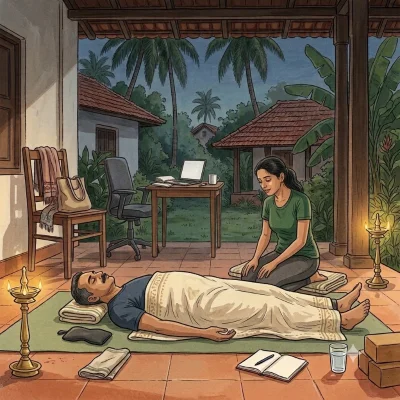
1.17 Yogic relaxation techniques
Relaxation: letting go, wide awake
In one line
Yogic relaxation is neither slumping in front of a screen nor falling asleep. You let the muscles, the breath and the mind loosen one by one, and you stay aware while it happens.
Two switches: the stress response and the relaxation response
Part of your nervous system runs on its own, without being asked. This autonomic nervous system has two branches that pull in opposite directions. The sympathetic branch is the accelerator. Faced with a deadline, a near-miss on the road or an argument, it speeds up the heart, quickens the breath, braces the muscles and puts digestion on hold, so that you can fight or run. That is the stress response. The parasympathetic branch is the brake: the heart slows, the breath lengthens, the muscles soften and digestion starts again. That is the relaxation response, often summed up as “rest and digest”.
The two branches pull against each other, so a body cannot be deeply tense and deeply relaxed at the same moment. That is the working idea behind relaxation methods: IGNOU’s unit on stress management uses it to explain why deliberate muscle relaxation works against stress. Source The nervous system itself is covered in the body’s systems.
| Stress response | Relaxation response | |
|---|---|---|
| Branch | sympathetic: the accelerator | parasympathetic: the brake |
| Heart | faster | slower |
| Breath | quick, high in the chest | slow, low in the abdomen |
| Muscles | braced | soft |
| Digestion | on hold | working again |
| Mind | alert, narrow, ready to react | calm, wide, able to reflect |
Stress itself is not the enemy. S-VYASA, the yoga university in Bengaluru, calls it necessary for growth: it is what makes us alert. Trouble starts when modern speed keeps the accelerator pressed and alertness turns into hypersensitivity. So its stress-management programme, SMET (Self Management of Excessive Tension), pairs stimulation with relaxation, a principle it traces to the Māṇḍūkya Upaniṣad. Source
Śavāsana: the pose that takes away tiredness
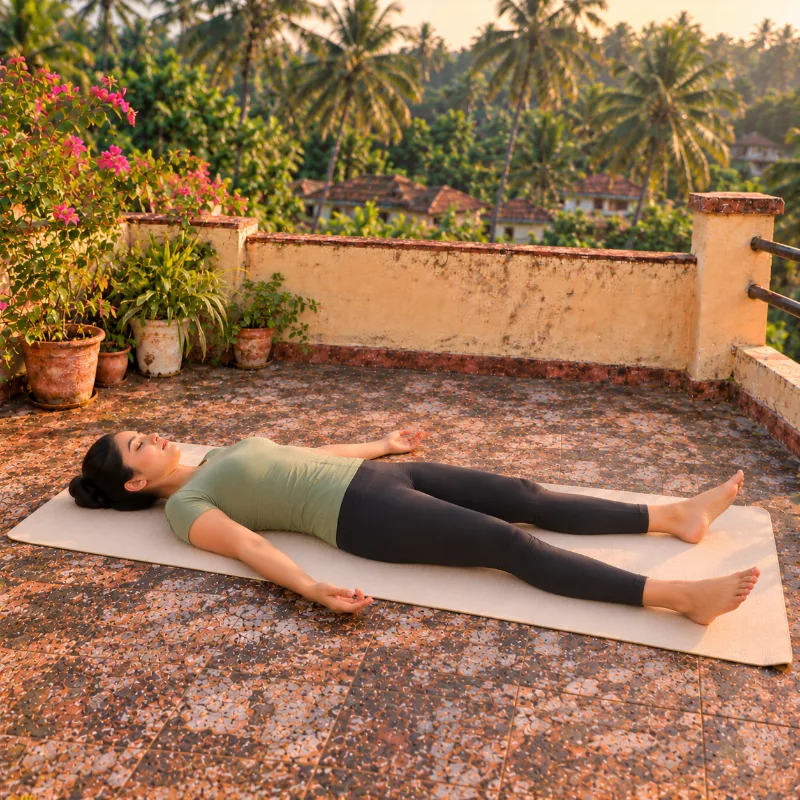
उत्तानं शववद्भूमौ शयनं तच्छवासनम् । शवासनं श्रान्तिहरं चित्तविश्रान्तिकारकम् ॥uttānaṃ śavavad bhūmau śayanaṃ tac chavāsanam · śavāsanaṃ śrānti-haraṃ citta-viśrānti-kārakam
Lying flat on the back on the ground, like a corpse, is śavāsana. Śavāsana takes away tiredness and gives the mind rest.
Haṭha Yoga Pradīpikā 1.32, numbered as in the Bihar School edition with Swami Muktibodhananda’s commentary, which these notes follow (some editions number it 1.34) · Source · Source
The verse names the pose by its look, a body lying still like a corpse (śava), and by its two gifts: it removes fatigue (śrānti) and lets the mind (citta) rest (viśrānti).
The Common Yoga Protocol of the Ministry of Ayush teaches it like this: lie on your back with arms and legs comfortably apart, palms up, eyes closed. Relax the whole body on purpose. Become aware of the natural breath and let it grow slow. Stay until you feel refreshed. It says the pose relieves tension, rests both body and mind, and helps in managing stress, because the mind, usually pulled outward, turns back in. Source
Two more resting poses
Lying on the front
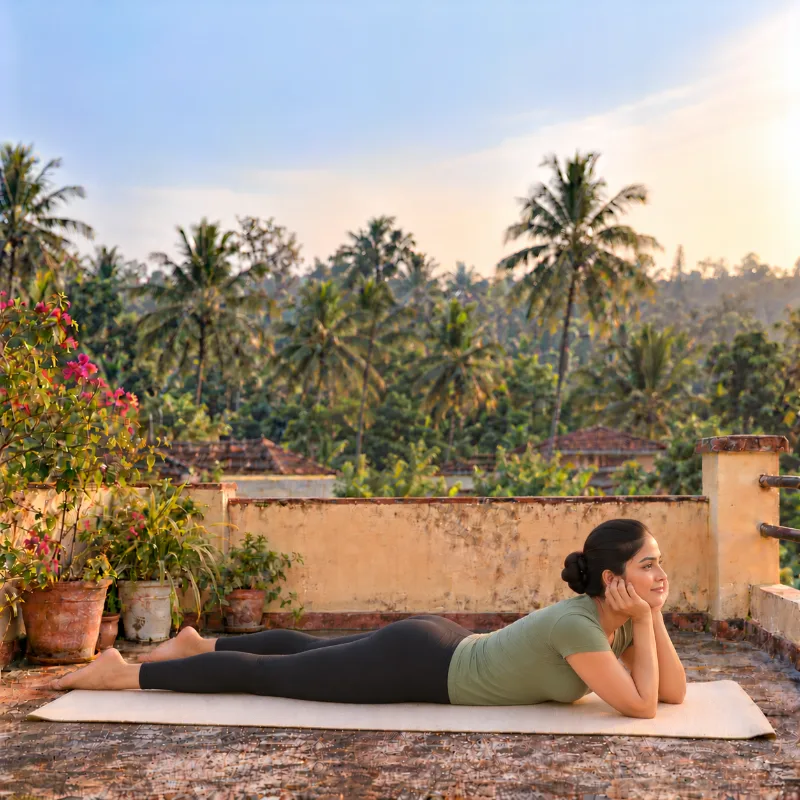
Makarāsana, the crocodile
Lie on your front, feet wide apart and toes turned out. In the Common Yoga Protocol you stack the palms and rest your head on them; Swami Satyananda’s Asana Pranayama Mudra Bandha (Bihar School), like the photo, props the chin in the hands on the elbows. The Protocol uses it to rest between the front-lying poses and says it relaxes the whole body and helps counter stress and anxiety. Source Avoid it in pregnancy and with a frozen shoulder. In the āsana library
Kneeling forward bend
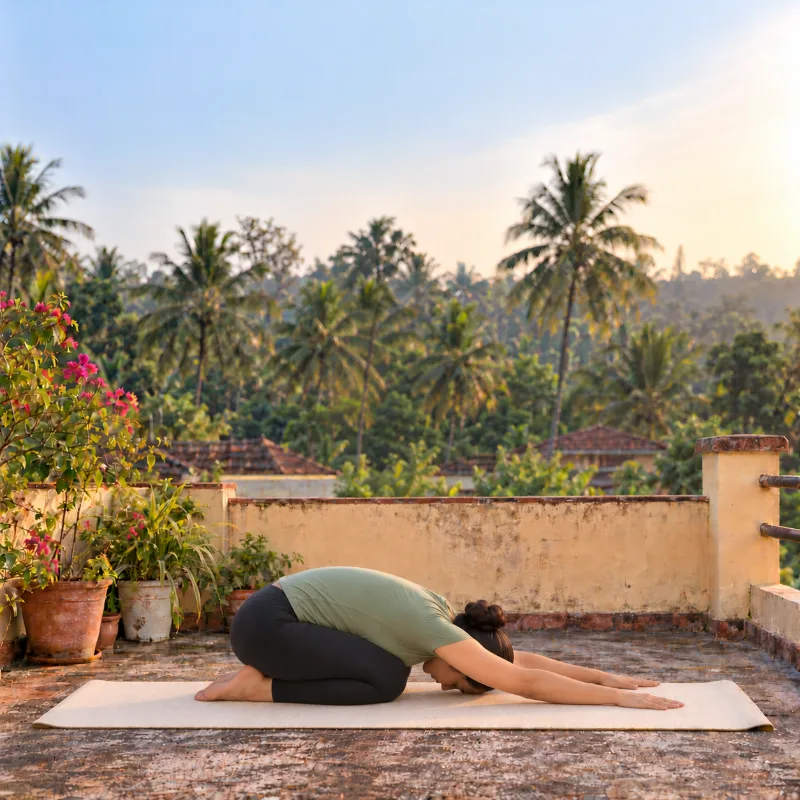
Śaśāṅkāsana, the hare
From Vajrāsana, fold forward, rest the forehead on the floor and stretch the arms ahead: a quiet pose that turns attention inward. The Bihar School groups it with the forward bends of the vajrāsana series and notes that it can also be held as a relaxing pose. Source The Common Yoga Protocol teaches a related hare pose, Śaśakāsana, with the knees apart and the chin on the floor, and says it helps reduce stress and anxiety. Source Avoid it with acute back pain; with arthritis of the knees, skip the kneeling. In the āsana library
Instant, quick and deep relaxation
S-VYASA teaches three graded relaxations in its SMET programme: the Instant, Quick and Deep Relaxation Techniques, known as IRT, QRT and DRT. Source In outline, as they are usually taught, all three lying in śavāsana:
IRT · about a minute
Tense, then let go
Tighten the body part by part from the feet upward, hold the whole body tight for a moment, then release everything at once and rest. Useful between two tasks.
QRT · a few minutes
Ride the breath
Watch the abdomen rise as you breathe in and fall as you breathe out. Let the breath slow and deepen, and feel the relaxation spread with each out-breath.
DRT · longer
Part by part, with sound
Relax the body piece by piece from the toes up, often with a low chant of A for the lower body, U for the middle and M for the head, then the whole AUM, ending in a sense of expansion.
Timings and details differ from teacher to teacher, so learn them from one and treat this as a map. The deepest relaxation in this syllabus is yoga nidrā, next.
A myth to drop
No relaxation replaces sleep. MDNIY, the Ministry of Ayush’s national yoga institute, calls the idea that 20 minutes of meditation or śavāsana equals 7 hours of sleep entirely false: nothing substitutes for the sleep your body needs. Source
1.17 · P1.6 b Yoga nidrā
Yoga nidrā: the body asleep, awareness awake
In one line
Yoga nidrā is guided relaxation in śavāsana. A voice leads your attention through a set sequence: a resolve, the parts of the body, the breath, feelings, images, and the resolve again. The body rests as if asleep; you stay just awake enough to follow.
What the name means, and where it comes from
Nidrā means sleep. Yoga nidrā is often translated as psychic or yogic sleep: a state on the border of waking and sleeping, in which the body is deeply relaxed and awareness is still present. MDNIY describes it in just these terms: a state of awareness between waking and sleeping, reached through a careful guided meditation, in which you stay aware of your surroundings. Source
The method taught today was developed by Swami Satyananda Saraswati, founder of the Bihar School of Yoga at Munger, from nyāsa, an old tantric practice. Nyāsa means placing: in it, mantras are placed on one part of the body after another, with touch and attention. Yoga nidrā keeps that journey of attention through the body. The Bihar School describes it as a systematic method for complete physical, mental and emotional relaxation, in which consciousness works at a deeper level of awareness. Source
The stages
- Preparation. Lie in śavāsana, covered if it is cool, and settle. Listen to sounds far away, then nearer, then in the room; feel the body lying on the floor. Quietly decide: “I will stay awake.”
- Saṅkalpa, the resolve. A short, positive sentence in your own words, such as “I am calm and steady.” Repeat it three times in the mind, with feeling. It is a seed planted while the mind is open.
- Rotation of consciousness. The guide names parts of the body quickly, in a fixed order: the right hand thumb, each finger, the palm, and on through the right side; then the left side; the back; the front, from the top of the head down; and finally the major parts and the whole body. You only move your attention where the voice goes. No effort, no movement.
- Breath awareness. Watch the natural breath, at the navel or the nostrils, without changing it, often counting the breaths.
- Feelings and sensations. Pairs of opposites are woken and then let go: heaviness and lightness, cold and heat, often pain and pleasure.
- Visualisation. The guide names images one after another, or leads a short inner journey. You let them appear on the screen of the mind, without effort.
- Saṅkalpa again. The same resolve, three times, now in a deeply relaxed mind.
- Ending. Awareness returns slowly: breath, body, the floor, the room. Move the fingers and toes, stretch, roll to one side, and sit up only when you are ready.
MDNIY’s booklet on yoga for mental health names the same ingredients: awareness that relaxes every part of the body in turn, with breathing, feeling, visualisation and a positive resolve. Source
Animation · Yoga nidrā
A journey of awareness through the body
Rotation of consciousness right hand thumb … the whole body
Head on the left; the body’s right side is at the bottom. front of the body · the back, beneath you
Eight stages, from preparation to ending. In the rotation, the guide names each part in a fixed order: the right hand and right side, the left side, the back, the front, then the major parts and the whole body. Each dot marks one part.
Tips for practice
- Lie on a mat rather than your bed, and keep a light cover nearby: the body cools as it relaxes.
- Keep still. If you must move, move once, deliberately, and settle again.
- Don’t try hard to concentrate. Follow the voice lightly; if you miss a part, join again at the next.
- If you fall asleep, the body still rests. With practice you stay with the voice for longer.
- Teachers usually advise keeping one saṅkalpa for a long time rather than changing it every session.
- Choose a regular time. The Bihar School’s daily routine for the International Day of Yoga 2024 puts yoga nidrā, or a short “yoga nap”, in the late afternoon or early evening. Source
What it supports
Put modestly, yoga nidrā gives deep rest. MDNIY writes that it helps relieve physical and mental fatigue, stress and stiffness, brings calm and clarity, and is used in the care of sleep problems, anxiety and stress. Source The Common Yoga Protocol names it among the practices an institution may add to the standard session. Source It does not replace a night’s sleep, and it does not replace treatment.
Who should be careful
- Psychiatric conditions such as psychosis, severe depression or the after-effects of trauma: inward practices can bring up strong images and memories. Practise only with your doctor’s agreement and a trained teacher, keep sessions short, and open your eyes whenever you need to.
- Teachers: guide gently. Keep images pleasant and familiar, avoid frightening or very personal themes, and always end slowly.
- During a session, if you feel dizzy, anxious or disturbed, open your eyes, take a few slow breaths and sit up.
- Medical conditions: yoga complements treatment; it does not replace it. Work with your doctor.
1.18 Dhyāna and its role in health and well-being
Dhyāna: when holding the mind becomes a flow
In one line
Patañjali’s last three limbs are one movement inward. Dhāraṇā ties the mind to one point; dhyāna is that attention flowing on without a break; samādhi is when only the object shines, and the sense of a separate meditator falls away.
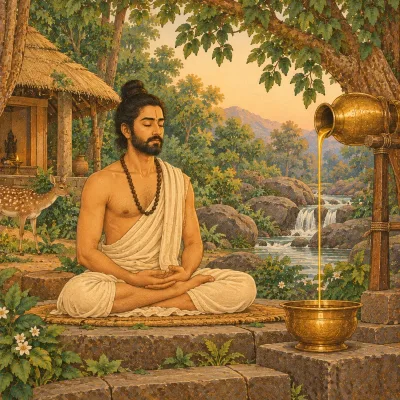
Patañjali’s three steps inward
देशबन्धश्चित्तस्य धारणा ॥deśa-bandhaś cittasya dhāraṇā
Binding the mind to one place is dhāraṇā, concentration.
तत्र प्रत्ययैकतानता ध्यानम् ॥tatra pratyayaika-tānatā dhyānam
There, one unbroken stream of the same awareness is dhyāna, meditation.
तदेवार्थमात्रनिर्भासं स्वरूपशून्यमिव समाधिः ॥tad evārtha-mātra-nirbhāsaṃ svarūpa-śūnyam iva samādhiḥ
When that same meditation shines with the object alone, as if empty of its own form, it is samādhi, absorption.
NIOS’s yoga course reads them the same way: dhāraṇā holds the mind on one object, dhyāna is an unbroken flow of knowing toward it, and when the three are practised together on one object Patañjali calls them saṁyama (3.4). Source Editions count 195 or 196 sūtras in all (MDNIY gives 195, NIOS 196); the numbers on this page are the same in both. Source Iyengar’s Light on Yoga walks through all eight limbs, these three included, before it reaches the āsanas.
The ladder: pratyāhāra, dhāraṇā, dhyāna
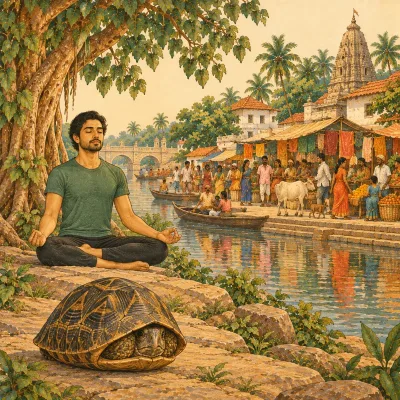
1 · Withdrawing
Pratyāhāra
The senses stop chasing their objects and turn back, the way a tortoise draws in its limbs (Bhagavad Gītā 2.58). Source Sounds are still heard; they no longer pull you out.
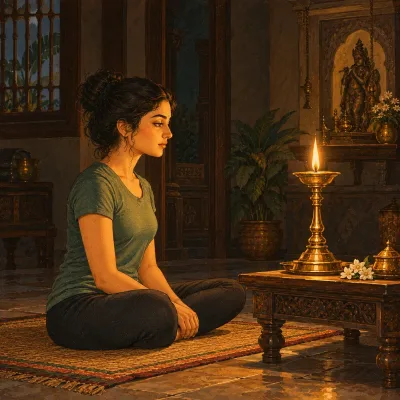
2 · Holding
Dhāraṇā
The mind is held on one point: the breath, a flame, a mantra, a place in the body. It wanders; you bring it back. This takes effort. It is concentration.
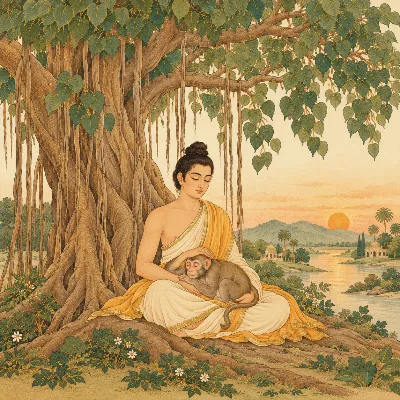
3 · Flowing
Dhyāna
The returns grow shorter until attention simply stays, like oil poured in a thread. Little effort is left. This is meditation.
Concentration or meditation? In daily speech the words are used loosely. In yoga they are steps. Concentration is the effort of holding; meditation is what that effort becomes when it no longer needs pushing. That is why the Common Yoga Protocol’s instruction for dhyāna says you need not concentrate: keep a mild focus between the eyebrows, stay conscious of the breath, and let the thoughts settle into one. Source
The Gītā’s instructions for sitting
Chapter 6 of the Bhagavad Gītā gives the oldest practical instructions in this syllabus. Sit alone in a quiet place, with body and mind under control, free of craving and of grasping (6.10). Set up a firm seat in a clean place, neither too high nor too low (6.11). Make the mind one-pointed, rein in thought and the senses, and practise to purify yourself (6.12). Hold body, head and neck in one line, still and steady, with the gaze resting as if on the tip of the nose, not looking around (6.13).
शुचौ देशे प्रतिष्ठाप्य स्थिरमासनमात्मनः । नात्युच्छ्रितं नातिनीचं चैलाजिनकुशोत्तरम् ॥śucau deśe pratiṣṭhāpya sthiram āsanam ātmanaḥ · nātyucchritaṃ nātinīcaṃ cailājina-kuśottaram
In a clean place, set up your own firm seat, neither too high nor too low, with kuśa grass, a deerskin and a cloth laid one over another.
Bhagavad Gītā 6.11 · Source
समं कायशिरोग्रीवं धारयन्नचलं स्थिरः । सम्प्रेक्ष्य नासिकाग्रं स्वं दिशश्चानवलोकयन् ॥samaṃ kāya-śiro-grīvaṃ dhārayann acalaṃ sthiraḥ · samprekṣya nāsikāgraṃ svaṃ diśaś cānavalokayan
Holding body, head and neck in a line, unmoving and steady, gazing as it were at the tip of your own nose, and not looking about.
Bhagavad Gītā 6.13 · Source · 6.10 and 6.12: Source · Source
Today the same advice is a folded blanket on a firm, clean floor: stable, not wobbly, and comfortable enough to forget.
Meditation, health and well-being
Meditation is not medicine, but it is one of the most studied parts of yoga. What Indian institutions say, put modestly:
Stress
The Common Yoga Protocol says regular meditation helps let go of fear, anger and anxiety and keeps the mind calm. Source At AIIMS New Delhi, the physiology department’s Stress and Cognitive Electroimaging Lab has studied the effect of meditation on the stress response. Source
Attention
The Protocol adds that it increases concentration, memory and clarity of thought. Source The same AIIMS lab has studied how meditation affects stress-induced changes in cognitive function. Source
Sleep
When the mind is heavy or stressed, MDNIY suggests bhrāmarī or nāḍī śodhana, dhyāna and śavāsana before bed to let go of restlessness. Source
Emotional balance
MDNIY notes that meditation is used, from childhood to old age, alongside the care of many psychological conditions, and that its benefits depend on sincerity and regularity. Source
More on the mind in yoga and psychology.
Health note
Meditation complements medical and psychological care; it does not replace it. With depression, an anxiety disorder, psychosis or trauma, practise with your doctor’s knowledge and a trained teacher, and keep sessions short and eyes-open if needed.
Practical tips
- Same time, same place. Early morning or evening, before a meal rather than just after.
- A firm, level seat (Gītā 6.11), with spine, neck and head in one line (6.13). A cushion under the hips helps the knees down; a chair is fine.
- Prepare the body. A few minutes of loosening practices and a few rounds of nāḍī śodhana settle body and breath before you sit.
- One object, kept. The breath, Om, So’ham or the point between the eyebrows. Switching every day keeps you a beginner.
- Start small. Five minutes you actually sit beats thirty you skip. Add time slowly.
- End gently. Rub the palms warm, cup them over the eyes, and open the eyes into the hands.
When it gets difficult
| Difficulty | What helps |
|---|---|
| The mind wanders | Expected, every time. Notice, let go, come back, without scolding: each return is the practice. Counting the breaths or repeating a mantra gives the mind a handle. |
| Sleepiness | Sit upright instead of lying down, keep the eyes slightly open, practise when fresh, and do a few loosening practices or take a short walk first. |
| A restless body | Loosening practices or āsanas before you sit, a higher cushion, a shorter sitting. |
| Strong emotions or memories | Open the eyes, feel the hands and feet, breathe slowly. Tell your teacher; if it keeps happening, your doctor too. |
| “Nothing is happening” | Results come with regular practice over time; the Common Yoga Protocol says persistent, regular practice is essential. The Gītā’s answer to a mind that is hard to hold is the same: practice and letting go (6.35). |
यतो यतो निश्चरति मनश्चञ्चलमस्थिरम् । ततस्ततो नियम्यैतदात्मन्येव वशं नयेत् ॥yato yato niścarati manaś cañcalam asthiram · tatas tato niyamyaitad ātmany eva vaśaṃ nayet
Wherever the restless, unsteady mind wanders off, bring it back from there, and settle it in the Self.
P1.6 a Praṇava japa and So’ham japa
Japa: one sound, returned to again and again
In one line
Japa is repeating a mantra, aloud, in a whisper or silently. Each repetition brings the wandering mind back to one point, so japa is concentration made gentle.
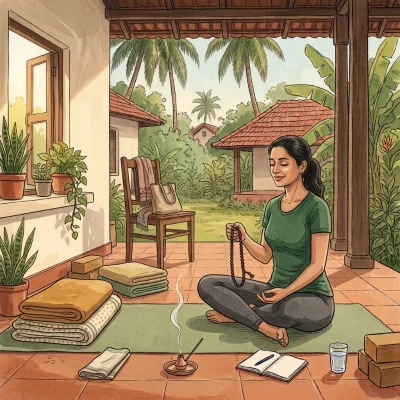
The Yoga Institute in Mumbai describes japa as the disciplined repetition of a mantra, usually counted on a mālā of 108 beads, practised to calm and focus the mind. Source MDNIY’s instructor syllabus lists the recitation of praṇava (Om) and So’ham among the practices that lead to meditation. Source
Patañjali on Om
तस्य वाचकः प्रणवः ॥tasya vācakaḥ praṇavaḥ
The word that expresses Him (Īśvara) is praṇava, Om.
तज्जपस्तदर्थभावनम् ॥taj-japas tad-artha-bhāvanam
Its repetition, and dwelling on its meaning (is the practice).
ततः प्रत्यक्चेतनाधिगमोऽप्यन्तरायाभावश्च ॥tataḥ pratyak-cetanādhigamo ’py antarāyābhāvaś ca
From that comes awareness turned inward, and the obstacles fall away.
Īśvara, in the Yoga Sūtra, is a special puruṣa, untouched by affliction, action, its fruit or its traces (1.24). Source Om is the word that names it. Notice what Patañjali pairs with the repetition: bhāvanā, dwelling on the meaning. Mechanical counting is not the point. IGNOU’s summary: meditation on God or on praṇava helps concentrate the mind. Source The same unit notes that this place for God is what sets Yoga apart from its paired darśana, Sāṅkhya. More in the six darśanas.
Three ways to say a mantra
| Way | How | Why |
|---|---|---|
| Vaikharī | aloud | Good for beginners: the sound steadies a scattered mind. |
| Upāṁśu | whispered, lips moving, heard only by you | Quieter, so attention has to come closer. |
| Mānasika | mental: no sound, no movement | The subtlest, and traditionally the most powerful. |
The Yoga Institute and the Art of Living give the same three. Source · Source A useful order in practice: start aloud, let it become a whisper, then let it go silent.
Using a mālā
- A mālā has 108 beads and one larger bead, the sumeru or meru (also called the guru bead), which marks where a round begins and ends.
- Rest the mālā on the middle finger and move one bead with the thumb for each repetition. Keep the index finger away: it is said to stand for the ego. Source
- At the sumeru, by tradition, don’t cross it. Turn the mālā around and go back the other way for the next round.
- One round is 108 repetitions. Begin with one round and add more only when the first one is steady.
Praṇava japa and So’ham japa
Praṇava japa is the repetition of Om, aloud or in the mind, with its meaning held lightly in view; how to sound it is under Om meditation. So’ham means “I am That” (saḥ, that; aham, I). The Yoga Institute calls it a mantra that aligns breath with awareness. Source It is fitted to the breath: so on the in-breath, ham on the out-breath. When it is no longer said but only heard in the breath, it becomes ajapā.
- Sit steady, spine erect, eyes closed. Take a few slow breaths.
- Repeat the mantra aloud for a few minutes, then whisper it, then repeat it mentally.
- Keep the meaning in view: let each Om point beyond its sound; let each So’ham be a quiet recognition, not a slogan.
- When you stop, sit in silence for a minute before opening the eyes.
P1.6 c Chakra meditation
Cakra meditation: seven stations along the spine
In one line
Tantra and Haṭha yoga picture seven centres, the cakras, along the spine, each a lotus with its own element and seed sound. In cakra meditation you move your attention from one to the next, from the base of the spine to the crown, to steady and refine it.
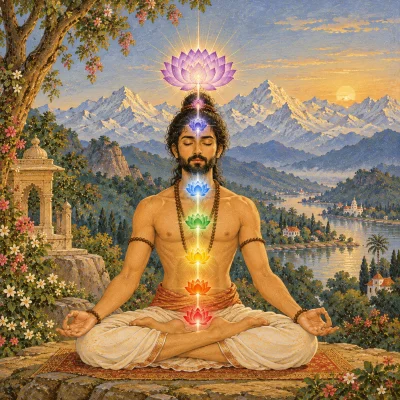
Cakra (often spelt chakra) means wheel; NIOS’s yoga course prefers “vortex” or “whirlpool”. It places seven cakras in the subtle body, along suṣumnā, the central channel in the spine, from mūlādhāra at its base to sahasrāra at the crown of the head. Source Some accounts count six cakras along the spine and treat sahasrāra, the thousand-petalled lotus, as the summit above them; an IGNOU history unit describes it that way. Source The channels themselves are covered under Haṭha yoga.
A map, not anatomy
You will not find the cakras in an anatomy book. They belong to the subtle body described by tantra and taken up by Haṭha yoga, and they work as stations for attention. When books link them with nerve plexuses or glands, read that as a later comparison, not as what the old texts say. Among the Haṭha texts, the Śiva Saṁhitā describes the cakras in its fifth chapter; Kaivalyadhama teaches cakra meditation verse by verse from it. Source
The seven at a glance
| Cakra | Where | Element | Petals | Bīja | Colour |
|---|---|---|---|---|---|
| Mūlādhāra root base | base of the spine: the perineum (the cervix in women) | earth | 4 | laṁ | deep red |
| Svādhiṣṭhāna one’s own place | in the spine, two finger-widths above mūlādhāra | water | 6 | vaṁ | crimson |
| Maṇipūra city of jewels | in the spine behind the navel | fire | 10 | raṁ | bright yellow |
| Anāhata unstruck (sound) | in the spine behind the heart | air | 12 | yaṁ | blue |
| Viśuddhi specially pure | in the spine behind the throat | space (ākāśa) | 16 | haṁ | violet |
| Ājñā command | mid-brain, behind the eyebrow centre, at the top of the spine | mind | 2 | Om (some lists: kṣaṁ) | silver |
| Sahasrāra thousand-petalled | crown of the head | beyond the elements | 1000 | none: silence | shining |
Names, places, elements, petals and colours: NIOS. Source Seed mantras as Kaivalyadhama teaches them, with silence at sahasrāra. Source Colours differ between texts. Kaivalyadhama warns that the cakras have often been distorted into colours and mystical visualisations, and teaches them from the classical text instead. Source
Animation · The cakras
Seven lotuses along the spine
1 of 7 · the base
Mūlādhāra मूलाधार
root base
- Where
- base of the spine: the perineum (the cervix in women)
- Element
- earth
- Petals
- 4
- Bīja
- laṁ
- Colour
- deep red
Seven lotuses from the base of the spine to the crown. Tap one to open it, or ascend through all seven.
A guided cakra meditation
- Sit steady with the spine erect. Let the breath settle for a minute.
- Take your attention to the base of the spine, mūlādhāra. Feel that point and repeat its seed sound, laṁ, a few times, aloud or in the mind. If a picture helps, see a small lotus there.
- Move up, one station at a time: svādhiṣṭhāna with vaṁ, maṇipūra with raṁ, anāhata with yaṁ, viśuddhi with haṁ, ājñā with Om.
- At sahasrāra, the crown, there is no sound. Rest in the silence.
- Come back gently: feel the whole spine, then the breath and the body, then open the eyes.
Kaivalyadhama’s cakra course has the same shape: a guided ascent from root to crown, using the seed mantras in sequence. Source
Go gently
Cakra meditation is a concentration practice, not a way to force energy upward. Keep sessions short at first. If you feel agitated, dizzy, overheated or unsettled, return to simple breath awareness and speak to your teacher. With a psychiatric condition, practise only with your doctor’s agreement and a trained teacher.
P1.6 d Ajapā dhāraṇā
Ajapā: the mantra that repeats itself
In one line
Japa is a mantra you repeat. Ajapā is one you don’t have to: tradition hears the breath itself sounding so as it comes in and ham as it goes out. The practice is to listen.
A-japā means “not recited”. The Gheraṇḍa Saṁhitā, near the end of its chapter on prāṇāyāma, explains it like this: the breath goes out with the sound haṁ and comes back in with sa, and every living being repeats this mantra, called the ajapā gāyatrī, 21,600 times in a day and a night, without trying (Gheraṇḍa Saṁhitā, chapter 5; editions number these verses differently). That figure is fifteen breaths a minute, around the clock: 21,600 ÷ 1,440 minutes.
Dhāraṇā, as in Patañjali, is holding the attention. Ajapā dhāraṇā holds it on this self-repeating mantra, so the effort of japa drops away while the attention stays.
How the practice unfolds
Ajapā japa as taught by the Bihar School of Yoga goes in stages. Here is its outline, kept simple:
- Breath awareness. Sit steady and watch the natural breath, without changing it.
- Ujjāyī. Let the breath pass with a soft sound at the throat, slow and even. (Ujjāyī in the prāṇāyāma unit.)
- The frontal passage. Feel the breath travel up the front of the body from the navel to the throat as you breathe in, and down from the throat to the navel as you breathe out.
- Hear the sounds. So rises with the in-breath, ham falls with the out-breath. Don’t say them; listen for them.
- Later stages, learned from a teacher, take the same awareness along a passage in the spine as well, and the practice deepens toward pure listening.
The Bihar School’s daily routine for the International Day of Yoga 2024 gives a short form for the night, before sleep: five minutes of ajapā japa with awareness of So Ham in the frontal passage between navel and throat. Source Claims should stay modest: this is a calming concentration practice that rides on the breath. Its gift is that it needs no counting and no effort.
Animation · Ajapā japa
So rises, ham falls
Breathing in, so; breathing out, ham
0 breaths heard
At 10 breaths a minute: 14,400 a day. Tradition’s 21,600 is 15 a minute.
The breath rises from the navel to the throat sounding so, and falls back sounding ham. You are not saying it; you only listen.
P1.6 e Om meditation
Om: three sounds and a silence
In one line
Om is chanted as A, U and M, followed by silence. The Māṇḍūkya Upaniṣad maps the three sounds to waking, dreaming and deep sleep, and the soundless fourth to turīya: the pure awareness present through all three.
ओमित्येतदक्षरमिदं सर्वम्om ity etad akṣaram idaṃ sarvam
Om: this syllable is all this.
Māṇḍūkya Upaniṣad 1 (opening words) · Source
The Māṇḍūkya is the shortest of the principal Upaniṣads, only twelve verses, and it is entirely about Om. It names four states of the self: the waker (vaiśvānara, also called viśva) who knows the outer world; the dreamer (taijasa) who knows an inner world of images; the deep sleeper (prājña), who knows no objects at all; and the fourth (turīya), not one more state but the awareness in which the other three come and go. Then, in verses 8 to 12, it lays the syllable over them. Source
| Sound | State | The self in that state | In the chant | Verse |
|---|---|---|---|---|
| A (akāra) | waking (jāgrat) | vaiśvānara | low, in the abdomen | 9 |
| U (ukāra) | dreaming (svapna) | taijasa | in the chest | 10 |
| M (makāra) | deep sleep (suṣupti) | prājña | humming in the head | 11 |
| Silence (amātra) | the fourth (turīya) | the Self itself | the stillness after the sound | 12 |
“In the chant” is how teachers place the sounds in practice; the Upaniṣad itself maps the sounds to the states.
अमात्रश्चतुर्थोऽव्यवहार्यः प्रपञ्चोपशमः शिवोऽद्वैत एवमोङ्कार आत्मैव संविशत्यात्मनाऽऽत्मानं य एवं वेद ॥amātraś caturtho ’vyavahāryaḥ prapañcopaśamaḥ śivo ’dvaita evam oṅkāra ātmaiva saṃviśaty ātmanātmānaṃ ya evaṃ veda
The fourth has no parts. It is beyond all dealings, the stilling of the spread-out world, peaceful, non-dual. So Om is the Self itself. Whoever knows this enters the Self by the self.
Māṇḍūkya Upaniṣad 12 · Source
Animation · Om in the body
A, U, M, and the silence
One breath of Om: A opens low in the abdomen, U rises into the chest, M hums in the head, and then the silence. The line below is the sound: broad waves for A, tighter for U, a fine hum for M, and stillness.
How to chant Om
- Sit tall, shoulders soft, eyes closed. Breathe in fully and quietly.
- A: open the mouth and let a low “aa” sound. Feel it low, in the abdomen.
- U: round the lips into “oo”. The vibration rises into the chest.
- M: close the lips and hum “mm”. Feel it in the throat and the head. Many teachers let the hum carry the longest part of the breath.
- Silence: when the breath is spent, don’t rush the next one. Rest in the quiet that follows. This is the fourth part of Om, and the heart of the meditation.
- Repeat a few times, then sit on in silence.
A flows into U and U into M, with no gaps: one sound that changes shape as it rises.
Chanting together
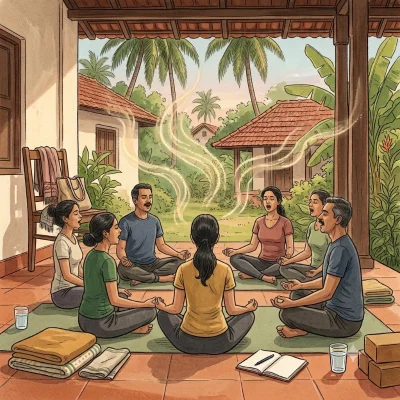
In a group, each person chants on their own breath; nobody has to match anyone. Listen to the whole room rather than to your own voice. The sound swells, overlaps and fades, and the shared silence after the last Om is often the deepest moment of a class.
What it supports
Put modestly: the long humming out-breath of M is the same thing that makes bhrāmarī calming, and the Common Yoga Protocol says the resonance of a humming sound has a soothing effect on the nervous system and mind. Source MDNIY reports evidence of favourable changes in mind and body from the chanting of mantras and ślokas. Source
Caution
Chant softly and never strain the voice. With a sore throat, a cold or blocked sinuses, chant in the mind instead. If the humming brings on a headache or dizziness, stop and breathe normally.
Quick revision
Test yourself
What does Haṭha Yoga Pradīpikā 1.32 say about śavāsana?
Lying flat on the back on the ground like a corpse is śavāsana; it takes away tiredness (śrānti-haram) and gives the mind rest (citta-viśrānti-kārakam). That is the numbering of the Bihar School edition (Swami Muktibodhananda); some editions number the verse 1.34.
Contrast the stress response with the relaxation response.
The stress response is the sympathetic branch of the autonomic nervous system: faster heart and breath, braced muscles, digestion on hold. The relaxation response is the parasympathetic branch: slower heart and breath, soft muscles, digestion resumes. The two pull against each other, which is why relaxation works against stress.
Name three relaxing poses and the three S-VYASA relaxation techniques.
Śavāsana, Makarāsana and Śaśāṅkāsana. Instant, Quick and Deep Relaxation Techniques: IRT, QRT and DRT, taught in S-VYASA’s SMET programme.
Who systematised yoga nidrā, from what, and what are its stages?
Swami Satyananda Saraswati of the Bihar School of Yoga, from the tantric practice of nyāsa. Stages: preparation, saṅkalpa, rotation of consciousness, breath awareness, feelings and sensations (pairs of opposites), visualisation, saṅkalpa again, ending.
Define dhāraṇā, dhyāna and samādhi from the Yoga Sūtra. What is saṁyama?
3.1: dhāraṇā is binding the mind to one place. 3.2: dhyāna is an unbroken flow of the same awareness there. 3.3: samādhi is when only the object shines, as if the mind were empty of its own form. 3.4: the three together on one object are saṁyama.
What does the Bhagavad Gītā (6.10–6.13) say about the seat and posture for meditation?
Sit alone in a quiet place, mind and body controlled (6.10); a firm seat in a clean place, neither too high nor too low, of kuśa grass, deerskin and cloth (6.11); make the mind one-pointed (6.12); hold body, head and neck in a line, still, gaze as if at the tip of the nose, not looking around (6.13).
What do Yoga Sūtra 1.27–1.29 teach about Om?
1.27: praṇava (Om) is the word that expresses Īśvara. 1.28: its japa together with dwelling on its meaning (bhāvanā). 1.29: from that comes inward-turned awareness and the removal of obstacles.
Name the three kinds of japa and the main rules for a mālā.
Vaikharī (aloud), upāṁśu (whispered) and mānasika (mental). A mālā has 108 beads and a sumeru bead; beads are moved with the thumb over the middle finger, the index finger is kept away, and the sumeru is not crossed: you turn the mālā around.
Give the element, petals and bīja of anāhata and viśuddhi. Which cakra has no bīja?
Anāhata: air, 12 petals, yaṁ. Viśuddhi: space (ākāśa), 16 petals, haṁ. Sahasrāra, the thousand-petalled lotus at the crown, has no seed sound: silence.
What is ajapā, and how does Om map to the Māṇḍūkya’s four states?
Ajapā is the mantra the breath repeats by itself: so (sa) on the in-breath, ham on the out-breath, 21,600 times a day and night according to the Gheraṇḍa Saṁhitā (chapter 5), which is 15 breaths a minute. In Om, A is waking (vaiśvānara), U dreaming (taijasa), M deep sleep (prājña), and the silence is turīya, the fourth.
Sources
Where this comes from
- Prescribed books: B.K.S. Iyengar, Light on Yoga (its introduction to the eight limbs, and śavāsana); Swami Harshananda, Ṣaḍdarśana: the six systems of Hindu philosophy, Ramakrishna Math (the Yoga darśana); Patañjali’s Yoga Sūtra; Swami Satyananda Saraswati, Asana Pranayama Mudra Bandha, Bihar School of Yoga / Yoga Publications Trust, Munger (śavāsana, makarāsana, śaśāṅkāsana, ujjāyī); Hatha Yoga Pradipika with commentary by Swami Muktibodhananda, Bihar School of Yoga / Yoga Publications Trust, Munger (the śavāsana verse, numbered as in this edition). Yoga nidrā and ajapā japa follow the Bihar School’s method as its own website describes it. Explained here in my own words, with no quotations from these books.
- Classical texts: Haṭha Yoga Pradīpikā 1.32; Yoga Sūtra 1.24, 1.27–1.29, 3.1–3.4; Bhagavad Gītā 2.58, 6.10–6.13, 6.26, 6.35; Māṇḍūkya Upaniṣad 1, 9–12; Gheraṇḍa Saṁhitā chapter 5 (ajapā); Śiva Saṁhitā chapter 5 (the cakras).
- Yoga Sūtra, Bhagavad Gītā and Māṇḍūkya text: IIT Kanpur Gita Supersite (Heritage IITK), YS 1.27, YS 3.1, BG 6.11, BG 6.13, Māṇḍūkya 1, Māṇḍūkya 12 (other verses linked in place).
- Haṭha Yoga Pradīpikā 1.32: School of Yoga, chapter 1; Karuna Yoga Vidya Peetham, Śavāsana.
- Ministry of Ayush, Common Yoga Protocol (English booklet, hosted by the Ministry of External Affairs): Makarāsana, Śaśakāsana, Śavāsana, bhrāmarī, dhyāna, institutional practices.
- MDNIY (Morarji Desai National Institute of Yoga): Yoga for Mental Health; Friday Webinar series (yoga nidrā, sleep); Certificate Course in Yoga for Protocol Instructor, syllabus; Yoga Sūtra crash course (195 sūtras).
- NIOS: Physical Education and Yog, lesson 18, Hatha Yog (the cakras); Yoga Level C, chapter 9 (Vibhūti Pāda, 196 sūtras).
- IGNOU (eGyanKosh): Stress management techniques; Māṇḍūkya Upaniṣad; Yoga (Īśvara and praṇava); Intellectual developments (cakras and suṣumnā).
- S-VYASA, Self Management of Excessive Tension (SMET).
- Bihar School of Yoga: practice (Swami Satyananda and yoga nidrā); International Day of Yoga 2024 routine (yoga nidrā, ajapā japa).
- Kaivalyadhama: Chakra meditation (Śiva Saṁhitā) and intensive workshop (seed mantras).
- The Yoga Institute, Mumbai, Mantra yoga; the Art of Living, What is japa.
- AIIMS New Delhi, Department of Physiology, Stress and Cognitive Electroimaging Lab.