1.1 Foundation of Yoga
Yoga: the word, its definitions, its aim
In one line
Yoga comes from the root yuj, “to join”. The classical texts define it as a mind that is still, even and skilful, and its aim is freedom from sorrow. Today that also means health, harmony and knowing yourself.
The root: yuj
The Ministry of Ayush’s Common Yoga Protocol says the word yoga comes from the Sanskrit root yuj, meaning “to join”, “to yoke” or “to unite”: in the yogic texts, the union of the individual consciousness with the universal consciousness. Source
Sanskrit grammar, which goes back to Pāṇini, lists the root yuj with more than one meaning, and each meaning gives yoga a different shade:
| Root, as the grammarians list it | Meaning | Yoga as… |
|---|---|---|
| युजिर् योगे yujir yoge | to join, to unite | union |
| युज समाधौ yuja samādhau | to be absorbed, to concentrate (samādhi) | absorption |
| युज संयमने yuja saṁyamane | to restrain, to control | discipline |
Which one does Patañjali mean? His first commentator, Vyāsa, says simply yogaḥ samādhiḥ, “yoga is samādhi”. The later commentator Vācaspati Miśra explains that in the Yoga Sūtra the word comes from yuja samādhau, not from yujir yoge. A University of Lucknow Sanskrit lecture sets this out. Source The National Sanskrit University’s yoga textbook ties the senses of control and contemplation to Pāṇini Source, and Kaivalyadhama lists all three senses. Source So: union is the popular meaning, absorption is Patañjali’s, and control is the means.
Five classical definitions
The syllabus asks for definitions from the Yoga Sūtra, the Bhagavad Gītā and the Kaṭha Upaniṣad. B.K.S. Iyengar’s Light on Yoga, one of the prescribed books, opens its introduction with the same root and with definitions from these three sources. Watch the two strands join, then step through the five.
Animation · the root yuj
Yuj: to join
- युजिर् योगे yujir yoge to join
- युज समाधौ yuja samādhau to be absorbed
- युज संयमने yuja saṁyamane to restrain
1 · Yoga Sūtra 1.2 · Patañjali
योगश्चित्तवृत्तिनिरोधः ॥
yogaś citta-vṛtti-nirodhaḥ
Yoga is the stilling (nirodha) of the movements (vṛtti) of the mind (citta). The next sūtra says what follows: “then the seer rests in its own nature” (YS 1.3).
2 · Bhagavad Gītā 2.48
योगस्थः कुरु कर्माणि सङ्गं त्यक्त्वा धनञ्जय ।
सिद्ध्यसिद्ध्योः समो भूत्वा समत्वं योग उच्यते ॥
yogasthaḥ kuru karmāṇi saṅgaṁ tyaktvā dhanañjaya, siddhy-asiddhyoḥ samo bhūtvā samatvaṁ yoga ucyate
Settled in yoga, do your work, Arjuna, letting go of attachment. Stay the same in success and in failure: that evenness (samatva) is called yoga.
3 · Bhagavad Gītā 2.50
बुद्धियुक्तो जहातीह उभे सुकृतदुष्कृते ।
तस्माद्योगाय युज्यस्व योगः कर्मसु कौशलम् ॥
buddhi-yukto jahātīha ubhe sukṛta-duṣkṛte, tasmād yogāya yujyasva yogaḥ karmasu kauśalam
One whose understanding is joined to this evenness casts off, here and now, both good and bad deeds: neither binds him. So give yourself to yoga: yoga is skill in action (karmasu kauśalam).
4 · Bhagavad Gītā 6.23
तं विद्याद् दुःखसंयोगवियोगं योगसंज्ञितम् ।
स निश्चयेन योक्तव्यो योगोऽनिर्विण्णचेतसा ॥
taṁ vidyād duḥkha-saṁyoga-viyogaṁ yoga-saṁjñitam, sa niścayena yoktavyo yogo ’nirviṇṇa-cetasā
Know that the breaking of the bond with sorrow is called yoga. Practise it with determination, with a mind that does not lose heart. A neat paradox: yoga, “joining”, is here an un-joining.
5 · Kaṭha Upaniṣad 2.3.11
तां योगमिति मन्यन्ते स्थिरामिन्द्रियधारणाम् ।
अप्रमत्तस्तदा भवति योगो हि प्रभवाप्ययौ ॥
tāṁ yogam iti manyante sthirām indriya-dhāraṇām, apramattas tadā bhavati yogo hi prabhavāpyayau
That steady holding of the senses is what the wise call yoga. Then one becomes watchful, for yoga comes and goes: it can grow, and it can be lost.
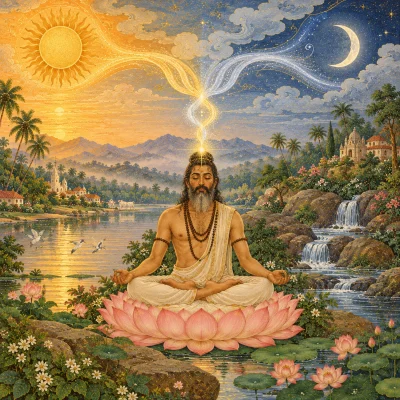
Two strands, the individual and the universal, braid together and become one point of light: yoga as union.
| Source | Key words | Yoga is… |
|---|---|---|
| Yoga Sūtra 1.2 | citta-vṛtti-nirodhaḥ | the stilling of the mind’s movements |
| Bhagavad Gītā 2.48 | samatvaṁ yoga ucyate | evenness of mind |
| Bhagavad Gītā 2.50 | yogaḥ karmasu kauśalam | skill in action |
| Bhagavad Gītā 6.23 | duḥkha-saṁyoga-viyogam | breaking the bond with sorrow |
| Kaṭha Upaniṣad 2.3.11 | sthirām indriya-dhāraṇām | the steady holding of the senses |
Kaṭha numbering: the Upaniṣad has two chapters of three vallīs each, so 2.3.11 (chapter 2, vallī 3, verse 11) is also cited as 6.11 when the six vallīs are counted straight through. Vyāsa’s yogaḥ samādhiḥ (on YS 1.1) is a sixth definition worth knowing.

The aim of yoga
Patañjali
Kaivalya: freedom
When the mind is still, “the seer rests in its own nature” (YS 1.3). The last sūtra calls the final state kaivalya, aloneness: pure consciousness standing in itself, no longer mixed up with the mind (YS 4.34).
The Gītā
Freedom from sorrow
Yoga cuts the bond with sorrow (6.23), and its fruit in daily life is an even mind and skilful action (2.48, 2.50). The Gītā also says yoga destroys sorrow for one who is moderate in food, rest, work and sleep (6.17).
For everyone today
Health, harmony, self-knowledge
The Common Yoga Protocol: the aim of practice is to overcome suffering and reach a sense of freedom, with holistic health, happiness and harmony. MDNIY: the aim is self-realisation, overcoming all kinds of suffering. Source
Objectives
The aim is the destination; the objectives are the milestones a practitioner and a teacher work towards. Drawn from MDNIY’s overview and the Common Yoga Protocol:
- Health of body and mind: preserving, maintaining and promoting physical and mental health.
- Prevention: yoga is known for disease prevention and the promotion of health.
- Support in lifestyle disorders: helping to manage many lifestyle-related disorders, alongside medical care, never instead of it.
- Harmony: between mind and body, and between the person and nature.
- Values: MDNIY calls basic human values “the very identity” of yoga sādhanā; the yamas and niyamas come first.
- Spiritual growth: self-realisation, which MDNIY calls “spiritual evolution”.
Common misconceptions
Myth
“Yoga is only physical exercise.”
Āsana is one of Patañjali’s eight limbs (YS 2.29). MDNIY calls dhyāna, meditation, the essence of yoga sādhanā.
Myth
“Yoga is a religion.”
The CYP says the science of yoga began before the first religions or belief systems, and MDNIY calls it a worthy practice for people of all religions, races and nationalities.
Myth
“You must be flexible to start.”
Patañjali asks only that a posture be steady and comfortable (sthira-sukham āsanam, YS 2.46). The CYP says practise according to your capacity. Flexibility is a result, not an entry ticket.
Myth
“It is for the young, or for women.”
The National Sanskrit University’s textbook says yoga can be practised by all. The Gītā’s teaching is given to a warrior on a battlefield. Practices are simply adapted to age and health.
Myth
“It must hurt to work.”
The CYP: practise slowly, relaxed, aware of body and breath, with no jerks. The Haṭha Yoga Pradīpikā even lists overexertion, prayāsa, among the six things that destroy yoga (HYP 1.15).
Myth
“It is a quick fix.”
The CYP: results take time, so regular practice is essential. Patañjali says practice becomes firm only when kept up for a long time, without a break, with devotion (YS 1.14).
Myth
“Yoga means feats and powers.”
Lying on nails, stopping the heartbeat or bending iron rods are not yoga, says the National Sanskrit University’s textbook: the mark of yoga is the power to hold the mind at will. Source
1.2 Foundation of Yoga
Origin, history and development
In one line
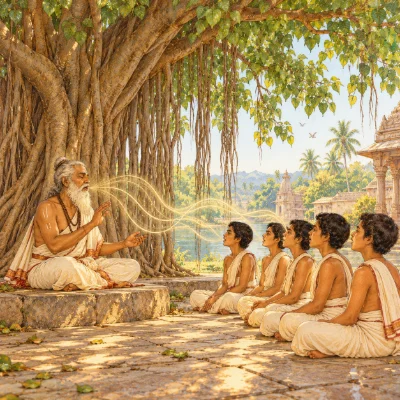
Yoga is very old, but exactly how old is debated. The Indus seals hint at it, the Vedas and Upaniṣads develop it, Patañjali systematises it, the Haṭha yogis make the body its doorway, and modern teachers and research institutes carry it to the world, which now marks 21 June.

-
Pre-Vedic · Indus–Sarasvatī civilisation, about 2700 BC
Seals and figures “with Yogic motives and figures performing Yoga Sadhana suggest the presence of Yoga in ancient India”, says MDNIY. Suggest, not prove: the Indus script is still unread. In mythology Śiva is the first teacher of yoga.
-
Vedic · the four Vedas
Yoga was part of worship (upāsanā) and learned under a guru. The sun was given the highest importance, and MDNIY suggests Sūrya Namaskāra may have grown from that; prāṇāyāma was part of the daily ritual.
-
Pre-classical · Upaniṣads and epics
The Upaniṣads turn the search inward: the Kaṭha’s chariot, the Śvetāśvatara’s seat and breath (see 1.3). MDNIY’s sources for this age: the Vedas, the Upaniṣads, the Smṛtis, Buddhist and Jaina teaching, Pāṇini, the two epics and the Purāṇas.
-
Classical · 500 BC – 800 AD, “tentatively” (MDNIY)
Mahāvīra’s five great vows and the Buddha’s eightfold path, “the early nature of Yoga sadhana”; the Gītā’s jñāna, bhakti and karma yoga; Patañjali’s Yoga Sūtra and Vyāsa’s commentary on it.
-
Post-classical · 800 – 1700 AD
The great ācāryas Śaṅkara, Rāmānuja and Madhva; saint-poets such as Surdas, Tulsidas, Purandaradasa and Mirabai; and the Nāth yogis of Haṭha yoga, Matsyendranātha and Gorakṣanātha, with Svātmārāma (the Haṭha Yoga Pradīpikā) and Gheraṇḍa (the Gheraṇḍa Saṁhitā).
-
Modern · from 1700 AD (MDNIY’s “modern period” is 1700–1900)
Ramana Maharshi, Ramakrishna, Vivekananda; then teachers such as Swami Sivananda, T. Krishnamacharya, Shri Yogendra, B.K.S. Iyengar and Swami Satyananda Saraswati, founder of the Bihar School of Yoga in Munger Source. Research begins: Swami Kuvalayananda founded Kaivalyadhama at Amalner in 1917 and its research centre at Lonavala in 1924. Source
-
Today · 21 June
In December 2014 the UN General Assembly adopted India’s resolution declaring 21 June the International Day of Yoga, with 175 countries as co-sponsors, the most ever for a General Assembly resolution. Source
Where the books disagree: MDNIY calls its period dates tentative and places the Gītā, Mahāvīra and the Buddha in the classical period, while other textbooks call the age of the Upaniṣads, epics, Jainism and Buddhism “pre-classical” and keep “classical” for Patañjali. Patañjali’s own date is debated. All period quotes: MDNIY, Yoga: its origin, history and development.
For the full story with every source, see the talk From a seal to Rajpath.
1.3 Foundation of Yoga
Yoga in the principal Upaniṣads
In one line
The Upaniṣads, the closing teachings of the Vedas, turn the search inward. They picture the self as a chariot’s rider, describe five sheaths of a person, give a seat and a breath for meditation, and make Om the bow that carries the self to Brahman.
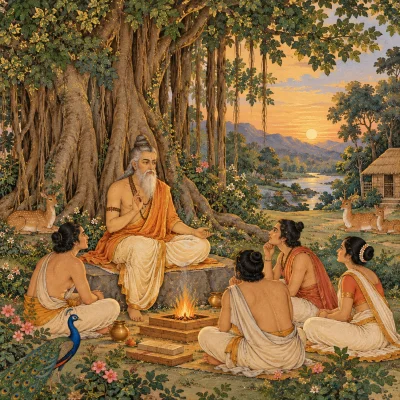
MDNIY counts 108 Upaniṣads among yoga’s sources. Books differ on how many are “principal”: ten is the classic list, often extended to eleven, twelve or thirteen with the Śvetāśvatara and others. A separate, later group, the Yoga Upaniṣads, such as the Śāṇḍilya, Yogatattva, Dhyānabindu and Nādabindu, deals with yoga practice directly. Source
Kaṭha Upaniṣad: the chariot (1.3.3–9)
Young Naciketas asks Yama, the lord of death, what lies beyond death. Part of the answer is one of yoga’s best-known pictures.
आत्मानं रथिनं विद्धि शरीरं रथमेव तु ।
बुद्धिं तु सारथिं विद्धि मनः प्रग्रहमेव च ॥
ātmānaṁ rathinaṁ viddhi śarīraṁ ratham eva tu, buddhiṁ tu sārathiṁ viddhi manaḥ pragraham eva ca
Know the self as the master of the chariot and the body as the chariot. Know the intellect as the charioteer and the mind as the reins.
Kaṭha Upaniṣad 1.3.3 · Source
| In the picture | In you |
|---|---|
| master of the chariot | the self, ātman |
| chariot | the body, śarīra |
| charioteer | the intellect, buddhi |
| reins | the mind, manas |
| horses | the senses, indriya (1.3.4) |
| roads | the sense objects (1.3.4) |
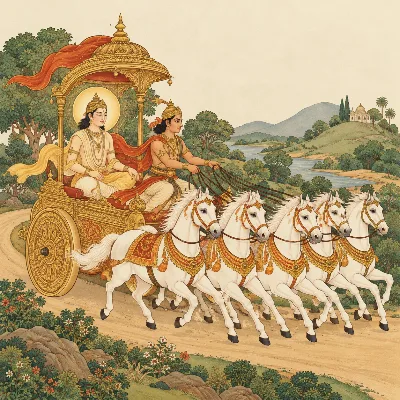
With an undiscerning charioteer and slack reins, the horses run wild. But one whose charioteer is discerning and who holds the reins of the mind “reaches the end of the road”, the highest place (1.3.9). That is yoga in one image: the intellect, through a steady mind, guides the senses. Source
Kaṭha: yoga as steady senses (2.3.10–11)
यदा पञ्चावतिष्ठन्ते ज्ञानानि मनसा सह ।
बुद्धिश्च न विचेष्टते तामाहुः परमां गतिम् ॥
yadā pañcāvatiṣṭhante jñānāni manasā saha, buddhiś ca na viceṣṭate tām āhuḥ paramāṁ gatim
When the five senses of knowing come to rest together with the mind, and the intellect too stops stirring, that, they say, is the highest state. The very next verse names it yoga: “the steady holding of the senses” (2.3.11, in 1.1).
Kaṭha Upaniṣad 2.3.10 · Source
Taittirīya: five sheaths, and a son who kept asking
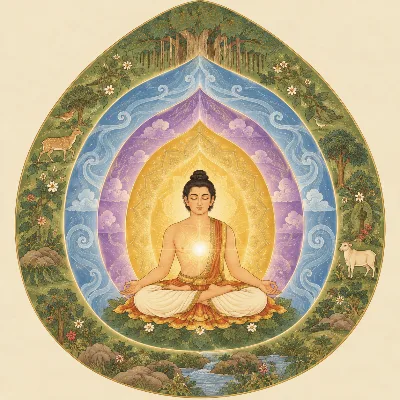
The second chapter, the Brahmānanda (or Ānanda) Vallī, describes a person as five nested sheaths (pañcakośa), from the outermost to the innermost (2.1–2.5):
- Annamaya: made of food, the physical body.
- Prāṇamaya: made of prāṇa, the vital energy and breath.
- Manomaya: made of mind, thoughts and feelings.
- Vijñānamaya: made of understanding, the intellect that discerns.
- Ānandamaya: made of bliss, the innermost layer.
The same chapter then measures human joy against ever higher joys, the ānanda mīmāṁsā (2.8). In the third chapter, the Bhṛgu Vallī, Bhṛgu asks his father Varuṇa, “Teach me Brahman”, and is sent to find it through tapas. He realises in turn that food, prāṇa, mind and understanding are Brahman, and at last that bliss, ānanda, is Brahman (3.1–3.6). Source The story is in the 4 October class notes. The YCB syllabus asks specifically for pañcakośa viveka and ānanda mīmāṁsā. Source
Śvetāśvatara, chapter 2: an early meditation manual
- Posture (2.8): hold the body straight, with chest, neck and head erect; draw the senses and the mind into the heart.
- Breath (2.9): regulate the breath and, when it has grown quiet, breathe out gently through the nose; hold the mind as a driver holds a cart yoked to unruly horses.
- Place (2.10): level and clean, free of pebbles, fire and sand, quiet, pleasing to the mind, sheltered from the wind.
- Signs on the way (2.11): forms like mist, smoke, sun, wind, fire, fireflies, lightning, crystal and moon appear before Brahman is revealed.
- Signs of progress (2.12–2.13): below.
लघुत्वमारोग्यमलोलुपत्वं वर्णप्रसादं स्वरसौष्ठवं च ।
गन्धः शुभो मूत्रपुरीषमल्पं योगप्रवृत्तिं प्रथमां वदन्ति ॥
laghutvam ārogyam alolupatvaṁ varṇa-prasādaṁ svara-sauṣṭhavaṁ ca, gandhaḥ śubho mūtra-purīṣam alpaṁ yoga-pravṛttiṁ prathamāṁ vadanti
Lightness, health, freedom from craving, a clear complexion, a pleasant voice, a sweet smell and little waste: these, they say, are the first signs of progress in yoga.
Śvetāśvatara Upaniṣad 2.13 · Source
Muṇḍaka 2.2.3–4: the bow, the arrow, the target
Take up the great bow of the Upaniṣads, fit to it an arrow sharpened by meditation, draw it with a mind absorbed in That, and know the imperishable as the target (2.2.3). Then:
प्रणवो धनुः शरो ह्यात्मा ब्रह्म तल्लक्ष्यमुच्यते ।
अप्रमत्तेन वेद्धव्यं शरवत्तन्मयो भवेत् ॥
praṇavo dhanuḥ śaro hy ātmā brahma tal lakṣyam ucyate, apramattena veddhavyaṁ śaravat tanmayo bhavet
Om is the bow, the self is the arrow, and Brahman is called the target. It is to be hit by one who is not careless. Like the arrow, become one with it.
Muṇḍaka Upaniṣad 2.2.4 · Source
Animation · Muṇḍaka Upaniṣad 2.2.3–4
Om is the bow, the self is the arrow
Muṇḍaka 2.2.3: take up the bow of the Upaniṣads and fit to it the arrow, the self, sharpened by meditation.
Muṇḍaka 2.2.6 adds the instruction in plain words: meditate on the self as Om. Source
Māṇḍūkya: AUM and the four states
Only twelve verses long. “All this is Om” (verse 1); “this self is Brahman, and it has four quarters” (verse 2). The three sounds of AUM map onto three states of experience, and the silence after them onto the fourth (verses 3–12). Source For Om as a practice, see Om meditation.
| Sound | State | Name of that aspect of the self |
|---|---|---|
| A | waking (jāgrat) | vaiśvānara |
| U | dreaming (svapna) | taijasa |
| M | deep sleep (suṣupti) | prājña |
| silence | the fourth (turīya), beyond all three | peaceful, auspicious, non-dual (verses 7 and 12) |
Praśna: prāṇa, the chief
In the second question, the powers of the body, the elements and the senses, quarrel over which of them holds it up. Prāṇa begins to leave, and all the others are forced to leave with it; when it settles, they settle. So they accept prāṇa as the chief (2.3–2.4). Source The third answer: prāṇa is born from the self, as a shadow from a person (3.3). Source How the breath is trained is in prāṇāyāma.
Chāndogya and Bṛhadāraṇyaka: Om and prāṇa
The Chāndogya opens: “One should meditate on the syllable Om as the udgītha”, the chant of the Sāmaveda (1.1.1). Source Both Upaniṣads tell the same contest of the senses as the Praśna, and in both prāṇa wins: it is “the eldest and the best” (Chāndogya 5.1.1; Bṛhadāraṇyaka 6.1). Source And the Bṛhadāraṇyaka gives the prayer many classes begin with:
असतो मा सद्गमय । तमसो मा ज्योतिर्गमय । मृत्योर्मामृतं गमय ॥
asato mā sad gamaya, tamaso mā jyotir gamaya, mṛtyor mā ’mṛtaṁ gamaya
Lead me from the unreal to the real, from darkness to light, from death to immortality.
Bṛhadāraṇyaka Upaniṣad 1.3.28 · Source
1.4 Foundation of Yoga
Yoga in the Jaina and Bauddha traditions
In one line
Jainism and Buddhism do not accept the authority of the Vedas, but both are full of yoga: vows that match Patañjali’s yamas, meditation, and a path to freedom. Mahāvīra and the Buddha were contemporaries.
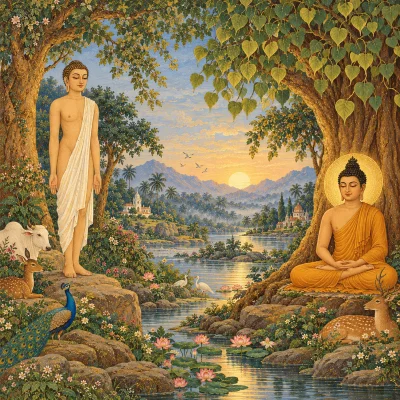
MDNIY calls Mahāvīra’s five great vows and the Buddha’s eightfold path “the early nature of Yoga sadhana”. Source
Jainism: the three jewels and the five vows
A jina is one who has conquered the passions; Jainas follow 24 tīrthaṅkaras, from Ṛṣabhadeva, the first, to Vardhamāna Mahāvīra, the last. Source Books date him and the Buddha differently: the National Sanskrit University’s textbook says the sixth century BC, IGNOU the fifth.
सम्यग्दर्शनज्ञानचारित्राणि मोक्षमार्गः ॥
samyag-darśana-jñāna-cāritrāṇi mokṣa-mārgaḥ
Right faith, right knowledge and right conduct together are the path to liberation. These are the three jewels, ratnatraya.
Umāsvāti, Tattvārtha Sūtra 1.1
- Yoga as the three jewels: Haribhadra defined yoga as whatever leads to liberation (in his Yogabindu), and in his Yogaśataka as the coming together, in one soul, of right knowledge, right faith and right conduct. Source
- Eight views: Haribhadra’s Yogadṛṣṭisamuccaya describes eight “views” (dṛṣṭi) of growing insight, from mitrā, the friendly, to parā, the supreme, and sets them beside Patañjali’s eight limbs.
- The five vows: ahiṁsā (non-violence), satya (truth), asteya (non-stealing), brahmacarya (continence) and aparigraha (non-possessiveness). Monks keep them in full as mahāvratas, great vows; lay people keep them as aṇuvratas, small vows.
- The echo in Patañjali: they are exactly the five yamas (YS 2.30), and Patañjali even calls the yamas, kept everywhere and always, the mahāvrata (YS 2.31).
- Kāyotsarga: kāya, body, + utsarga, letting go. Standing (or sitting) perfectly still, arms hanging loose, giving up attention to the body, as Mahāvīra is shown in the picture above.
- Dhyāna: conduct and austerity prepare the ground, but only meditation removes the subtle passions; Hemacandra taught that dhyāna leads to self-knowledge, and self-knowledge to the end of karma.
- Prekṣā dhyāna today: prekṣā means seeing carefully. The meditation of the Terāpanth teacher Ācārya Mahāprajña, who “through Yoga… taught the art of a depression-free life to lakhs of people” Source, is practised daily at Jain Vishva Bharati Institute, Ladnun. Source
Buddhism: the middle way
Prince Siddhārtha, troubled by old age, sickness and death, left home at 29. He tried the extremes, including severe fasting, and found that neither indulgence nor self-torture works: the middle way. Source The story is in the 18 October class notes.
The four noble truths: there is suffering (duḥkha); it has a cause, craving (tṛṣṇā); it can cease (nirodha, nirvāṇa); and there is a path to its end. Source
| The eightfold path | Group |
|---|---|
| 1 right view · 2 right resolve | prajñā, wisdom |
| 3 right speech · 4 right action · 5 right livelihood | śīla, ethical conduct |
| 6 right effort · 7 right mindfulness · 8 right concentration | samādhi, meditation |
The National Sanskrit University’s textbook calls the last three “purely yogic in nature”, and notes that the Buddha used breath regulation, postures and meditation. Buddhist meditation is often described as two movements: samatha, calming the mind, and vipassanā, insight into the impermanent nature of body and mind. Source A classic starting point is ānāpānasati, mindful attention to the breath coming in and going out. Vipassanā is “a meditation technique propounded by Lord Buddha”. Source
| Patañjali | Jaina | Bauddha | |
|---|---|---|---|
| Ethics | five yamas | five vows (mahāvrata, aṇuvrata) | five precepts (pañcaśīla) |
| Path | eight limbs | three jewels, austerity, dhyāna | eightfold path |
| Goal | kaivalya | kaivalya | nirvāṇa |
The goals follow IGNOU, which says the Buddhist and Jaina ideals “culminated in Nirvāṇa and Kaivalya respectively” Source. The four attitudes of YS 1.33 (friendliness, compassion, gladness, equanimity) are also central in Buddhist teaching.
1.5 Foundation of Yoga
Bhāratīya darśana: philosophy as a way of seeing
In one line
Darśana means seeing. Indian philosophy is a family of ways of seeing reality, each joined to a way of living, nearly all aiming at freedom from suffering. Schools that accept the authority of the Vedas are āstika; those that do not are nāstika.
Dṛśyate anena iti darśanam: that by which one sees is darśana. IGNOU traces the word to the root dṛś, “to perceive or to have a vision”. Source The 18 October class began with microscopes and telescopes: a darśana is an instrument of vision.
Salient features
A practical goal
The overriding aim of every school is to end human suffering, or, put positively, to reach the highest happiness (IGNOU).
Theory joined to practice
Philosophy is meant to be lived. The Yoga darśana is called the practical side of Sāṅkhya.
Karma and rebirth
Accepted by every school except the Cārvāka, which rejects rebirth, karma and liberation.
Ignorance binds
Bondage comes from not seeing truly. In Sāṅkhya the self, through ignorance, identifies with mind and ego; for Patañjali avidyā is the field in which every other affliction grows (YS 2.4).
Pramāṇa
Each school states its valid means of knowledge. Patañjali accepts three: perception, inference and reliable testimony (YS 1.7). The Cārvāka accepts perception alone; Kumārila’s Mīmāṁsā recognises six.
Liberation
For every school but the Cārvāka, mokṣa, freedom, is the highest of the four aims of life; the Jaina and Bauddha names for it are kaivalya and nirvāṇa.
Sources for the features: IGNOU, divisions of Indian philosophy; IGNOU, Sāṅkhya; IGNOU, Mīmāṁsā.
Āstika and nāstika: the Veda test
In everyday speech āstika means a believer in God and nāstika an atheist. In philosophy the test is different: an āstika school accepts the authority of the Vedas, a nāstika school does not. The six āstika schools are the ṣaḍdarśana; the three nāstika schools are the Cārvāka, the Jaina and the Bauddha. Source
Why are Sāṅkhya and Mīmāṁsā āstika without a creator God? Because the test is the Vedas, not God. Sāṅkhya explains the world by the contact of two realities, prakṛti and puruṣa, with no creator needed. Source Mīmāṁsā gives the Vedas more importance than God and rules out a God behind the creation of the world. Source Yoga, Sāṅkhya’s partner, does speak of Īśvara, a special puruṣa untouched by affliction and karma (YS 1.23–1.24).
Not everyone accepts the neat split. IGNOU notes that some call Sāṅkhya non-Vedic because it rests on reasoning, and that the Buddhist philosopher Dharmakīrti said Buddhists should not be called atheists, since they believe in another world.
Animation · the darśana tree
One root of seeking, two great branches
Nine fruits, one tree
- Left branch
- Āstika: six schools that accept the Vedas, studied in three pairs.
- Right branch
- Nāstika: Cārvāka, Jaina and Bauddha, which do not.
- Details
- Tap a fruit. Every school is also in the table in 1.7.
The tree grows from one search, freedom from suffering. Tap any fruit to see its founder, key text and idea.
1.6 Foundation of Yoga
Sādhaka and bādhaka: what helps, what hinders
In one line
Sādhaka tattva are the factors that carry practice forward; bādhaka tattva are those that block it. The Haṭha Yoga Pradīpikā names six of each, and Patañjali names nine obstacles and their remedies.
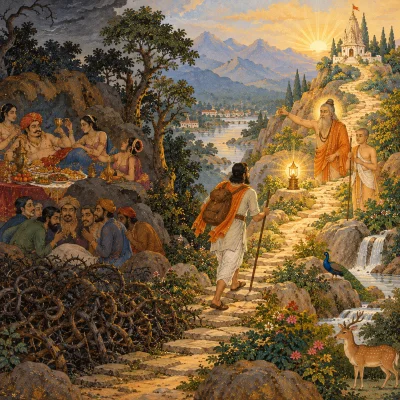
Sādhaka comes from sādh, to accomplish; bādhaka from bādh, to obstruct. The YCB syllabus lists “Sadhaka and Badhaka tatva, principle to be followed by Hatha Yoga practitioner”. Source
Six that destroy yoga (HYP 1.15)
अत्याहारः प्रयासश्च प्रजल्पो नियमाग्रहः ।
जनसङ्गश्च लौल्यं च षड्भिर्योगो विनश्यति ॥
atyāhāraḥ prayāsaś ca prajalpo niyamāgrahaḥ, janasaṅgaś ca laulyaṁ ca ṣaḍbhir yogo vinaśyati
Overeating, overexertion, too much talk, rigid clinging to rules, too much company and restlessness: by these six, yoga is destroyed.
Haṭha Yoga Pradīpikā 1.15
Six that bring success (HYP 1.16)
उत्साहात्साहसाद्धैर्यात्तत्त्वज्ञानाच्च निश्चयात् ।
जनसङ्गपरित्यागात्षड्भिर्योगः प्रसिद्ध्यति ॥
utsāhāt sāhasād dhairyāt tattva-jñānāc ca niścayāt, janasaṅga-parityāgāt ṣaḍbhir yogaḥ prasiddhyati
Through enthusiasm, courage, patience, knowledge of the truth, firm resolve and giving up needless company: by these six, yoga succeeds.
Haṭha Yoga Pradīpikā 1.16
Numbering: Haṭha Yoga Pradīpikā verse numbers in these notes follow the prescribed Bihar School edition (commentary by Swami Muktibodhananda), which agrees here with IGNOU’s study unit. Source Other editions differ: manuscripts disagree on the number of verses, and one printed edition inserts extra verses on yama and niyama after 1.16, so later numbers can shift.
Animation · Haṭha Yoga Pradīpikā 1.15–16
The lamp of practice
Sādhaka · helps (1.16)
Bādhaka · hinders (1.15)
Switch each quality on or off. Helpers feed the flame; hindrances starve it.
Mitāhāra: moderate food (HYP 1.58)
सुस्निग्धमधुराहारश्चतुर्थांशविवर्जितः ।
भुज्यते शिवसंप्रीत्यै मिताहारः स उच्यते ॥
susnigdha-madhurāhāraś caturthāṁśa-vivarjitaḥ, bhujyate śiva-samprītyai mitāhāraḥ sa ucyate
Pleasant, nourishing, sweet food, eaten leaving a quarter of the stomach empty and offered as if to please Śiva: that is called mitāhāra, moderate eating.
Haṭha Yoga Pradīpikā 1.58; the verses after it, to 1.63, list wholesome and unwholesome foods
The Gītā says the same in one line: yoga destroys sorrow for one who is moderate in food and recreation, in effort, and in sleep and waking (6.17). Source More in sāttvic food.
Patañjali’s nine obstacles (YS 1.30) and their companions (1.31)
व्याधिस्त्यानसंशयप्रमादालस्याविरतिभ्रान्तिदर्शनालब्धभूमिकत्वानवस्थितत्वानि चित्तविक्षेपास्तेऽन्तरायाः ॥
vyādhi-styāna-saṁśaya-pramādālasyāvirati-bhrānti-darśanālabdha-bhūmikatvānavasthitatvāni citta-vikṣepās te ’ntarāyāḥ
These nine distractions of the mind are the obstacles (antarāya):
Yoga Sūtra 1.30 · Source
| Obstacle | Meaning |
|---|---|
| vyādhi | illness |
| styāna | dullness, mental inertia |
| saṁśaya | doubt |
| pramāda | carelessness |
| ālasya | laziness, heaviness of body and mind |
| avirati | craving, not letting go of sense pleasures |
| bhrānti-darśana | false perception, delusion |
| alabdha-bhūmikatva | failing to reach a stage |
| anavasthitatva | failing to stay in a stage once reached |
The companions (1.31): pain (duḥkha), despair (daurmanasya), unsteadiness of the body (aṅgamejayatva) and disturbed breathing in and out (śvāsa-praśvāsa). When these show up, a distraction is at work.
The remedies (YS 1.32–1.39)
The first remedy is one-pointed practice on a single principle, eka-tattva-abhyāsa (1.32). Then comes the best-known sūtra on attitude:
मैत्रीकरुणामुदितोपेक्षाणां सुखदुःखपुण्यापुण्यविषयाणां भावनातश्चित्तप्रसादनम् ॥
maitrī-karuṇā-muditopekṣāṇāṁ sukha-duḥkha-puṇyāpuṇya-viṣayāṇāṁ bhāvanātaś citta-prasādanam
The mind becomes clear and calm by cultivating friendliness (maitrī) towards the happy, compassion (karuṇā) towards the suffering, gladness (muditā) towards the virtuous, and equanimity (upekṣā) towards the unvirtuous.
Yoga Sūtra 1.33 · Source
Or, says Patañjali, steady the mind through the breath, by exhaling and holding it out (1.34); through attention on a subtle sense experience (1.35); on an inner light free from sorrow (1.36); on a mind free from attachment (1.37); on insight from dream or deep sleep (1.38); or by meditating on whatever you find uplifting (1.39).
The two wings: abhyāsa and vairāgya (YS 1.12–1.14)
अभ्यासवैराग्याभ्यां तन्निरोधः ॥ तत्र स्थितौ यत्नोऽभ्यासः ॥
स तु दीर्घकालनैरन्तर्यसत्कारासेवितो दृढभूमिः ॥
abhyāsa-vairāgyābhyāṁ tan-nirodhaḥ · tatra sthitau yatno ’bhyāsaḥ · sa tu dīrgha-kāla-nairantarya-satkārāsevito dṛḍha-bhūmiḥ
The mind’s movements are stilled by practice (abhyāsa) and non-attachment (vairāgya). Practice is the effort to stay steady. It becomes firmly grounded when kept up for a long time, without a break, and with devotion.
Yoga Sūtra 1.12–1.14 · Source
The two lists
Sādhaka tattva · helpful
- The six of HYP 1.16: enthusiasm, courage, patience, knowledge of the truth, firm resolve, leaving needless company.
- Mitāhāra, moderate food (HYP 1.58; Gītā 6.17).
- A suitable, quiet place to practise (HYP 1.12–13; Śvetāśvatara 2.10).
- Abhyāsa and vairāgya (YS 1.12–1.14).
- One-pointed practice and the four attitudes (YS 1.32–1.33).
Bādhaka tattva · obstacles
- The six of HYP 1.15: overeating, overexertion, too much talk, rigid clinging to rules, too much company, restlessness.
- The nine antarāyas (YS 1.30).
- Their four companions (YS 1.31).
- Unwholesome food (HYP 1.58–63).
Caution
- “Leave a quarter of the stomach empty” is about not overeating, not about skipping meals. With diabetes, pregnancy, an eating disorder or any medical diet, follow your doctor’s plan.
- Overexertion is itself a bādhaka. Practise within your capacity; with chronic illness, pain or a heart condition, the Common Yoga Protocol asks you to consult a physician or yoga therapist first. Source
1.7 Foundation of Yoga
The six darśanas, in three pairs
In one line
The six āstika schools are studied in three pairs: Nyāya with Vaiśeṣika, Sāṅkhya with Yoga, Mīmāṁsā with Vedānta. The two in a pair look at different things but complete each other.
The prescribed book here is Swami Harshananda’s Ṣaḍdarśana: the six systems of Hindu philosophy (Ramakrishna Math), a short introduction to all six schools; the table below sums up the same ground in my own words. The 18 October class notes cover the pairs; the tree in 1.5 lets you tap through them.

| Pair | School | Founder | Key text | Core idea |
|---|---|---|---|---|
| 1 | Nyāya | Gautama (Gotama; not the Buddha) | Nyāya Sūtra | The science of reasoning and the pramāṇas; right knowledge of reality brings liberation (apavarga). |
| Vaiśeṣika | Kaṇāda | Vaiśeṣika Sūtra | Reality sorted into categories (padārtha) such as substance, quality and action; matter made of atoms. | |
| 2 | Sāṅkhya | Kapila | Sāṅkhya Sūtra; Īśvarakṛṣṇa’s Sāṅkhya Kārikā | Two realities, puruṣa (consciousness) and prakṛti (nature, made of three guṇas), unfolding into 25 tattvas. |
| Yoga | Patañjali | Yoga Sūtra | The practical side of Sāṅkhya: stilling the mind through the eight limbs until the seer is free. | |
| 3 | Pūrva Mīmāṁsā | Jaimini | Mīmāṁsā (Jaimini) Sūtra | Rules for interpreting the Vedas; ritual action and dharma. |
| Uttara Mīmāṁsā, Vedānta | Bādarāyaṇa (Vyāsa) | Brahma Sūtra | Brahman and ātman; read through the Upaniṣads, the Gītā and the Brahma Sūtra (the prasthāna-trayī), giving Advaita, Viśiṣṭādvaita, Dvaita and other schools. |
Founders, texts and ideas follow IGNOU Source; Mīmāṁsā and Vedānta as a pair, IGNOU. The Yoga Sūtra has four pādas; editions count 195 or 196 sūtras (the difference lies in the third pāda).
Sāṅkhya’s 25 tattvas and three guṇas
Yoga borrows its map of the person from Sāṅkhya, so it is worth knowing well. From prakṛti, in the presence of puruṣa, evolve in order: mahat or buddhi (intellect), ahaṅkāra (ego, the “I” and “mine”), manas (mind), then the senses and the elements. Source
| Tattvas | Count |
|---|---|
| puruṣa, pure consciousness | 1 |
| prakṛti, nature in its unmanifest state | 1 |
| mahat (buddhi), ahaṅkāra, manas | 3 |
| five senses of knowing (jñānendriya): ear, skin, eye, tongue, nose | 5 |
| five organs of action (karmendriya): speech, hands, feet, excretion, reproduction | 5 |
| five subtle elements (tanmātra): sound, touch, form, taste, smell | 5 |
| five gross elements (mahābhūta): space, air, fire, water, earth | 5 |
| Total | 25 |
The three guṇas, the strands of prakṛti: sattva, light, clarity and pleasure; rajas, activity and restlessness; tamas, heaviness and inertia. They mix in everything, and their balance shifts. Practice aims to make the mind sāttvic.
Quick revision
Test yourself
What does the root yuj mean, and which sense does Patañjali take?
Three senses are listed: yujir yoge, to join; yuja samādhau, to be absorbed; yuja saṁyamane, to restrain. Vyāsa says “yoga is samādhi”, and Vācaspati Miśra derives Patañjali’s yoga from yuja samādhau.
Give the definitions of yoga from YS 1.2, BG 2.48 and BG 2.50.
YS 1.2: yogaś citta-vṛtti-nirodhaḥ, the stilling of the mind’s movements. BG 2.48: samatvaṁ yoga ucyate, evenness of mind is yoga. BG 2.50: yogaḥ karmasu kauśalam, yoga is skill in action.
Which text defines yoga as “the steady holding of the senses”?
The Kaṭha Upaniṣad, 2.3.11 (also cited as 6.11): tāṁ yogam iti manyante sthirām indriya-dhāraṇām.
In the Kaṭha’s chariot, what do the chariot, charioteer, reins and horses stand for?
Chariot: the body. Charioteer: the intellect (buddhi). Reins: the mind (manas). Horses: the senses. The master of the chariot is the self, and the roads are the sense objects (1.3.3–4).
In Muṇḍaka 2.2.4, what are the bow, the arrow and the target?
Om (praṇava) is the bow, the self (ātman) is the arrow, Brahman is the target. Hit it without carelessness and, like the arrow, become one with it.
Name the four states of the Māṇḍūkya and the sounds of AUM that go with them.
A, waking (vaiśvānara); U, dreaming (taijasa); M, deep sleep (prājña); and the silence after them, turīya, the fourth, beyond all three.
List the six bādhaka and six sādhaka tattva of the Haṭha Yoga Pradīpikā.
Bādhaka (1.15): atyāhāra, prayāsa, prajalpa, niyamāgraha, janasaṅga, laulya. Sādhaka (1.16): utsāha, sāhasa, dhairya, tattvajñāna, niścaya, janasaṅga-parityāga.
What are Patañjali’s nine antarāyas?
YS 1.30: vyādhi (illness), styāna (dullness), saṁśaya (doubt), pramāda (carelessness), ālasya (laziness), avirati (craving), bhrānti-darśana (false perception), alabdha-bhūmikatva (not reaching a stage) and anavasthitatva (not staying in it).
What makes a darśana āstika? Why is Sāṅkhya āstika though it needs no creator God?
Accepting the authority of the Vedas, not belief in God. Sāṅkhya accepts the Vedas but explains the world through prakṛti and puruṣa alone, so it is āstika without a creator.
Name the three pairs of āstika darśanas with their founders.
Nyāya (Gautama) and Vaiśeṣika (Kaṇāda); Sāṅkhya (Kapila) and Yoga (Patañjali); Pūrva Mīmāṁsā (Jaimini) and Vedānta (Bādarāyaṇa).
Sources
Where this comes from
- Prescribed books (explained in my own words, never quoted): B.K.S. Iyengar, Light on Yoga (its introduction on the meaning of yoga); Swami Harshananda, Ṣaḍdarśana: the six systems of Hindu philosophy (Ramakrishna Math), for 1.5 and 1.7; Patañjali’s Yoga Sūtra; Hatha Yoga Pradipika, with commentary by Swami Muktibodhananda (Bihar School of Yoga / Yoga Publications Trust, Munger), for 1.6.
- Yoga Sūtra 1.1–1.3, 1.7, 1.12–1.14, 1.23–1.24, 1.30–1.39, 2.4, 2.29–2.31, 2.46, 4.34: Heritage IITKanpur (formerly the Gita Supersite).
- Bhagavad Gītā 2.48, 2.50, 6.17, 6.23: Heritage IITKanpur.
- Upaniṣads: Kaṭha 1.3.3–9, 2.3.10–11; Muṇḍaka 2.2.3–4, 2.2.6; Śvetāśvatara 2.8–2.13; Māṇḍūkya 1–12; Praśna 2.3–2.4, 3.3; Taittirīya 2.1–2.8, 3.1–3.6; Chāndogya 1.1.1, 5.1; Bṛhadāraṇyaka 1.3.28, 6.1: Heritage IITKanpur.
- Haṭha Yoga Pradīpikā 1.12–1.16, 1.58–1.63 (numbering as in the prescribed Bihar School edition, which agrees with IGNOU’s unit; other editions differ). Umāsvāti, Tattvārtha Sūtra 1.1. Haribhadra, Yogabindu, Yogaśataka and Yogadṛṣṭisamuccaya.
- Ministry of Ayush, Common Yoga Protocol: the root yuj, aim of practice, guidelines.
- MDNIY, Yoga: its origin, history and development (Dr Ishwar V. Basavaraddi): aim, objectives, periods.
- Yoga Certification Board, Yoga Wellness Instructor syllabus.
- University of Lucknow, Dept. of Sanskrit, Meaning of “yoga” in Patañjali’s Yogasūtra.
- National Sanskrit University, Tirupati: An introduction to yoga (etymology, misconceptions, Jaina and Bauddha yoga); Yoga and meditation (Yoga Upaniṣads).
- Kaivalyadhama: Yoga: classical and contemporary perspective; The legacy.
- IGNOU (eGyanKosh): divisions of Indian philosophy; Sāṅkhya; Mīmāṁsā; introduction to Buddhism; Eastern and Western perspectives (vipassanā); Haṭhapradīpikā.
- PIB: International Day of Yoga, history; Vipassanā; Ācārya Mahāprajña centenary.
- Jain Vishva Bharati Institute: prekṣā meditation. Bihar School of Yoga.