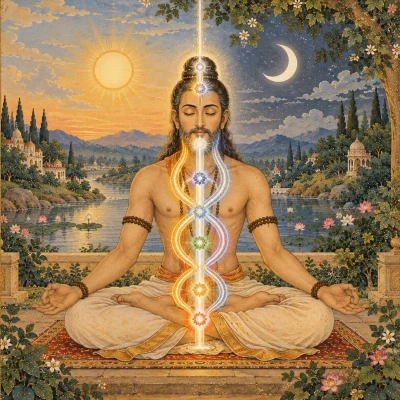
1.8 Foundation of Yoga
Aṣṭāṅga yoga: eight limbs, one climb
In one line
Patañjali’s yoga has eight limbs (aṣṭa, eight; aṅga, limb). The first five steady how we live, sit, breathe and use the senses. The last three are one inner movement of attention that ends in complete absorption.
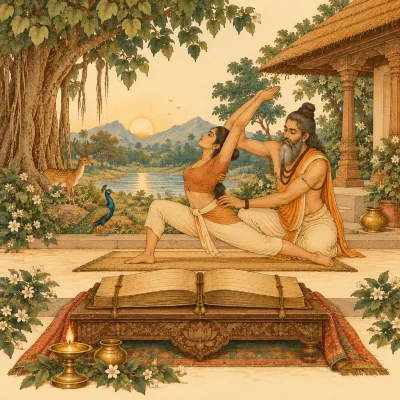
The Yoga Sūtra has four chapters (pādas). The second, the Sādhana Pāda, is the practical one, and in its 29th sūtra Patañjali names all eight limbs in a single breath. IGNOU’s yoga course describes aṣṭāṅga as the tool Patañjali gives to the beginner. Source
यमनियमासनप्राणायामप्रत्याहारधारणाध्यानसमाधयोऽष्टावङ्गानिyama-niyama-āsana-prāṇāyāma-pratyāhāra-dhāraṇā-dhyāna-samādhayo ’ṣṭāv aṅgāni
Restraint, observance, posture, breath regulation, withdrawal of the senses, concentration, meditation and absorption are the eight limbs. YS 2.29 · Source
Limbs, and also steps. A limb is part of one body: you do not finish yama before you are allowed to sit in āsana, and a beginner works on several limbs at once. Yet the order matters. Prāṇāyāma begins “when that is achieved”, that is, once the seat is steady (2.49), and each of the three inner limbs grows out of the one before it (3.1–3.3).
B.K.S. Iyengar’s Light on Yoga, one of the prescribed books, opens with a long introduction that walks through all eight limbs before it teaches a single posture: the āsanas are meant to sit inside this whole path. The home page has a one-line version of each limb. These notes go deeper, sūtra by sūtra, and the animation shows how the eight fit together.
Animation · Yoga Sūtra 2.29 and 3.4
Eight steps up one mountain
Saṃyama · YS 3.4
Climb the eight steps from yama to samādhi. The sage steps are the outer five (bahiraṅga), the gold steps the inner three (antaraṅga). At the summit dhāraṇā, dhyāna and samādhi fuse into one act, saṃyama. Each limb is explained in full below the animation.
Eight limbs from yama to samādhi; the last three, held on one object, are saṃyama (YS 3.4).
The outer five: bahiraṅga
Bahis means outside. Patañjali calls the last three limbs “inner” compared with the ones before them (3.7), so the tradition calls the first five the outer limbs. They work with what can be seen and checked: behaviour, habits, the body, the breath and the senses.
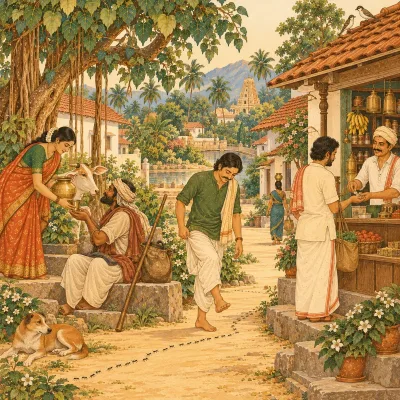
Limb 1 · outer · YS 2.30–2.31, 2.35–2.39
Yama यम restraints
How we treat others: five things we hold back from.
अहिंसासत्यास्तेयब्रह्मचर्यापरिग्रहा यमाःahiṃsā-satya-asteya-brahmacarya-aparigrahā yamāḥ
Non-harming, truthfulness, non-stealing, continence and non-grasping are the yamas. YS 2.30 · Source
- Ahiṃsā, non-harming, in deed, word and thought. Fruit (2.35): around a person firmly established in it, hostility falls away.
- Satya, truthfulness. Fruit (2.36): actions and their results come to rest on that person’s word.
- Asteya, non-stealing. Fruit (2.37): all riches present themselves.
- Brahmacarya, continence; for householders, usually read as moderation of the senses. Fruit (2.38): vigour, vīrya, is gained.
- Aparigraha, non-grasping: not hoarding, not taking more than we need. Fruit (2.39): the how and why of one’s births becomes clear.
Sūtra 2.31 raises the bar: when the yamas are not limited by birth, place, time or circumstance, they become the mahāvrata, the great vow, universal and without exceptions. जातिदेशकालसमयानवच्छिन्नाः सार्वभौमा महाव्रतम् (Source). The fruits are Patañjali’s promises (2.35–2.39); read 2.35 in Sanskrit.
Today: leave the angry reply in drafts until morning. Ahiṃsā includes words, and a message cannot be unsent.
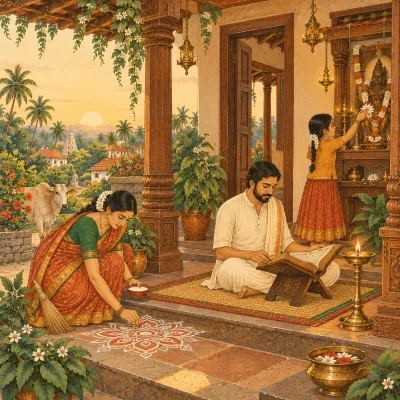
Limb 2 · outer · YS 2.32, 2.40–2.45
Niyama नियम observances
How we treat ourselves: five things we cultivate.
शौचसंतोषतपःस्वाध्यायेश्वरप्रणिधानानि नियमाःśauca-santoṣa-tapaḥ-svādhyāya-īśvarapraṇidhānāni niyamāḥ
Cleanliness, contentment, discipline, self-study and surrender to Īśvara are the niyamas. YS 2.32 · Source
- Śauca, cleanliness of body, surroundings and mind. Fruit (2.40–2.41): a healthy detachment from one’s own body and from contact with other bodies; then purity of mind, cheerfulness, one-pointedness, mastery of the senses and fitness to see the Self.
- Santoṣa, contentment. Fruit (2.42): happiness that nothing surpasses.
- Tapas, discipline: the heat of steady effort. Fruit (2.43): as impurities burn away, body and senses are perfected.
- Svādhyāya, self-study: study of the scriptures, and of oneself. Fruit (2.44): communion with one’s chosen deity, the iṣṭa-devatā.
- Īśvara-praṇidhāna, surrender to Īśvara, offering the fruits of action. Fruit (2.45): perfection in samādhi.
Three of the five, tapas, svādhyāya and īśvara-praṇidhāna, also form Patañjali’s kriyā yoga, the yoga of action, in the very first sūtra of the Sādhana Pāda (2.1). Source
Today: five minutes each morning with a page that lifts you, before the phone. That is svādhyāya, and keeping the habit is tapas.
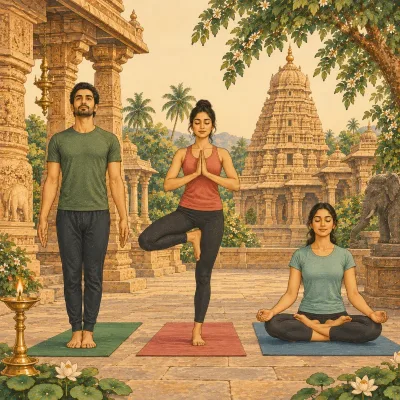
Limb 3 · outer · YS 2.46–2.48
Āsana आसन posture, seat
A posture that is both steady and easy.
स्थिरसुखमासनम्sthira-sukham āsanam
Āsana is steady and comfortable. YS 2.46 · Source
How? By relaxing effort and letting the mind rest on the infinite (2.47). The result: the pairs of opposites, heat and cold, praise and blame, no longer knock us over (2.48). Patañjali speaks of a seat for meditation; the hundreds of postures came later, through Haṭha yoga. See Sthira sukham on the concept map, and the āsana unit on the next page.
Today: hold Vṛkṣāsana for five easy breaths rather than wobbling through fifteen tense ones. Steady and easy, together.
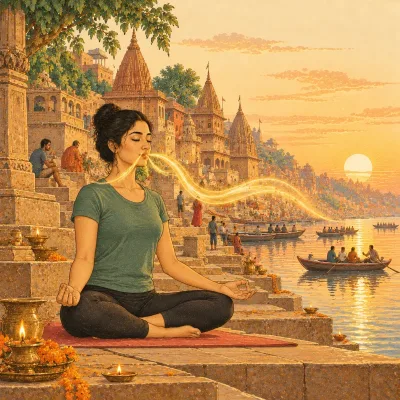
Limb 4 · outer · YS 2.49–2.53
Prāṇāyāma प्राणायाम breath regulation
Once the seat is steady, the flow of breath is regulated.
तस्मिन्सति श्वासप्रश्वासयोर्गतिविच्छेदः प्राणायामःtasmin sati śvāsa-praśvāsayor gati-vicchedaḥ prāṇāyāmaḥ
That being achieved, prāṇāyāma is the regulation, a pause, in the movement of inhalation and exhalation. YS 2.49 · Source
The breath can be held out, held in or simply stopped; it is measured by place, time and count, and becomes long and subtle (2.50). A fourth kind goes beyond outer and inner (2.51). Then the covering over the inner light thins (2.52), and the mind becomes fit for concentration (2.53). The practices themselves are on the prāṇāyāma page.
Today: before a difficult conversation, take six breaths with the out-breath a little longer than the in-breath.
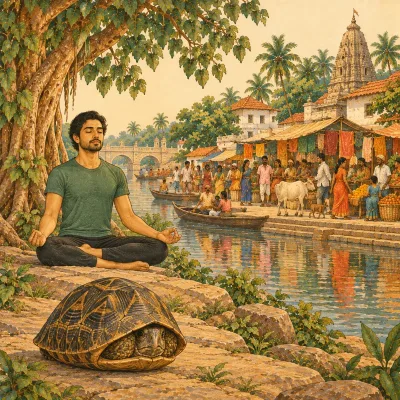
Limb 5 · outer · YS 2.54–2.55
Pratyāhāra प्रत्याहार withdrawal of the senses
The senses stop running out after their objects and follow the mind inward.
स्वविषयासंप्रयोगे चित्तस्वरूपानुकार इवेन्द्रियाणां प्रत्याहारःsva-viṣaya-asaṃprayoge citta-svarūpānukāra ivendriyāṇāṃ pratyāhāraḥ
When the senses do not engage with their objects and, as it were, take on the nature of the mind, that is pratyāhāra. YS 2.54 · Source
Then comes the highest mastery over the senses (2.55). Pratyāhāra is the hinge between outer and inner practice: the tortoise drawing in its limbs is the classic picture.
Today: study with the phone face down in another room. The eyes and ears stop chasing every ping, and the mind is free to settle.
The inner three: antaraṅga
The last three limbs open the third chapter, the Vibhūti Pāda. They are not three separate techniques so much as three stages of one movement of attention: holding it, letting it flow, and losing oneself in it.
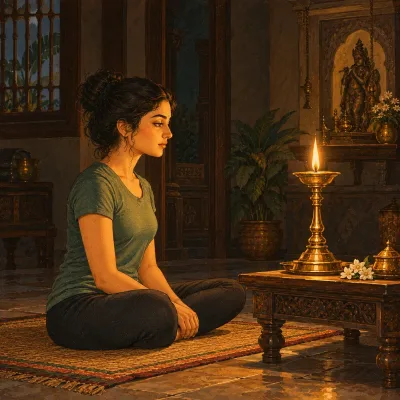
Limb 6 · inner · YS 3.1
Dhāraṇā धारणा concentration
Holding the mind on one place; dhṛ means to hold.
देशबन्धश्चित्तस्य धारणाdeśa-bandhaś cittasya dhāraṇā
Dhāraṇā is binding the mind to one place. YS 3.1 · Source
The “place” can be the breath at the nostrils, the heart, a flame, a sound or a form. The mind wanders; dhāraṇā is the patient bringing back. Why a form helps: a form to hold the mind.
Today: read one page, and each time the mind drifts, bring it back to the line without scolding it.
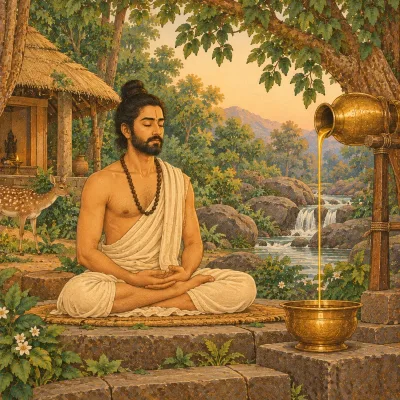
Limb 7 · inner · YS 3.2
Dhyāna ध्यान meditation
Holding becomes flowing: one unbroken stream of attention.
तत्र प्रत्ययैकतानता ध्यानम्tatra pratyaya-ekatānatā dhyānam
There, a continuous flow of the same awareness is dhyāna. YS 3.2 · Source
In dhāraṇā the mind is brought back again and again; in dhyāna it no longer needs bringing back. The image often used is oil poured from one vessel to another, in an unbroken stream. More on the meditation page.
Today: the few minutes when a musician practising scales stops counting and simply plays. Attention flows instead of being pushed.

Limb 8 · inner · YS 3.3
Samādhi समाधि absorption
Only the object remains; the sense of a separate meditator falls away.
तदेवार्थमात्रनिर्भासं स्वरूपशून्यमिव समाधिःtad evārtha-mātra-nirbhāsaṃ svarūpa-śūnyam iva samādhiḥ
That same dhyāna, when only the object shines forth, as if empty of its own form, is samādhi. YS 3.3 · Source
The kinds of samādhi are the subject of the first chapter, the Samādhi Pāda; see Samādhi on the concept map.
Today: we only get glimpses: the moment absorbed in a sunset when there is no “I am watching”, only the sky. Samādhi is that, made steady and clear.
Saṃyama: three in one
The inner three together · YS 3.4–3.8
Saṃyama संयम holding together
Dhāraṇā, dhyāna and samādhi on one object, practised as a single act.
त्रयमेकत्र संयमःtrayam ekatra saṃyamaḥ
The three together on one object are saṃyama. YS 3.4 · Source
By mastering it comes the light of wisdom, prajñāloka (3.5), applied stage by stage (3.6). Then two important sūtras for the exam: these three are inner compared with the earlier five (3.7, त्रयमन्तरङ्गं पूर्वेभ्यः), yet even they are outer compared with seedless samādhi, nirbīja samādhi (3.8, तदपि बहिरङ्गं निर्बीजस्य). “Inner” and “outer” are relative words. Source · Source
Today: the way one difficult exam topic finally opens up after days of single-minded attention: holding, flowing and absorbed, on one subject.
Class notes: the eight limbs and the four pādas were first listed on 6 September. The Yoga Sūtra and its place among the six darśanas: Foundations, 1.7.
1.9 Foundation of Yoga
Four paths, one summit: Jñāna, Bhakti, Karma and Rāja yoga
In one line
Yoga meets people where they are: the thinker through knowledge (Jñāna), the feeler through devotion (Bhakti), the doer through selfless action (Karma), and the meditator through stilling the mind (Rāja). They are not rival clubs; most of us walk more than one.

The Morarji Desai National Institute of Yoga (MDNIY) notes that the Bhagavad Gītā elaborately presents Jñāna yoga, Bhakti yoga and Karma yoga, and lists them among the traditional schools of yoga, along with Dhyāna, Pātañjala, Haṭha, Mantra, Laya and Rāja yoga. Source IGNOU’s yoga course puts it simply: jñāna is knowing, karma is doing and bhakti is feeling, the three sides of a human being. Source Picture them as the head, the hands and the heart. Add the mind made still in meditation, Rāja yoga, and you have the four paths that Swami Vivekananda made famous in his four books, Jñāna-Yoga, Bhakti-Yoga, Karma-Yoga and Rāja-Yoga.
Animation · four paths, one summit
Four roads up the same mountain
Four paths
Four roads up one mountain: Jñāna through the head, Bhakti through the heart, Karma through the hands and Rāja through the stilled mind. The table below this section compares them side by side.
Knowledge, devotion, action and meditation: four different starting points, one summit.
Jñāna yoga: the path of knowledge
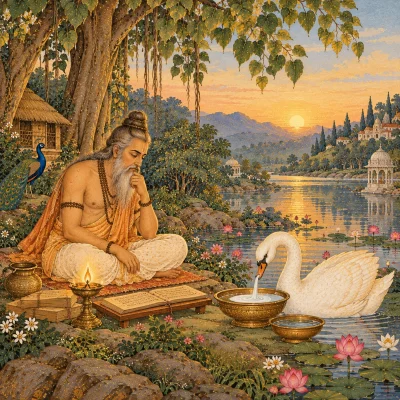
Jñāna is knowledge, but not information: it is knowing what is real. Its tool is the buddhi, the discriminating intellect, and its goal is to realise that the individual self, the jīva, and Brahman are not two. In practice it is the path of Vedānta, one of the six darśanas, which Swami Harshananda’s Ṣaḍdarśana, one of the prescribed books, introduces alongside the Yoga darśana. More on the six darśanas.
IGNOU sets out the practice in two parts. First come four qualifications, the sādhana-catuṣṭaya, the four pillars a seeker builds: Source
- Viveka, discrimination: telling the lasting (nitya) from the passing (anitya).
- Vairāgya, dispassion: losing the thirst for pleasures seen or heard of. Patañjali defines it in YS 1.15.
- Ṣaṭ-sampatti, the six treasures: śama (calm of mind), dama (restraint of the senses), uparati (withdrawal from what gives only passing joy), titikṣā (endurance of the pairs of opposites), śraddhā (faith in the teaching and the teacher) and samādhāna (a mind settled on the goal).
- Mumukṣutva, the longing to be free.
Then the inner practice, in three stages taught by the Upaniṣads: śravaṇa, listening to the teaching; manana, reflecting on it until every doubt is answered, the way an animal chews the cud; and nididhyāsana, dwelling on it until it shapes how you live.
आत्मा वा अरे द्रष्टव्यः श्रोतव्यो मन्तव्यो निदिध्यासितव्यो मैत्रेयिātmā vā are draṣṭavyaḥ śrotavyo mantavyo nididhyāsitavyo maitreyi
The Self, dear Maitreyī, is to be seen: to be heard about, reflected on and deeply meditated upon. Bṛhadāraṇyaka Upaniṣad 2.4.5 · Source
Knowledge of this kind is learned from a teacher. The Gītā says how to approach one: “learn it by humility, by sincere questions and by service; the wise who have seen the truth will teach you” (BG 4.34). Source More on the teacher in the teaching unit.
Today: when a worry flares up, ask: will this matter in five years? Sorting the lasting from the passing is viveka in everyday clothes.
Bhakti yoga: the path of the heart

Bhakti comes from the root bhaj, to serve or worship (IGNOU). It is love turned towards the divine, whatever form one holds dear. Chapter 12 of the Bhagavad Gītā is called Bhakti Yoga. It describes the devotee who is dear to the Lord not by rituals but by inner qualities: Source
अद्वेष्टा सर्वभूतानां मैत्रः करुण एव च । निर्ममो निरहङ्कारः समदुःखसुखः क्षमी ॥adveṣṭā sarva-bhūtānāṃ maitraḥ karuṇa eva ca / nirmamo nirahaṅkāraḥ sama-duḥkha-sukhaḥ kṣamī
Hating no being, friendly and compassionate, free of “mine” and of ego, the same in pain and pleasure, forgiving. BG 12.13 · Source
Bhakti asks for nothing grand. “Whoever offers me with devotion a leaf, a flower, a fruit or water, I accept it” (BG 9.26). Source In the Bhāgavata Purāṇa, the boy Prahlāda names nine ways of devotion, the navavidhā bhakti:
श्रवणं कीर्तनं विष्णोः स्मरणं पादसेवनम् । अर्चनं वन्दनं दास्यं सख्यमात्मनिवेदनम् ॥śravaṇaṃ kīrtanaṃ viṣṇoḥ smaraṇaṃ pāda-sevanam / arcanaṃ vandanaṃ dāsyaṃ sakhyam ātma-nivedanam
Hearing about Viṣṇu, singing his glory, remembering him, serving his feet, worship, prayer, service, friendship and complete self-offering. Bhāgavata Purāṇa 7.5.23 · Source
| Form | What it means | An everyday form |
|---|---|---|
| Śravaṇa | hearing the divine stories and teachings | listening to a Gītā talk on the way to work |
| Kīrtana | singing the divine name and glory | a bhajan or kīrtana with others |
| Smaraṇa | remembering, keeping God in mind | a name repeated quietly while walking |
| Pāda-sevana | serving the Lord’s feet: humble service | cleaning the temple, or serving people as God’s creation |
| Arcana | worship | a flower and a lamp at the home shrine |
| Vandana | prayer, bowing | a moment of gratitude before eating |
| Dāsya | the attitude of a servant | doing one’s duties as an offering |
| Sakhya | friendship with God | speaking to God as to a close friend |
| Ātma-nivedana | complete self-offering, surrender | “Thy will be done”, meant from the heart |
The nine as listed by The Yoga Institute, Mumbai, which also gives everyday ways to practise them. Source IGNOU adds the five moods (bhāvas) of love for God: śānta (peace), dāsya (a servant’s), sakhya (a friend’s), vātsalya (a parent’s) and mādhurya (a beloved’s). Source
Today: cook one meal as an offering: wash, chop and serve with full attention and love. Arcana and sevā in an ordinary kitchen.
Karma yoga: the path of the hands
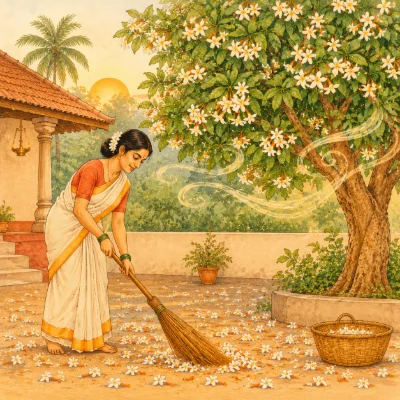
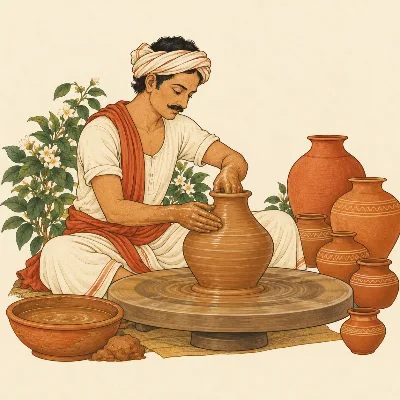
Karma yoga is union through action. We cannot stop acting (BG 3.5), so the Gītā teaches how to act without being bound: do your duty fully, and let go of your grip on the result. This is niṣkāma karma, action without selfish desire for its fruits.
कर्मण्येवाधिकारस्ते मा फलेषु कदाचन । मा कर्मफलहेतुर्भूर्मा ते सङ्गोऽस्त्वकर्मणि ॥karmaṇy evādhikāras te mā phaleṣu kadācana / mā karma-phala-hetur bhūr mā te saṅgo ’stv akarmaṇi
Your right is to the work alone, never to its fruits. Do not let the fruit be your motive, and do not cling to doing nothing either. BG 2.47 · Source
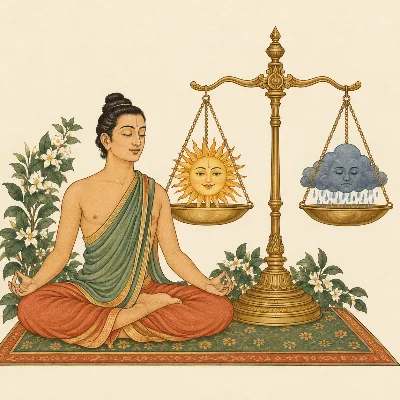
And the summary of the path: “so always do the work that must be done, without attachment; acting without attachment, a person reaches the highest” (BG 3.19). Source IGNOU draws four working rules from the Gītā: work with a sense of duty; work without getting entangled; do not let worry about results disturb the mind while you work; and meet success and failure with equanimity. Source My class notes work through both Gītā definitions with everyday examples: skill in action and equanimity, 27 September; and niṣkāma karma and sevā as the practice for the innermost sheath: the five kośas in practice, 11 October.
Today: prepare the class, the report or the meal as well as you possibly can, then let go of whether anyone praises it. The work was yours; the applause never was.
Rāja yoga, dhyāna, and where Haṭha fits
Rāja means royal: the royal path of the mind. Patañjali never uses the name; later tradition gave it to the meditative path of the Yoga Sūtra. The Haṭha Yoga Pradīpikā uses “rāja yoga” as one of the names of samādhi itself (HYP chapter 4). Its method is the eight limbs above, and its heart is a pair that both Patañjali and the Gītā name: practice and non-attachment.
अभ्यासवैराग्याभ्यां तन्निरोधःabhyāsa-vairāgyābhyāṃ tan-nirodhaḥ
The movements of the mind are stilled by practice and non-attachment. YS 1.12 · Source
Chapter 6 of the Gītā, on meditation, says the same about the restless mind: it is hard to hold, “but by practice and by dispassion it is held” (BG 6.35). Source Haṭha yoga is not a fifth rival path: the Haṭha Yoga Pradīpikā says it is taught only for the sake of Rāja yoga (see 1.10 below).
Today: ten minutes of sitting each morning, coming back to the breath every time the mind wanders. That return, again and again, is abhyāsa.
How the paths meet. The Gītā sets them on one ladder in a single verse:
श्रेयो हि ज्ञानमभ्यासाज्ज्ञानाद्ध्यानं विशिष्यते । ध्यानात्कर्मफलत्यागस्त्यागाच्छान्तिरनन्तरम् ॥śreyo hi jñānam abhyāsāj jñānād dhyānaṃ viśiṣyate / dhyānāt karma-phala-tyāgas tyāgāc chāntir anantaram
Knowledge is better than mere practice; meditation is better than knowledge; letting go of the fruits of action is better than meditation; and from letting go, peace follows at once. BG 12.12 · Source
Side by side
| Path | Works through | Method | Key texts | Today |
|---|---|---|---|---|
| Jñāna yoga ज्ञानयोग | the head: knowing, the buddhi | viveka, vairāgya, the six treasures, longing for freedom; then śravaṇa, manana, nididhyāsana | the Upaniṣads (BU 2.4.5); BG 4.34; Vedānta | ask “will this matter in five years?” |
| Bhakti yoga भक्तियोग | the heart: feeling, love | the nine forms of devotion: hearing, singing, remembering, service, worship, prayer, servanthood, friendship, surrender | BG chapter 12; BG 9.26; Bhāgavata Purāṇa 7.5.23 | cook one meal as an offering |
| Karma yoga कर्मयोग | the hands: doing, willing | niṣkāma karma: duty done well, without clinging to its fruits; equanimity in success and failure | BG 2.47, 2.48, 2.50, 3.19 | do your best work, then let go of the praise |
| Rāja yoga राजयोग | the mind, made still | the eight limbs; practice and non-attachment; dhyāna. Haṭha is its ladder | Yoga Sūtra (YS 1.12, 2.29); BG chapter 6 | ten minutes of sitting, returning to the breath |
| All four together. The paths are not walls but strands of one rope. Knowledge steadies devotion, devotion softens action, selfless action quietens the mind for meditation. The Gītā puts them on one ladder (BG 12.12), and IGNOU notes that in aṣṭāṅga yoga the three classic paths coexist. | ||||
1.10 Foundation of Yoga
Haṭha yoga: balancing the sun and the moon
In one line
Haṭha yoga works through the body and the breath to balance two forces in us, prāṇa (vital energy) and the mind, so that the mind can become still. Its own classic text calls it a staircase to Rāja yoga.
Ha and ṭha
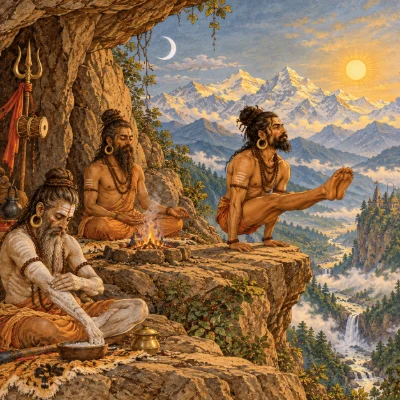
In the dictionary, haṭha means force or effort, and Haṭha yoga is sometimes explained as the yoga of effort. The traditional teaching reads the word differently, as two seed syllables: ha, the sun, and ṭha, the moon. NIOS explains it this way: ha, the sun, is the piṅgalā nāḍī and stands for prāṇa, the vital force; ṭha, the moon, is the iḍā nāḍī and stands for the mind, mental energy. So Haṭha means the union of the two. Source This is a symbolic reading, not grammar, and a very useful one.
Why balance them? NIOS notes that in most of us the two are out of balance. When prāṇa dominates, a person tends towards restlessness, anger and aggression; when mental energy dominates, towards tension, anxiety and low mood. Haṭha gives techniques to bring the two into harmony. Source
Three channels: iḍā, piṅgalā and suṣumnā
A nāḍī (from nad, flow) is a channel of prāṇa in the subtle body, not a nerve. The Haṭha Yoga Pradīpikā speaks of 72,000; three matter most. Source The channels and cakras belong to the subtle body, the sūkṣma śarīra; the water-pipe picture of prāṇa and the nāḍīs is in the 11 October notes.
- Suṣumnā, the central channel, runs in the centre of the spine from the mūlādhāra cakra at its base to the sahasrāra at the crown.
- Iḍā starts on the left of mūlādhāra and criss-crosses the spine at each cakra, ending on the left of the ājñā cakra between the eyebrows. It is the moon (candra) nāḍī: cool, passive, inward.
- Piṅgalā mirrors it, from the right of mūlādhāra to the right of ājñā. It is the sun (sūrya) nāḍī: warm, active, outward.
You can feel this in the breath. NIOS: when the left nostril flows more freely, iḍā is active; when the right, piṅgalā; when both flow equally, suṣumnā. The dominance changes roughly every 60 to 90 minutes. At the physical level, NIOS links piṅgalā with the sympathetic nervous system (activity) and iḍā with the parasympathetic (rest). The main aim of Haṭha is a balanced flow in iḍā and piṅgalā; when both are purified and balanced and the mind is controlled, prāṇa begins to flow in suṣumnā. Source The cakras themselves are covered on the meditation page, and alternate-nostril breathing on the prāṇāyāma page.
Animation · ha + ṭha
The sun channel, the moon channel and the middle way
Balanced: iḍā and piṅgalā flow equally, and suṣumnā, the central channel, fills with light from the base of the spine to the crown.
A staircase to Rāja yoga
The Haṭha Yoga Pradīpikā opens by saying what Haṭha is for. IGNOU: Svātmārāma regards Haṭha as the preliminary stage of Rāja yoga, the means to master the body, while Rāja yoga masters the mind. Source Pradīpikā verse numbers in these notes follow the Bihar School of Yoga edition with Swami Muktibodhananda’s commentary, one of the prescribed books; other editions can differ by a verse or two.
श्रीआदिनाथाय नमोऽस्तु तस्मै येनोपदिष्टा हठयोगविद्या । विभ्राजते प्रोन्नतराजयोगमारोढुमिच्छोरधिरोहिणीव ॥śrī-ādināthāya namo ’stu tasmai yenopadiṣṭā haṭha-yoga-vidyā / vibhrājate pronnata-rāja-yogam āroḍhum icchor adhirohiṇīva
Salutations to Śrī Ādinātha, Śiva, who taught the science of Haṭha yoga. It shines like a staircase for one who wishes to climb to the heights of Rāja yoga. HYP 1.1
प्रणम्य श्रीगुरुं नाथं स्वात्मारामेण योगिना । केवलं राजयोगाय हठविद्योपदिश्यते ॥praṇamya śrī-guruṃ nāthaṃ svātmārāmeṇa yoginā / kevalaṃ rāja-yogāya haṭha-vidyopadiśyate
Bowing to his guru, the yogī Svātmārāma teaches the science of Haṭha solely for the sake of Rāja yoga. HYP 1.2 · Source
So the body work is never the end. A strong, flexible body that never becomes a quiet mind has stopped halfway up the stairs.
The order of practice
MDNIY calls the Pradīpikā’s method caturaṅga yoga, yoga with four limbs (Source), and IGNOU lists them as āsana, prāṇāyāma, mudrā and bandha, and nādānusandhāna. The text gives the order of these four near the end of its first chapter (HYP 1.56). Ṣaṭkarma comes first only when it is needed:
- Ṣaṭkarma, when needed. The six cleansing practices are for those with excess fat or phlegm (kapha); others need not do them (HYP 2.21; IGNOU). The six are dhauti, basti, neti, trāṭaka, nauli and kapālabhāti (HYP 2.22). Source Details on the ṣaṭkarma page.
- Āsana, the first limb of Haṭha, “to gain steadiness, health and lightness of body” (kuryāt tad āsanaṃ sthairyam, HYP chapter 1). MDNIY quotes the same line. The Pradīpikā singles out Siddhāsana, Padmāsana, Siṃhāsana and Bhadrāsana.
- Kumbhaka, prāṇāyāma with breath retention: eight kinds, in chapter 2. See the prāṇāyāma page.
- Mudrā and bandha, seals and locks that direct prāṇa: ten, in chapter 3. See bandhas and mudrās.
- Nādānusandhāna, attending to the inner sound (nāda), which leads into samādhi, in chapter 4.
Place, food and the guru
Place. The Pradīpikā describes the right place for practice in HYP 1.12–1.13: a small, simple room in a peaceful, well-governed land where food is easy to find, with a small door and no holes, kept clean and free of insects. IGNOU summarises these verses as the suitable place and house for practising Haṭha. Source Today: a quiet, clean, airy corner, the same one each day, with no clutter and no phone.
Food. Mitāhāra means moderate food: neither too much nor too little, pleasant and nourishing, leaving a quarter of the stomach empty (HYP 1.58). Source The Gheraṇḍa Saṃhitā gives its own rules on diet and mitāhāra in its fifth chapter, before it teaches prāṇāyāma. More in the nutrition unit.
Helps and hindrances. The Pradīpikā lists six things that help practice and six that destroy it (HYP 1.15–1.16): see sādhaka and bādhaka.
The guru. Svātmārāma says he received Haṭha by the grace of Matsyendra and Gorakṣa (HYP 1.4), and IGNOU notes that chapter 2 prescribes prāṇāyāma under the supervision of one’s guru. Source Haṭha was always taught person to person, adjusted to the student in front of the teacher. A book or a web page can explain; it cannot watch you practise.
Caution
- Learn ṣaṭkarma, kumbhaka (breath retention), bandhas and mudrās from a qualified teacher, never from a page. Go slowly, as the Pradīpikā itself advises.
- NIOS lists precautions for the bandhas and related mudrās, several of which hold the breath: avoid them with high or low blood pressure, heart disease, hernia, glaucoma or other eye problems, peptic or duodenal ulcers, after recent surgery, and during pregnancy and menstruation; avoid jālandhara bandha with a stiff neck or cervical spondylosis. Source
- If you have a medical condition, yoga complements treatment; it does not replace it. Talk to your doctor and your teacher first.
1.11 Foundation of Yoga
The three texts: Haṭha Yoga Pradīpikā, Gheraṇḍa Saṃhitā and Yoga Sūtra
In one line
Patañjali’s Yoga Sūtra is the classical map of the mind, in eight limbs. The Haṭha Yoga Pradīpikā (four limbs) and the Gheraṇḍa Saṃhitā (seven limbs) are later practical manuals that begin with the body and breath and lead to the same goal.
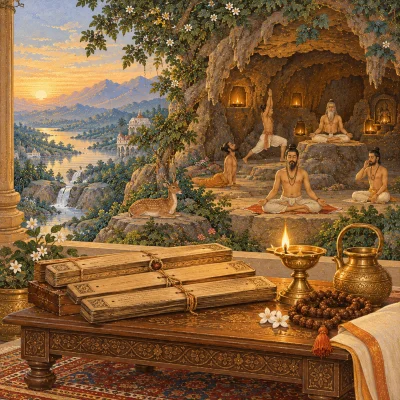
MDNIY names the Ṣaḍaṅga (six-limbed) yoga of the Gorakṣaśataka, the Caturaṅga (four-limbed) yoga of the Haṭha Yoga Pradīpikā and the Saptāṅga (seven-limbed) yoga of the Gheraṇḍa Saṃhitā as the main teachings of Haṭha. Source The history talk compares the counts too: how many limbs does yoga have?
Animation · three manuscripts
Untie a bundle, unroll its chapters
Haṭha Yoga Pradīpikā · four upadeśas (chapters)
- 1 · Āsana15 āsanas; the place, mitāhāra, helps and hindrances
- 2 · Prāṇāyāma6 ṣaṭkarma cleansings; 8 kumbhakas
- 3 · Mudrā10 mudrās, the bandhas among them
- 4 · Samādhinādānusandhāna, the inner sound, in 4 stages
Gheraṇḍa Saṃhitā · seven upadeśas, one limb each
- 1 · Ṣaṭkarmaśodhana, cleansing: 21 techniques in 6 groups
- 2 · Āsanadṛḍhatā, firmness: 32 āsanas
- 3 · Mudrāsthiratā, steadiness: 25 mudrās
- 4 · Pratyāhāradhīratā, calm
- 5 · Prāṇāyāmalāghava, lightness: 8 kumbhakas
- 6 · Dhyānapratyakṣa, seeing the Self: 3 kinds
- 7 · Samādhinirliptatā, untouched freedom: 6 kinds
Yoga Sūtra · four pādas, 195 sūtras
- 1 · Samādhi Pāda51 sūtras: the goal, the mind, practice and non-attachment
- 2 · Sādhana Pāda55 sūtras: kriyā yoga and the five outer limbs
- 3 · Vibhūti Pāda55 sūtras: the inner three, saṃyama and its powers
- 4 · Kaivalya Pāda34 sūtras: kaivalya, final freedom
Gheraṇḍa’s seven limbs beside Patañjali’s eight
Three manuscripts: the Pradīpikā in four chapters, the Gheraṇḍa Saṃhitā in seven, the Yoga Sūtra in four pādas. The compare view lines up seven limbs against eight.
Haṭha Yoga Pradīpikā
Written by Svātmārāma of the Nātha lineage, which traces Haṭha from Ādinātha (Śiva) through Matsyendranātha and Gorakṣanātha. IGNOU dates the text between the mid-14th and mid-16th centuries (about 1350–1550 CE); NIOS places the Haṭha texts between the 9th and 15th centuries. Source · NIOS
- Chapter 1, Āsana: salutations and lineage, the place of practice, the helps and hindrances, 15 āsanas with their benefits, and food.
- Chapter 2, Prāṇāyāma: why the breath matters, the six ṣaṭkarma cleansings, nāḍī purification and eight kumbhakas.
- Chapter 3, Mudrā: kuṇḍalinī and ten mudrās, including the three bandhas.
- Chapter 4, Samādhi: laya (dissolution of the mind), nādānusandhāna in four stages, and the many names of samādhi.
Editions differ. Most have four chapters, but the Kaivalyadhama edition from Lonavala has a fifth, on correcting the ill effects of faulty practice; verse totals differ between manuscripts and editions; and some editions list ten yamas and ten niyamas in chapter 1. That is why the same verse can carry a different number in different books. (IGNOU)
Gheraṇḍa Saṃhitā
A dialogue in which the sage Gheraṇḍa teaches his disciple Caṇḍakāpāli. It calls its path ghaṭastha yoga: ghaṭa is a pot, here the body, which must be purified and made strong to hold the practice. IGNOU dates it to about the 17th century. Its seven chapters each teach one limb, and two verses name what each limb gives: Source
षट्कर्मणा शोधनं च आसनेन भवेद्दृढम् । मुद्रया स्थिरता चैव प्रत्याहारेण धीरता ॥ प्राणायामाल्लाघवं च ध्यानात्प्रत्यक्षमात्मनि । समाधिना निर्लिप्तं च मुक्तिरेव न संशयः ॥ṣaṭkarmaṇā śodhanaṃ ca āsanena bhaved dṛḍham / mudrayā sthiratā caiva pratyāhāreṇa dhīratā // prāṇāyāmāl lāghavaṃ ca dhyānāt pratyakṣam ātmani / samādhinā nirliptaṃ ca muktir eva na saṃśayaḥ
Ṣaṭkarma purifies; āsana makes firm; mudrā makes steady; pratyāhāra brings calm; prāṇāyāma brings lightness; dhyāna, direct perception of the Self; samādhi, freedom from attachment. Liberation follows, without doubt. GS 1.10–1.11 · Source
Gheraṇḍa says there are as many āsanas as there are kinds of creatures, 84 lakh; of these, 84 are the best, and he chooses 32 for practice (GS 2.1–2.2). Many are on our āsana page, such as Bhujaṅgāsana, Gomukhāsana and Uṣṭrāsana.
Patañjali’s Yoga Sūtra

A sūtra is a thread: a short aphorism, meant to be memorised and unpacked by a teacher. Patañjali’s text is the root text of the Yoga darśana. It begins with atha (“now”) and ends with iti. IGNOU gives its four pādas as 51, 55, 55 and 34 sūtras, 195 in all; some editions count 196, with one extra sūtra in the third pāda. Source Its date is debated; the textbooks give a period rather than a year (see the history talk). My first class on it: 6 September.
Side by side
| Haṭha Yoga Pradīpikā | Gheraṇḍa Saṃhitā | Yoga Sūtra | |
|---|---|---|---|
| Author | Svātmārāma, Nātha lineage | the sage Gheraṇḍa, teaching Caṇḍakāpāli | Patañjali |
| Date | about 1350–1550 CE (IGNOU) | about 17th century (IGNOU) | classical period; debated |
| Form | verse, 4 chapters | dialogue in verse, 7 chapters | aphorisms, 4 pādas |
| Limbs | 4: āsana, kumbhaka, mudrā, nādānusandhāna | 7: ṣaṭkarma, āsana, mudrā, pratyāhāra, prāṇāyāma, dhyāna, samādhi | 8: yama to samādhi |
| Begins with | āsana | ṣaṭkarma, cleansing | yama, ethics |
| Counts | 15 āsanas, 8 kumbhakas, 10 mudrās, 6 cleansings | 32 āsanas, 25 mudrās, 8 kumbhakas, 21 cleansings | 195 sūtras (some count 196) |
| Goal | Rāja yoga, samādhi (HYP 1.2) | liberation, mukti (GS 1.11) | kaivalya, freedom (YS 4.34) |
The prescribed books meet these texts at different points. Light on Yoga teaches āsana and prāṇāyāma in modern detail, inside Patañjali’s eight limbs. Swami Harshananda’s Ṣaḍdarśana places the Yoga Sūtra among the six darśanas. Two come from the Bihar School of Yoga (Yoga Publications Trust, Munger). The Hatha Yoga Pradipika with Swami Muktibodhananda’s commentary is an English edition of the Pradīpikā itself (IGNOU lists it among the editions), and its verse numbers are the ones used here. Swami Satyananda Saraswati’s Asana Pranayama Mudra Bandha is a practice manual; its title names the practices of the Pradīpikā’s first three chapters.
Quick revision
Test yourself
Which sūtra lists the eight limbs, and in which pāda is it?
YS 2.29, yama-niyama-āsana-prāṇāyāma-pratyāhāra-dhāraṇā-dhyāna-samādhayo ’ṣṭāv aṅgāni, in the second chapter, the Sādhana Pāda.
Which limbs are bahiraṅga and which are antaraṅga? Which sūtra says so?
Yama, niyama, āsana, prāṇāyāma and pratyāhāra are the outer limbs; dhāraṇā, dhyāna and samādhi are the inner three. YS 3.7 calls the three inner compared with the previous five, and YS 3.8 adds that even they are outer compared with nirbīja (seedless) samādhi.
What is saṃyama?
Dhāraṇā, dhyāna and samādhi practised together on one object (YS 3.4, trayam ekatra saṃyamaḥ). Mastering it brings the light of wisdom, prajñāloka (YS 3.5).
Why are the yamas called the mahāvrata, the great vow?
When they are not limited by birth, place, time or circumstance, they become universal: the great vow (YS 2.31).
Name the four qualifications of Jñāna yoga, and the six treasures.
Viveka, vairāgya, ṣaṭ-sampatti and mumukṣutva. The six treasures: śama, dama, uparati, titikṣā, śraddhā and samādhāna. The inner practice is śravaṇa, manana and nididhyāsana (Bṛhadāraṇyaka Upaniṣad 2.4.5).
Name the nine forms of bhakti. Where do they come from?
Śravaṇa, kīrtana, smaraṇa, pāda-sevana, arcana, vandana, dāsya, sakhya and ātma-nivedana: Prahlāda’s teaching in the Bhāgavata Purāṇa, 7.5.23. Chapter 12 of the Gītā is called Bhakti Yoga.
“Yogaḥ karmasu kauśalam” and “samatvaṃ yoga ucyate”: which verses?
Bhagavad Gītā 2.50 (yoga is skill in action) and 2.48 (evenness of mind is called yoga). The core of Karma yoga is BG 2.47: your right is to the work, never to its fruits.
What do ha and ṭha stand for in Haṭha yoga?
Traditionally, ha is the sun, the piṅgalā nāḍī and prāṇa; ṭha is the moon, the iḍā nāḍī and the mind. Haṭha is their union. The reading is symbolic; the dictionary meaning of haṭha is force.
According to the Haṭha Yoga Pradīpikā, what is Haṭha for?
It is a staircase to the heights of Rāja yoga (HYP 1.1) and is taught solely for the sake of Rāja yoga (HYP 1.2).
How many limbs in the Pradīpikā, the Gheraṇḍa Saṃhitā and the Yoga Sūtra? How many āsanas in the two Haṭha texts?
Four (caturaṅga), seven (saptāṅga) and eight (aṣṭāṅga). The Pradīpikā describes 15 āsanas; the Gheraṇḍa Saṃhitā, 32 (GS 2.1–2.2). Gheraṇḍa’s seven: ṣaṭkarma, āsana, mudrā, pratyāhāra, prāṇāyāma, dhyāna, samādhi (GS 1.10–1.11).
Sources
Where this comes from
- Prescribed books: B.K.S. Iyengar, Light on Yoga (its introduction on the eight limbs); Swami Harshananda, Ṣaḍdarśana, the six systems of Indian philosophy (Ramakrishna Math), on the Yoga and Vedānta darśanas; Patañjali’s Yoga Sūtra; Hatha Yoga Pradipika with Swami Muktibodhananda’s commentary (Bihar School of Yoga / Yoga Publications Trust, Munger), whose verse numbers these notes follow; Swami Satyananda Saraswati, Asana Pranayama Mudra Bandha (Bihar School of Yoga / Yoga Publications Trust, Munger), for the practices named in the Haṭha sections. Explained in my own words; no quotations, no page numbers.
- Yoga Sūtra: 1.12, 1.15, 2.1, 2.29–2.55, 3.1–3.8, 4.34. Text from IIT Kanpur’s Heritage site (the former Gita Supersite), for example YS 2.29 and YS 3.4.
- Bhagavad Gītā: 2.47, 2.48, 2.50, 3.5, 3.19, 4.34, 6.35, 9.26, chapter 12 (12.12, 12.13). IIT Kanpur Heritage; chapter 12 summary on Learn Geeta.
- Upaniṣad and Purāṇa: Bṛhadāraṇyaka Upaniṣad 2.4.5 (IIT Kanpur Heritage); Bhāgavata Purāṇa 7.5.23 (JKYog India; the nine forms also at The Yoga Institute).
- Haṭha Yoga Pradīpikā (numbered as in the Bihar School edition): 1.1, 1.2, 1.4, 1.12–1.13, 1.15–1.16, 1.56 (order of practice), 1.58, chapter 1 (āsana), 2.21–2.22, chapters 2–4. Gheraṇḍa Saṃhitā: 1.10–1.11, 2.1–2.2, chapter 5.
- IGNOU, BYG-001 Introduction to Yoga and Yogic Texts: Unit 3, Streams of yoga: Jñāna, Bhakti and Karma; Unit 7, Patañjali Yoga Sūtra; Unit 8, Haṭhapradīpikā; Unit 9, Gheraṇḍa Saṃhitā.
- NIOS, Physical Education and Yog (373): Lesson 18, Haṭha Yog (ha and ṭha, the nāḍīs, HYP 1.2 and 2.22); Lesson 22, Mudrā and Bandha (precautions).
- MDNIY (Ministry of Ayush), I.V. Basavaraddi, Yoga: its origin, history and development: the schools of yoga, the Gītā’s three paths, caturaṅga, ṣaḍaṅga and saptāṅga yoga.
- Kaivalyadhama, Lonavala, Mitāhāra: yogic nutrition and mindful eating (HYP 1.58).
- My class notes: 6 September, 27 September, 11 October, 18 October; and From a seal to Rajpath, the history-of-yoga talk.