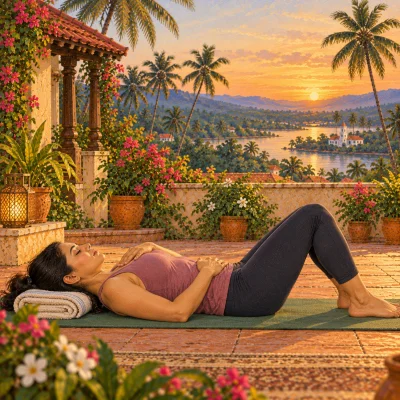
P1.5 a, b Preparatory breathing practices
Preparatory breathing: the three rooms of the breath
After this you can move the breath into the abdomen, the ribs and the collarbones on purpose, and join them into yogic deep breathing.
In one line
Before you regulate the breath, learn to move it on purpose: into the abdomen, into the ribs and into the top of the chest, one section at a time, then all three as one smooth wave. That is sectional breathing and yogic deep breathing.
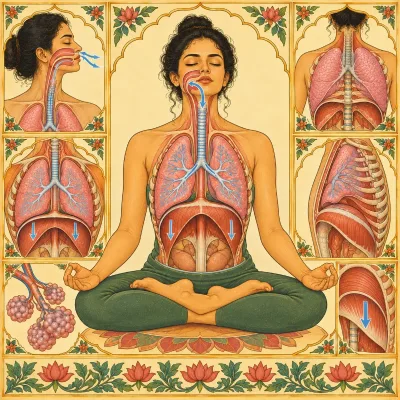
Many people breathe mostly into the upper chest without noticing. The preparatory practices make each part of the breath conscious. The NIOS yoga course counts four kinds of breathing to learn before prāṇāyāma: natural breathing (simply watching the breath), abdominal, thoracic, and yogic breathing, which joins them into one. Source The Ministry of Ayush’s national yoga institute, MDNIY, lists the same practices in its instructor syllabus under “preparatory breathing practices”: sectional breathing (abdominal, thoracic and clavicular) and yogic deep breathing. Source
How the breath moves
The lungs do not move by themselves; muscles around them do the work. The diaphragm, a dome of muscle under the lungs, flattens downward as it contracts. The belly moves out to make room, and air flows into the lower lungs. The muscles between the ribs lift and widen the rib cage, and air flows into the middle of the lungs. At the very end of a deep breath, a small lift under the collarbones fills the top. Breathing out reverses all of it. NIOS adds a useful fact: abdominal breathing moves the most air for the least muscular effort, while chest breathing costs more effort for the same air and goes with exertion, stress and tension. Source
Animation · Sectional breathing
One breath, three rooms
Full yogic breath
Top of the in-breath · Breath 1
- Collarbones
- Ribs
- Abdomen
Tap a label on the figure, or a button below, to practise one section; dashed outlines then show where the hands rest.
Full yogic breath at the top of the in-breath: the diaphragm is low, the ribs are wide and the collarbones lifted, so the lungs are full from bottom to top.
Sectional breathing: one section at a time
Lower · abdomen
Abdominal (diaphragmatic) breathing
Hands: palms on the abdomen, fingertips meeting at the navel.
What moves: the belly rises under the hands on the in-breath and falls on the out-breath. The chest stays quiet.
Middle · ribs
Thoracic (chest) breathing
Hands: palms on the sides of the lower ribs, fingers pointing forward.
What moves: the ribs widen sideways and forward against the hands. Keep the belly still.
Upper · collarbones
Clavicular breathing
Hands: fingertips resting just below the collarbones.
What moves: after the ribs have widened, a small lift of the upper chest and collarbones. The shoulders stay down. On its own it is the shallowest breath; you learn it to complete the full breath.
- Sit tall in one of the steady seats from class, or lie on your back with the knees bent, as in the picture at the top of this page.
- Watch the natural breath for a few rounds without changing it.
- Place the hands for the first section. Breathe in slowly through the nose and let the breath move only there. Breathe out slowly and feel it settle.
- Do a few slow rounds, rest with natural breaths, then move the hands to the next section. MDNIY’s protocol for pregnant women, for example, gives sectional breathing five rounds. Source
- Keep the breath silent, slow and easy throughout. Nothing is forced and nothing is held.
Yogic deep breathing: one wave
Now join the three. On the in-breath the abdomen rises, then the ribs widen, then the collarbones lift: one unbroken wave from the bottom of the lungs to the top. On the out-breath, reverse it. NCERT’s Class XI textbook describes the practice this way: abdomen first, then the chest, then the collarbone region, the whole procedure reversed on the out-breath, four to five times. Source Some teachers start the out-breath from the abdomen instead; follow your teacher’s cue. In every version the out-breath is smooth and unhurried.
- Sit tall, hands on the knees in chin or jñāna mudrā. Breathe out fully.
- Breathe in: abdomen, then ribs, then collarbones.
- Breathe out: collarbones, ribs, abdomen, a little slower than the in-breath.
- Repeat four or five times, then return to natural breathing and notice how you feel.
Why this comes before prāṇāyāma
The Haṭha Yoga Pradīpikā opens its chapter on prāṇāyāma with the order of practice: once āsana is steady, the yogi, self-controlled and eating wholesome food in moderation, takes up prāṇāyāma in the way the teacher shows (HYP 2.1). Patañjali puts it in the same place, after āsana (Yoga Sūtra 2.49, below). The preparatory practices are the bridge between the two:
- They train awareness of the breath, which the Common Yoga Protocol names as the starting point of prāṇāyāma, before any deliberate regulation. Source
- They free the diaphragm and the ribs, so later practices can be slow without strain.
- They show you, safely, how your own breath behaves before you ever hold it.
In class we practised anuloma-viloma with a breathing pacer: see the notes of 20 September.
Keep it easy
- Breathe through the nose, slowly, and never force the breath. These practices hold nothing.
- If you feel dizzy, tingly or breathless, stop and return to natural breathing.
- Do not hunch the shoulders up to the ears in clavicular breathing.
- With asthma or a heart or lung condition, yoga complements treatment: learn with a teacher and work with your doctor.
1.15 · P1.5 d, e Concept of prāṇāyāma
Prāṇāyāma: lengthening the breath, steadying the mind
After this you can give Patañjali’s definition (Yoga Sūtra 2.49–2.53), explain pūraka, kumbhaka and recaka, and name the eight kumbhakas of the Haṭha Yoga Pradīpikā.
In one line
Prāṇāyāma is the deliberate regulation of the breath. Patañjali defines it as a pause in the flow of in-breath and out-breath once the posture is steady. Its aim is not extra oxygen but a quieter, clearer mind.
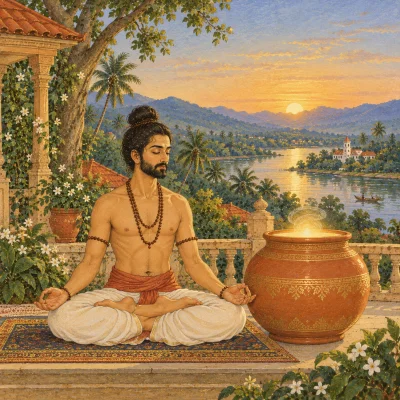
The word
Prāṇa is the vital force, the energy that keeps us alive; the breath is its most visible form. Āyāma means extension, expansion or control. So prāṇāyāma is the extension and regulation of prāṇa through the breath. Source Teachers also read the word as prāṇa + yama, restraint, which gives “control of prāṇa”; NCERT’s textbook glosses āyāma as restraint. Source Both readings point the same way: from breathing by habit to breathing with awareness and control. (The long ā in prāṇāyāma shows the word is built from āyāma.)
Patañjali’s definition
Prāṇāyāma is the fourth of the eight limbs, straight after āsana. Patañjali gives no list of techniques. He says what regulating the breath means, and what it brings.
तस्मिन्सति श्वासप्रश्वासयोर्गतिविच्छेदः प्राणायामः ॥tasmin sati śvāsa-praśvāsayor gati-vicchedaḥ prāṇāyāmaḥ
When that (the āsana) is accomplished, the pause (viccheda) in the flow (gati) of the in-breath (śvāsa) and the out-breath (praśvāsa) is prāṇāyāma.
Yoga Sūtra 2.49 · Source
बाह्याभ्यन्तर
It moves outward, inward, or is stopped; it is observed by place, time and number; and it becomes long and subtle.
Yoga Sūtra 2.50 · Source
| Term in 2.50 | Plain meaning |
|---|---|
| Bāhya vṛtti | the outward movement: the out-breath, and the pause after it |
| Ābhyantara vṛtti | the inward movement: the in-breath, and the pause after it |
| Stambha vṛtti | the stopped movement: the breath held still in one effort, wherever it is |
| Deśa (place) | where the breath goes and where you feel it |
| Kāla (time) | how long each part lasts, counted |
| Saṅkhyā (number) | how many breaths or rounds |
| Dīrgha, sūkṣma | long, and subtle: the breath grows longer and finer, until it is barely felt |
बाह्याभ्यन्तरविषयाक्षेपी चतुर्थः ॥bāhyābhyantara-viṣayākṣepī caturthaḥ
The fourth goes beyond the outer and the inner.
Yoga Sūtra 2.51 · Source
Commentators explain this “fourth” differently. One common reading is a stillness of the breath that arises on its own after long practice, which some teachers compare with the kevala kumbhaka of the Haṭha texts (below).
ततः क्षीयते प्रकाशावरणम् ॥ धारणासु च योग्यता मनसः ॥tataḥ kṣīyate prakāśāvaraṇam · dhāraṇāsu ca yogyatā manasaḥ
Then the covering over the inner light wears away, and the mind becomes fit for concentration (dhāraṇā).
These are the fruits Patañjali names: clarity, and a mind ready for the inner limbs. IGNOU’s yoga therapy unit reads the two sūtras the same way. Source Earlier, in chapter 1, Patañjali had already offered the breath as one way to calm the mind: “or by breathing out and holding the breath” (pracchardana-vidhāraṇābhyāṃ vā prāṇasya, Yoga Sūtra 1.34). Source
Why the Haṭha texts insist on it
चले वाते चलं चित्तं निश्चले निश्चलं भवेत् । योगी स्थाणुत्वमाप्नोति ततो वायुं निरोधयेत् ॥cale vāte calaṃ cittaṃ niścale niścalaṃ bhavet · yogī sthāṇutvam āpnoti tato vāyuṃ nirodhayet
When the breath moves, the mind moves; when the breath is still, the mind is still, and the yogi becomes steady as a pillar. So one should restrain the breath.
Haṭha Yoga Pradīpikā 2.2 · Source
The next verse adds the plain fact behind it: as long as the breath stays in the body, there is life; death is its leaving (HYP 2.3). Then comes the warning every practitioner should remember:
यथा सिंहो गजो व्याघ्रो भवेद्वश्यः शनैः शनैः । तथैव सेवितो वायुरन्यथा हन्ति साधकम् ॥yathā siṃho gajo vyāghro bhaved vaśyaḥ śanaiḥ śanaiḥ · tathaiva sevito vāyur anyathā hanti sādhakam
A lion, an elephant or a tiger is tamed slowly, step by step. The breath must be brought under control the same way; otherwise it harms the practitioner.
Haṭha Yoga Pradīpikā 2.15 · Source
The next verse puts it in one line: practised correctly, prāṇāyāma keeps the body free of disease; practised wrongly, it brings disorders (HYP 2.16). NIOS quotes it as the warning that comes with prāṇāyāma, “a very advanced practice”, to be built up slowly under an expert. Source (Haṭha Yoga Pradīpikā verse numbers on this page follow the Bihar School edition with Swami Muktibodhananda’s commentary; some other editions number chapter 2 slightly differently.)
Pūraka, kumbhaka, recaka: the three movements
| Part | What it is | Kinds |
|---|---|---|
| Pūraka | inhalation: a slow, smooth, complete filling | |
| Kumbhaka | retention: the breath held still | antar (inner) kumbhaka, held in after pūraka; bāhya (outer, also called bahir) kumbhaka, held out after recaka |
| Recaka | exhalation: slow and complete, usually longer than the in-breath |
NIOS calls kumbhaka the most important part of prāṇāyāma, and says it should be practised under an expert and not at all with high blood pressure or heart problems. Source The Haṭha Yoga Pradīpikā sorts retention further:
प्राणायामस्त्रिधा प्रोक्तो रेचपूरककुम्भकैः । सहितः केवलश्चेति कुम्भको द्विविधो मतः ॥prāṇāyāmas tridhā prokto reca-pūraka-kumbhakaiḥ · sahitaḥ kevalaś ceti kumbhako dvividho mataḥ
Prāṇāyāma is said to be threefold: out-breath, in-breath and retention. Retention is of two kinds, sahita and kevala.
Haṭha Yoga Pradīpikā 2.71 · Source
- Sahita kumbhaka, “accompanied”: a deliberate hold joined to in- and out-breathing. All eight classical kumbhakas are of this kind. Source
- Kevala kumbhaka, “alone”: the breath rests still by itself, without effort to breathe in or out. The text says to practise sahita until kevala comes (HYP 2.72–2.73). It is the fruit of long practice, not a technique for beginners.
Animation · Pūraka · kumbhaka · recaka
The pot that breathes
One breath at 1 : 0 : 2, the beginner’s ratio: in for 4 seconds, out for 8, nothing held. Choose a ratio and press Play to watch the pot fill, rest and empty.
1 : 4 : 2 is the traditional ratio. Practise it only under a teacher, and only after the gentler ratios feel easy.
Ratios: how long each part lasts
| Ratio (in : hold : out) | For whom | Where it comes from |
|---|---|---|
| 1 : 1, then 1 : 2, no hold | beginners | the Common Yoga Protocol: in and out equal at first, then slowly make the out-breath twice as long Source |
| 1 : 1 : 2 | when long, easy breathing is settled | Kaivalyadhama asks for a safe 1 : 1 : 2 before its advanced course Source |
| 1 : 2 : 2 | further practice, with a teacher | the next step in the same course, “1 : 1 : 2 → 1 : 2 : 2” |
| 1 : 4 : 2 | traditional; under a teacher only | the Gheraṇḍa Saṁhitā’s nāḍī-cleansing (chapter 5) counts 16, 64 and 32 |
The rule of thumb behind the table: lengthen the out-breath before you hold anything, add holds only with a teacher, and if the next in-breath comes in a gasp, the hold was too long.
Kinds of prāṇāyāma
सूर्यभेदनमुज्जायी सीत्कारी शीतली तथा । भस्त्रिका भ्रामरी मूर्च्छा प्लाविनीत्यष्टकुम्भकाः ॥sūrya-bhedanam ujjāyī sītkārī śītalī tathā · bhastrikā bhrāmarī mūrcchā plāvinīty aṣṭa-kumbhakāḥ
Sūrya bhedana, ujjāyī, sītkārī, śītalī, bhastrikā, bhrāmarī, mūrcchā and plāvinī: these are the eight kumbhakas.
| Kumbhaka | In one line |
|---|---|
| Sūrya bhedana | “piercing the sun”: the breath is drawn in through the right, or sun, nostril |
| Ujjāyī | through the nose with the throat gently narrowed, giving a soft, even, ocean-like sound |
| Sītkārī | in through the teeth with a hissing “sīt” sound, out through the nose; cooling |
| Śītalī | in through the tongue rolled into a tube, out through the nose; cooling (below) |
| Bhastrikā | “bellows”: forceful breaths in and out, heating |
| Bhrāmarī | the out-breath hums like a bee (below) |
| Mūrcchā | “swooning”: an advanced retention that brings a faint-like stillness of mind; teacher only |
| Plāvinī | “floating”: an advanced practice in which air fills the stomach so the body can float; teacher only |
Sources for the short descriptions: NIOS, NCERT, and a paraphrase of HYP chapter 2 for mūrcchā and plāvinī. NIOS · NCERT · HYP 2 The Gheraṇḍa Saṁhitā (chapter 5) also counts eight kumbhakas, with a different list: sahita, sūrya bheda, ujjāyī, śītalī, bhastrikā, bhrāmarī, mūrcchā and kevalī. It drops sītkārī and plāvinī and adds sahita and kevalī. For study, NIOS sorts the common ones by effect: balancing (nāḍī śodhana), tranquillising (bhrāmarī, ujjāyī), cooling (śītalī, sītkārī) and heating (bhastrikā, sūrya bhedana). Source Kapālabhāti is often taught alongside, but it is one of the cleansing ṣaṭkarmas.
The Common Yoga Protocol teaches three prāṇāyāmas: nāḍī śodhana, śītalī and bhrāmarī. They are also the three in the practical syllabus I am studying (P1.5 c–e), and MDNIY’s instructor syllabus lists śītalī and bhrāmarī without kumbhaka. Source Nāḍī śodhana has its own section below.
Śītalī prāṇāyāma (P1.5 d)
Śītala means cool, and also calm. The protocol describes śītalī as cooling body and mind and bringing harmony to the body. Source
- Sit in padmāsana or any comfortable seat, hands on the knees in jñāna mudrā.
- Roll the tongue from the sides into a tube and let it rest just outside the lips.
- Breathe in slowly through the tube, filling the lungs.
- Draw the tongue in, close the mouth, and breathe out slowly through both nostrils. That is one round; the protocol does five.
The protocol says it cools body and mind and can benefit people with high blood pressure, alongside their medical treatment. If the tongue will not roll, teachers often give sītkārī instead: breathing in through the teeth, also a cooling practice (NIOS).
Bhrāmarī prāṇāyāma (P1.5 e)
Bhramara is the black bee; the out-breath hums like one.
- Sit comfortably with the eyes closed. Breathe in deeply through the nose.
- Breathe out slowly and steadily, making a deep, even humming sound. That is one round; the protocol does five.
- Second version: close the ears with the thumbs, the eyes with the index fingers, rest the middle fingers beside the nose without closing it, and the ring and little fingers on the lips. This is ṣaṇmukhī mudrā, the seal of the six gates. Hum as before.
The protocol says bhrāmarī relieves stress, helps ease anxiety, anger and hyperactivity, soothes the nervous system with its humming, and prepares for concentration and meditation. Source It leads naturally into Om chanting.
Its place in sādhana
Prāṇāyāma is the hinge between body and mind. NIOS calls the breath “the bridge between the body and the mind”: regulate the breath, and the body and mind follow. Source In Patañjali’s order it follows āsana and makes the mind fit for dhāraṇā (2.53). In the model of the five sheaths it works on the prāṇamaya kośa, the sheath of prāṇa. The Bhagavad Gītā counts it among the offerings of a yogi’s life:
अपाने जुह्वति प्राणं प्राणेऽपानं तथापरे । प्राणापानगती रुद्ध्वा प्राणायामपरायणाः ॥apāne juhvati prāṇaṃ prāṇe ’pānaṃ tathāpare · prāṇāpāna-gatī ruddhvā prāṇāyāma-parāyaṇāḥ
Some offer the out-going breath (prāṇa) into the in-coming (apāna), others the in-coming into the out-going; stopping the movement of both, they are devoted to prāṇāyāma. Śaṅkara’s commentary reads these as pūraka, recaka and kumbhaka.
Bhagavad Gītā 4.29 · Source
Among the prescribed books, Swami Satyananda Saraswati’s Asana Pranayama Mudra Bandha (Bihar School of Yoga) teaches the practices on this page step by step, and Swami Muktibodhananda’s commentary on the Hatha Yoga Pradipika (Bihar School of Yoga) explains the classical verses. B.K.S. Iyengar’s Light on Yoga gives prāṇāyāma its own part, after the āsanas, and explains the bandhas in connection with it. Swami Harshananda’s Ṣaḍdarśana places prāṇāyāma within Patañjali’s eight limbs in its account of the Yoga darśana. For the paths that grew around it, see Haṭha yoga.
Practise safely
- Practise on an empty or light stomach, with bladder and bowels empty; eat 20 to 30 minutes after practice (Common Yoga Protocol).
- Breathe through the nose unless a practice says otherwise. Do not hold the breath unless the practice asks for it.
- Never strain. The breath should stay slow, steady and controlled.
- No breath retention with high blood pressure or heart disease (NIOS), or in pregnancy. In pregnancy also avoid forceful practices such as kapālabhāti (protocol), and do gentle ones only with an expert; MDNIY’s pregnancy protocol uses sectional breathing, nāḍī śodhana, bhrāmarī and śītalī.
- Stop at once if you feel faint, dizzy, sweaty or sick, and return to natural breathing (NIOS).
- Śītalī: avoid with a severe cold, cough or tonsillitis (protocol); NIOS adds low blood pressure and respiratory disorders. Bhrāmarī: avoid with nose or ear infections (protocol).
- For any medical condition, yoga complements treatment; work with your doctor. More in yoga therapy.
P1.5 c Anuloma-viloma / Nāḍī śodhana
Nāḍī śodhana: one nostril at a time
After this you can make nāsikā mudrā and breathe one full round of nāḍī śodhana the way the Common Yoga Protocol teaches it.
In one line
Breathe in through one nostril and out through the other, then back again: that is one round. It is the first prāṇāyāma taught because it is gentle, balancing and easy to count.
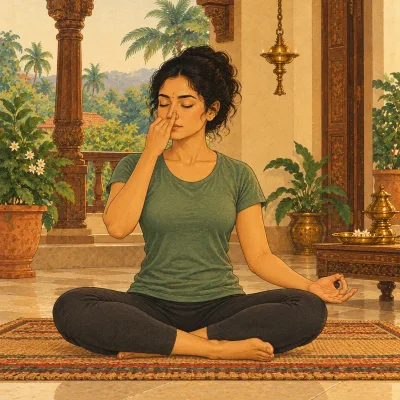
Nāḍī is a channel, one of the pipes that carry prāṇa (the water-pipe picture from class); śodhana is cleansing. NIOS translates the name as “channel clearing” and says it is done before the other prāṇāyāmas. Source Anuloma means “with the grain” and viloma “against the grain”, in reverse order: the breath goes one way, then comes back the other. NCERT glosses viloma as “in the reverse order”. Source
Behind it is the idea of the two great nāḍīs: iḍā, linked with the left nostril and the moon, and piṅgalā, linked with the right nostril and the sun, with suṣumnā, the central channel, between them. The Haṭha Yoga Pradīpikā gives the classical method in moon and sun terms (HYP 2.7–2.10), and NIOS says the practice balances iḍā and piṅgalā. More on the nāḍīs in Haṭha yoga.
The hand: nāsikā mudrā
Fold the index and middle fingers of the right hand into the palm. The thumb closes the right nostril; the ring finger (with the little finger beside it) closes the left. The left hand rests on the left knee in jñāna mudrā. The Common Yoga Protocol calls this right-hand position nāsāgra mudrā; others call it Viṣṇu mudrā. In another common version, the nāsikāgra mudrā of Asana Pranayama Mudra Bandha, the index and middle fingertips rest on the eyebrow centre instead of folding. Press the nostrils lightly, never hard. Source Bihar School talks also use the name nāsikāgra mudrā for gazing at the tip of the nose (nāsikāgra dṛṣṭi), so check whether a text means the hand or the gaze. Source
One round, as the Common Yoga Protocol teaches it
- Sit in any comfortable posture, spine and head straight, eyes closed. Relax with a few deep breaths.
- Left hand in jñāna mudrā on the left knee; right hand in nāsikā mudrā.
- Close the right nostril with the thumb. Breathe in through the left.
- Close the left nostril with the ring and little fingers, release the thumb, and breathe out through the right.
- Breathe in through the right. Close it, open the left, and breathe out through the left. That completes one round.
- Repeat for four more rounds: five in all.
Beginners keep in and out equal, then slowly make the out-breath twice as long (1 : 2). The breath stays slow, steady and controlled, never forced. Source NCERT adds: no sound from the nose, and no hard pressing on the nostrils. Source
Animation · Nāḍī śodhana
In one side, out the other
- In · left
- Out · right
- In · right
- Out · left
Round 1 of 5 · count 1
Breathing in through the left nostril while the thumb closes the right. The light rises along iḍā, the moon channel, to the eyebrow centre; next it will come down the other side.
Benefits, stated plainly
The Common Yoga Protocol says nāḍī śodhana induces tranquillity, helps concentration, increases vitality, lowers stress and anxiety, and eases cough disorders. Source NCERT adds that it calms and steadies the mind and improves focus. Source Read these as what the practice supports, not as treatment. The classical version in the Haṭha Yoga Pradīpikā adds retention after each in-breath and says the channels are purified in about three months (HYP 2.10); that version needs a teacher.
In class we practised it with a breathing pacer: notes of 20 September.
Caution
- Never force the breath or press hard on the nose.
- Beginners: no retention. Add kumbhaka only under a teacher, and never with high blood pressure, heart disease or in pregnancy.
- With a blocked nose, wait, or try neti first under guidance.
1.16 Concept of bandha
Bandhas: three locks
After this you can place the three locks, say when each is made (HYP 2.45), and know who should not practise them.
In one line
A bandha is a lock: a firm, steady hold at the throat, the abdomen or the pelvic floor, made while the breath is held in or out. Tradition says the locks keep prāṇa within the body and turn its flow upward.
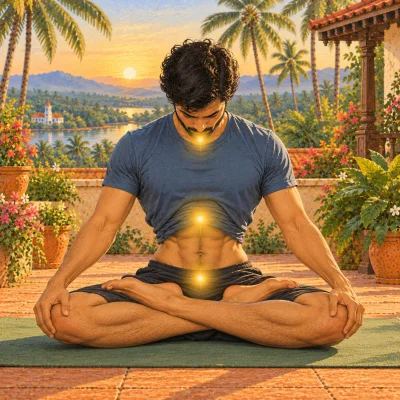
Bandha means to hold, tighten or lock. NIOS describes the bandhas as body locks made by tightening and lifting certain muscles, and names three main ones: jālandhara at the throat, uḍḍīyāna at the abdomen and mūla at the perineum. Mahā bandha is all three together. Source The Bihar School of Yoga uses the picture of a tap: close a running tap and pressure gathers in the pipe; open it and the water rushes out. A bandha gathers energy by blocking it, and releasing the bandha spreads it. Source
The Haṭha Yoga Pradīpikā counts the three bandhas among its ten mudrās (chapter 3) and ties them to the breath:
पूरकान्ते तु कर्तव्यो बन्धो जालन्धराभिधः । कुम्भकान्ते रेचकादौ कर्तव्यस्तूड्डियानकः ॥pūrakānte tu kartavyo bandho jālandharābhidhaḥ · kumbhakānte recakādau kartavyas tūḍḍiyānakaḥ
At the end of the in-breath, make the lock called jālandhara. At the end of the retention, as the out-breath begins, make uḍḍīyāna.
Haṭha Yoga Pradīpikā 2.45 · Source
So in the text, jālandhara seals the held in-breath, and uḍḍīyāna begins as the breath goes out. Practised as a bandha on its own, uḍḍīyāna is held with the lungs empty, after a full exhalation (NIOS). Light on Yoga likewise ties the bandhas to prāṇāyāma.
Animation · The three locks
Throat, abdomen, root
The three lock points: jālandhara at the throat, uḍḍīyāna at the abdomen, mūla at the pelvic floor. Choose a lock to see when it is made and what it does.
Throat · after breathing in
Jālandhara bandha
Jāla is a net or web, dhara holding. Sit firm, breathe in, hold. Lengthen the back of the neck and lower the chin towards the notch between the collarbones; straighten the arms and press the knees. Raise the head before breathing out. It seals the held breath at the throat. NIOS lists effects on the thyroid region and the throat; hold it only a few seconds at first. Source
Abdomen · after breathing out
Uḍḍīyāna bandha
Uḍḍīyāna means flying up. Breathe out completely and hold the breath out. With the chin lowered, lift the chest as if breathing in, without letting air in: the upper abdomen is drawn in and up under the ribs. Release the belly and raise the head before breathing in. NIOS says it supports digestion and helps with constipation. Source
Pelvic floor · in or out
Mūla bandha
Mūla is root. Sitting in siddhāsana, draw the perineum, the area between the anus and the genitals, in and up. Hold five to ten seconds without discomfort, then release slowly (NIOS). It tones the pelvic floor; tradition says it turns apāna, the downward-moving prāṇa, upward.
All three · after breathing out
Mahā bandha
The “great lock”: jālandhara, uḍḍīyāna and mūla together, held with the lungs empty, because uḍḍīyāna needs empty lungs. Release the locks and raise the head before you breathe in. Learn each lock alone first. This is the Bihar School form, as in Asana Pranayama Mudra Bandha; the Haṭha Yoga Pradīpikā’s own mahā bandha (chapter 3) is a seated hold with the breath in, using the throat and root locks.
Contraindications (NIOS)
- Uḍḍīyāna: high blood pressure, heart disease, hernia, glaucoma, peptic or duodenal ulcers, pregnancy and menstruation. Only on an empty stomach.
- Jālandhara: high or low blood pressure, heart disease, neck stiffness, cervical spondylosis. Never force the chin down.
- Mūla: high blood pressure, heart disease or any major illness, and bleeding from the rectum.
- Mahā bandha: everything listed above for the three locks.
- Pregnancy: no uḍḍīyāna or mahā bandha, and no breath-holding with any lock. Ask your doctor and a qualified teacher before trying any lock.
- Learn the bandhas from a teacher, and never combine them with long breath-holding on your own.
1.16 Concept of mudrā
Mudrās: seals and gestures
After this you can sort the mudrās into the Bihar School’s five groups and name the hand mudrās used in class.
In one line
A mudrā is a seal or gesture: a held position of the hands, eyes, body or pelvic floor that turns the attention inward. The bandhas are one family of mudrās.
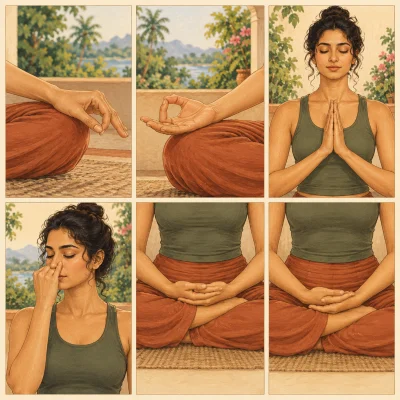
NIOS gives the meanings of mudrā as gesture, mark or seal, and notes that the Haṭha Yoga Pradīpikā describes 10 mudrās and the Gheraṇḍa Saṁhitā 25 (in its chapter 3). Source The ten of the Pradīpikā (chapter 3) are mahā mudrā, mahā bandha, mahā vedha, khecarī, uḍḍīyāna, mūla bandha, jālandhara, viparīta karaṇī, vajrolī and śakti cālana. Source
Five groups
Swami Satyananda Saraswati’s Asana Pranayama Mudra Bandha (Bihar School of Yoga) sorts the yoga mudrās into five groups:
| Group | Where | Examples |
|---|---|---|
| Hasta | hand | jñāna, chin, bhairava |
| Mana | head: eyes, ears, nose, tongue, lips | śāmbhavī (gazing at the eyebrow centre), nāsikāgra dṛṣṭi (gazing at the nose tip), kākī, ṣaṇmukhī, khecarī |
| Kāya | posture | viparīta karaṇī, yoga mudrā |
| Bandha | mudrās built on the locks | mahā mudrā, mahā vedha |
| Ādhāra | perineum | aśvinī, vajrolī |
NIOS groups them a little differently: hand, face (śāmbhavī, kākī) and postural (mahā mudrā, viparīta karaṇī, aśvinī).
The hand mudrās used in class
Chin and jñāna mudrā
The tip of the index finger touches the tip of the thumb, making a circle; the other three fingers stay straight and relaxed, hands on the knees (protocol). Schools differ on which name goes with which palm: Asana Pranayama Mudra Bandha calls the palm-down form jñāna and the palm-up form chin; others reverse the names.
Dhyāna mudrā
The meditation seal: the hands rest in the lap, palms up, one resting in the other. The protocol offers it, or jñāna mudrā, for meditation.
Añjali mudrā
Palms joined, as in namaskāra. The protocol joins the palms this way in vṛkṣāsana, calling it namaskāra mudrā, and Sūrya Namaskāra opens and closes with it.
Nāsikā mudrā
Index and middle fingers folded; thumb and ring finger free to close the nostrils, for nāḍī śodhana.
Bhairava mudrā
The hands rest in the lap, palms up, the right hand on the left. With the left hand on top it is called bhairavī mudrā (Asana Pranayama Mudra Bandha).
Ṣaṇmukhī mudrā
Closing the “six gates”: ears, eyes, nose and mouth, with the fingers, as in the second version of bhrāmarī.
MDNIY’s instructor syllabus lists four hasta mudrās to learn: chinmaya, brahma, jñāna and dhyāna. Source
Mudrās of the Haṭha texts
- Mahā mudrā, the great seal: one heel presses the perineum, the other leg is straight, the hands hold the big toe, the spine lengthens and the gaze goes to the eyebrow centre; the breath is held in, mūla bandha is applied and the throat is closed. It is repeated on both sides (NIOS).
- Viparīta karaṇī, the “inverted action”: lying on the back, the legs rise to vertical and the hands support the lower back, so the trunk is at about 45 degrees and the weight rests on the shoulders (NIOS). It is close to a half sarvāṅgāsana.
- Khecarī: the tongue is turned back into the cavity above the soft palate. It is an advanced practice taught only person to person, and no method is given here.
What do mudrās do? Teachers use them to steady the attention and to tie body, breath and mind together; NIOS calls mudrā a practice for physical, mental and spiritual well-being. It also lists many health benefits for single hand mudrās. Treat those as traditional claims, not treatment. Source
Caution (NIOS)
- Mahā mudrā: avoid in pregnancy, high blood pressure, eye disorders, heart disease and after recent surgery.
- Viparīta karaṇī: avoid during menstruation and pregnancy, and with high blood pressure, heart disease, eye disorders or constipation. Come down if the legs tingle.
- Śāmbhavī: avoid with glaucoma or other eye problems.
Quick revision
Test yourself
What does Yoga Sūtra 2.49 say prāṇāyāma is, and what must come first?
Once āsana is accomplished, prāṇāyāma is the pause (gati-viccheda) in the movement of the in-breath (śvāsa) and the out-breath (praśvāsa). Āsana comes first.
Name the three movements and the three measures of Yoga Sūtra 2.50.
Bāhya (outward), ābhyantara (inward) and stambha (stopped) vṛtti; observed by deśa (place), kāla (time) and saṅkhyā (number). The breath becomes dīrgha and sūkṣma, long and subtle.
What fruits of prāṇāyāma does Patañjali name?
2.52: the covering over the inner light wears away. 2.53: the mind becomes fit for dhāraṇā, concentration.
Define pūraka, recaka and kumbhaka, antar and bāhya kumbhaka, sahita and kevala kumbhaka.
Pūraka is inhalation, recaka exhalation, kumbhaka retention. Antar kumbhaka is held in after pūraka; bāhya kumbhaka is held out after recaka. Sahita kumbhaka is a deliberate hold joined to breathing; kevala kumbhaka is the breath resting still by itself, after long practice (HYP 2.71–2.73).
List the eight kumbhakas of the Haṭha Yoga Pradīpikā. How does the Gheraṇḍa Saṁhitā’s list differ?
HYP 2.44: sūrya bhedana, ujjāyī, sītkārī, śītalī, bhastrikā, bhrāmarī, mūrcchā, plāvinī. The Gheraṇḍa Saṁhitā (chapter 5) has sahita and kevalī in place of sītkārī and plāvinī.
Describe sectional breathing and the order of the full yogic breath.
Abdominal (hands on the abdomen), thoracic (hands on the lower ribs) and clavicular (fingertips below the collarbones), each practised alone. In the full yogic breath the in-breath fills abdomen, then ribs, then collarbones; the out-breath reverses the order.
Describe one round of nāḍī śodhana as the Common Yoga Protocol teaches it.
Right hand in nāsāgra (nāsikā) mudrā, left hand in jñāna mudrā. In through the left, out through the right, in through the right, out through the left: one round. Five rounds; beginners keep in and out equal, then move slowly to 1 : 2.
When are jālandhara and uḍḍīyāna applied, according to HYP 2.45?
Jālandhara at the end of pūraka, sealing the held in-breath; uḍḍīyāna at the end of kumbhaka, as recaka begins. As a separate bandha, uḍḍīyāna is held with the lungs empty after a full exhalation.
Who should not practise uḍḍīyāna bandha?
People with high blood pressure, heart disease, hernia, glaucoma, or peptic or duodenal ulcers; and no one during pregnancy or menstruation. Only on an empty stomach.
Name the five groups of mudrās in Asana Pranayama Mudra Bandha (Bihar School), with one example each.
Hasta, hand (jñāna); mana, head (śāmbhavī); kāya, postural (viparīta karaṇī); bandha, lock (mahā mudrā); ādhāra, perineal (aśvinī).
Sources
Where this comes from
- Prescribed books (named, not quoted; explained in my own words): Swami Satyananda Saraswati, Asana Pranayama Mudra Bandha (Bihar School of Yoga / Yoga Publications Trust, Munger), for the techniques, the bandhas and the five groups of mudrās; Swami Muktibodhananda, Hatha Yoga Pradipika with commentary (Bihar School of Yoga / Yoga Publications Trust, Munger), whose verse numbering this page follows; B.K.S. Iyengar, Light on Yoga (its part on prāṇāyāma); Swami Harshananda, Ṣaḍdarśana, the six systems of Hindu philosophy (Ramakrishna Math), on the Yoga darśana; Patañjali’s Yoga Sūtra.
- Classical texts: Yoga Sūtra 1.34, 2.49–2.53; Haṭha Yoga Pradīpikā 2.1–2.3, 2.7–2.10, 2.15–2.16, 2.44–2.45, 2.71–2.73 and chapter 3 (the ten mudrās); Gheraṇḍa Saṁhitā chapters 3 and 5; Bhagavad Gītā 4.29.
- Yoga Sūtra and Bhagavad Gītā text: IIT Kanpur Gita Supersite (Heritage IITK), YS 2.49, 2.50, 2.51, 2.52, 2.53, 1.34; BG 4.29.
- Ministry of Ayush, Common Yoga Protocol (English booklet, hosted by the Ministry of External Affairs): guiding principles, nāḍī śodhana, śītalī, bhrāmarī.
- MDNIY (Morarji Desai National Institute of Yoga), Certificate Course in Yoga for Protocol Instructor, syllabus, and protocol for pregnant women.
- NIOS, Physical Education and Yog, lesson 21, Pranayam and lesson 22, Mudra and Bandha.
- NCERT, Health and Physical Education, Class XI, chapter 6, Yoga: yogic deep breathing, the phases of prāṇāyāma, nāḍī śodhana.
- IGNOU (eGyanKosh), Unit 8, Hathapradeepika (contents of chapters 2 and 3) and Unit 19, Yoga therapy.
- School of Yoga, Haṭha Yoga Pradīpikā, chapter 2, an English paraphrase of the chapter (the taming of the breath, the eight kumbhakas, the bandhas with them, sahita and kevala). It gives no verse numbers; those on this page follow the Bihar School edition.
- Kaivalyadhama, Prāṇa Sādhanā course: the 1 : 1 : 2 and 1 : 2 : 2 ratios.
- Bihar School of Yoga, a talk on the parts of haṭha yoga (biharyoga.net, April 2015): the three bandhas and the tap image.