Wellness Introduction to yoga therapy
Yoga therapy: yoga fitted to one person
In one line
Yoga therapy is yoga chosen and adapted for one person’s health condition, and practised alongside medical care, never instead of it.
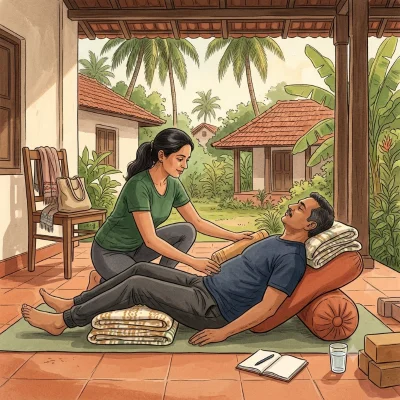
A general yoga class keeps a healthy person healthy. Yoga therapy (in Sanskrit, yoga cikitsā, yoga as treatment) applies the same practices to someone who is unwell: a person with diabetes, a stiff back, asthma, a pregnancy. IGNOU’s yoga therapy unit puts the difference in one phrase: yogic therapy treats the patient rather than the disease. Source Two people with the same diagnosis may get different practices, because their bodies, breath, habits and minds are different.
Yoga’s own starting point is prevention. Patañjali says it in three words:
हेयं दुःखमनागतम् ॥heyaṃ duḥkham anāgatam
The suffering that has not yet come is what is to be avoided. YS 2.16 Source
Past pain is over and present pain is already here; the pain yoga can still prevent lies ahead. That is why the same practices that ease an illness are also the best way to avoid one.
How therapy differs from a general class
| Aspect | General class | Yoga therapy |
|---|---|---|
| Starting point | A common sequence for a healthy group | Assessment: your diagnosis, medicines, reports, pain, breath, sleep, stress and goals |
| Plan | The same plan for everyone in the room | An individual plan for your condition and your stage of it |
| Practices | Full forms of the poses | Adapted practices: props, chair or wall, shorter holds, some practices left out |
| Over time | Drop in when you like | Follow-up: regular review, the plan changed as you change, in step with your doctor |
The Indian protocols build these steps in. A structured diabetes module on the government’s Vikaspedia portal asks you to consult a healthcare professional first, to practise under a qualified instructor in the early days, and to leave out any posture your condition restricts. Source IGNOU adds that therapy should start under supervision, and that some practices may have to be avoided depending on the patient’s clinical state. Source
The Ayush view: complementary care
India’s Ministry of Ayush treats yoga as part of health care that works with medicine. The Morarji Desai National Institute of Yoga (MDNIY) in Delhi, the Ministry’s yoga institute, opened Yoga Therapy Centres in hospitals from May 2007 “with a broader view of integrating” yoga into mainstream medical care. Source It runs preventive yoga units in 21 CGHS dispensaries in Delhi and the NCR, and a yoga therapy OPD on its own campus. Source Source MDNIY also publishes disease-specific protocols, used throughout this page. Source
In 2026 the Ministry released a Yoga Protocol for Non-Communicable Diseases and Target Groups, developed at MDNIY’s WHO Collaborating Centre for Traditional Medicine (Yoga). It covers diabetes, high blood pressure and bronchial asthma, and groups such as children, older people and pregnant women. A diabetologist quoted in the coverage calls yoga an adjunct: a support to medicines, not a replacement for them. Source
Two Indian pioneers of research
Lonavala, Maharashtra
Kaivalyadhama
Swami Kuvalayananda studied the effects of yogic practices on the body in the Baroda Hospital laboratory in 1920–21. He founded Kaivalyadhama at Amalner in 1917, and in 1924 set up its Health and Yoga Research Centre at Lonavala. The same year it began Yoga Mimamsa, which the institute calls the first scientific yoga journal. Source
Bengaluru, Karnataka
S-VYASA
Swami Vivekananda Yoga Anusandhana Samsthana is a yoga university whose research centre was founded more than three decades ago by Dr H. R. Nagendra and Dr R. Nagaratna, both known for their work in yoga therapy. Source Its campus houses Arogyadhama, an integrated health centre. Source Its integrated approach shapes much of this page.
What yoga can and cannot do
It can support
- calmer stress responses and better sleep
- slower, fuller breathing
- strength, flexibility, posture and balance
- weight and blood-sugar control, as part of a healthy lifestyle
- coping with a long illness, and quality of life
It cannot
- diagnose anything: that is your doctor’s job
- replace medicines, surgery or emergency care
- promise a cure: these notes never say “cures”
- make up for a practice that is wrong for you; done badly, yoga can harm
Always alongside your doctor
- Keep taking your medicines. Never stop or change a dose because you have started yoga; if your readings improve, your doctor adjusts the dose.
- Tell your yoga teacher about every diagnosis, surgery, injury and pregnancy, and tell your doctor about your yoga.
- Stop at once for chest pain, dizziness, unusual breathlessness, sharp pain or numbness, and seek medical help.
- An emergency, such as a severe asthma attack, very low sugar or a sudden severe headache, needs a hospital, not a mat.
In the Yoga Certification Board’s Yoga Wellness Instructor syllabus, this page matches Unit 3: the yogic concept of health (3.4), common diseases and their management by yoga (3.13), non-communicable diseases (3.14) and stress (3.15). Source
Wellness Concept of disease in the yogic view
Where illness begins: ādhi and vyādhi
In one line
In yoga’s view, much illness begins as a disturbance in the mind (ādhi), unsettles the flow of prāṇa, and finally shows in the body as disease (vyādhi).

Modern medicine sees illness mostly in the body. Yoga sees a person at three linked levels at least: the body, the prāṇa (the life force that moves as breath and energy) and the mind. Health is balance at every level, and illness can start at any of them.
Ādhi and vyādhi in the Yoga Vāsiṣṭha
The Yoga Vāsiṣṭha is a long dialogue in which the sage Vasiṣṭha teaches the young prince Rāma. It names two causes of suffering: ādhi, affliction of the mind, and vyādhi, disease of the body. Relief from both is happiness, and it adds that the disturbed mind is a cause of physical disease. Source The government’s Vikaspedia portal puts the chain in plain terms: going against cosmic laws creates ādhi, or stress, and ādhi kept up for a long time is pushed into the prāṇamaya and annamaya kośas, where it causes vyādhi. Source
Two kinds of ādhi
Sāmānya ādhi, the ordinary kind: everyday worries, desires and emotions. These give rise to psychosomatic illness. Sāra ādhi, the essential kind: the deep root that IGNOU says is responsible for birth and death itself. Source
Two kinds of vyādhi
Ādhija vyādhi, “born of ādhi”: stress-born, psychosomatic illness. Anādhija vyādhi, “not born of ādhi”: bodily ailments such as injury, infection or poisoning, whose causes are external. Source
The same Ministry of Ayush page traces stress-born illness through four phases: psychic (irritability, disturbed sleep), psychosomatic (general body signs such as raised blood pressure or a tremor), somatic (an organ starts to falter, as in pre-diabetes or weight gain) and organic (the full disease, such as a peptic ulcer, with damage that may not reverse). Source It ties sāra ādhi to heredity and inborn disorders, a slightly different reading from IGNOU’s. The earlier the phase, the more yoga can do.
So yoga therapy has most to offer for ādhija vyādhi, the stress-born, lifestyle illnesses. For an infection or a broken bone, medicine comes first; yoga helps with recovery, rest and morale.
Prāṇa, the bridge
How does a worry become a stomach ulcer? Through prāṇa. IGNOU explains that agitation in the mental sheath reaches the physical sheath through the prāṇic one: the disturbed mind causes violent fluctuations in the flow of prāṇa in the nāḍīs (the channels of prāṇa), and food is then not digested properly. The texts call it ajīrṇatvam, under-digestion, and atijīrṇatvam, over-digestion. Source Vikaspedia: a balance between the five prāṇas is health, and an imbalance results in disease. Source
Stress is the everyday name for this. IGNOU defines stress in yoga as speed at every level, from body to mind. Source Modern physiology agrees from the other side: chronic stress keeps the stress hormone cortisol high, which raises blood sugar and promotes belly fat and insulin resistance. Source More on the stress response in the body unit.
Animation · ādhi becomes vyādhi
From a troubled mind to an ailing body, and back
Three rings: the mind at the centre, prāṇa around it, the body outside. Watch a disturbance travel outward, then press Practise to heal it layer by layer.
- Balance. Mind, breath and body in rhythm.
- Ādhi. A disturbance begins in the mind.
- Prāṇa disturbed. The breath loses its rhythm.
- Vyādhi. Illness appears in the body.
- Dhyāna. Meditation calms the mind.
- Prāṇāyāma. Slow breathing steadies prāṇa.
- Āsana and kriyā. The body heals.
The disturbance began in the mind, made the breath uneven, and now shows in the body. The steps of healing run in the opposite order: mind, prāṇa, body.
The inner causes: kleśas and antarāyas
Patañjali names the roots of suffering directly. First, the five kleśas, afflictions that colour every thought:
अविद्यास्मितारागद्वेषाभिनिवेशाः पञ्च क्लेशाः ॥avidyāsmitārāgadveṣābhiniveśāḥ pañca kleśāḥ
Ignorance, the sense of “I”, attachment, aversion and the clinging to life are the five afflictions. YS 2.3 Source
Avidyā is not lack of information but mistaking the passing for the lasting. Asmitā is identifying with body and mind. Rāga pulls us towards what pleased us, dveṣa pushes us from what hurt us, and abhiniveśa is the deep fear of death. Each one keeps the mind in motion, which is ādhi.
Then the nine antarāyas, obstacles that scatter the mind. The first on the list is illness itself:
व्याधिस्त्यानसंशयप्रमादालस्याविरतिभ्रान्तिदर्शनालब्धभूमिकत्वानवस्थितत्वानि चित्तविक्षेपास्तेऽन्तरायाः ॥vyādhi-styāna-saṃśaya-pramāda-ālasya-avirati-bhrāntidarśana-alabdhabhūmikatva-anavasthitatvāni cittavikṣepās te ’ntarāyāḥ
Disease, dullness, doubt, carelessness, laziness, craving for the senses, wrong view, failing to reach a stage, and failing to hold it: these scatterings of the mind are the obstacles. YS 1.30 Source
दुःखदौर्मनस्याङ्गमेजयत्वश्वासप्रश्वासा विक्षेपसहभुवः ॥duḥkha-daurmanasya-aṅgamejayatva-śvāsapraśvāsā vikṣepasahabhuvaḥ
Pain, dejection, trembling of the body and disturbed breathing in and out come along with these scatterings. YS 1.31 Source
Read 1.30 and 1.31 together and you have the whole model of this page in two sūtras: the mind is scattered, the breath goes uneven, the body suffers. Patañjali’s answer is steady practice and detachment (YS 1.12), and the eight limbs, whose practice wears away the impurities that cloud the mind (YS 2.28). Source See the eight limbs.
Guṇa and doṣa, in one line. The mind’s balance is described by the three guṇas of Sāṅkhya (sattva, clarity; rajas, restlessness; tamas, heaviness; see the six darśanas), the body’s by the three doṣas (vāta, pitta, kapha; see the nutrition unit). IGNOU, following the Haṭha Yoga Pradīpikā, says āsana lowers rajas and tamas and helps correct the doṣa imbalances that cause disease. Source
Wellness Pañcakośa theory in healing
Healing layer by layer: the five kośas
In one line
Illness can start at any of the five layers of a person, so yoga therapy works at all five: body, prāṇa, mind, understanding and joy.
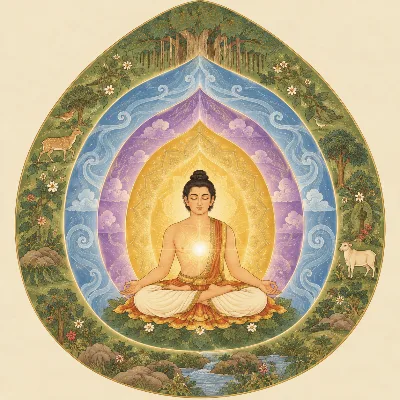
The Taittirīya Upaniṣad (chapters 2 and 3) describes a person as five sheaths, or kośas, one inside the other: annamaya, made of food; prāṇamaya, of prāṇa; manomaya, of mind; vijñānamaya, of understanding; ānandamaya, of bliss. You met them on the home page and in class on 11 October. IGNOU calls this pañcakośa theory the basis of yoga therapy, and explains that the imbalance begins in the manomaya kośa: in the ānandamaya there is perfect harmony, and in the vijñānamaya there is movement, but rightly channelled. Source
S-VYASA in Bengaluru trains its yoga therapists in the Integrated Approach of Yoga Therapy (IAYT) at its university teaching hospital. Source IGNOU lays the integrated approach out on this kośa map: practices for every layer, given together, because no single practice reaches all five. Source
| Kośa | When it is disturbed | Practices that act there |
|---|---|---|
| Annamaya the body | stiffness, pain, weight gain, poor digestion, the illness itself | āsana, sūkṣma vyāyāma, kriyās, and yogic diet: sāttvic, moderate food (mitāhāra) |
| Prāṇamaya prāṇa and breath | fast, shallow, uneven breathing; fatigue; a restless nervous system | breathing exercises and prāṇāyāma |
| Manomaya the mind | worry, anger, fear, racing thoughts: ādhi | relaxation, dhyāna, dhāraṇā, chanting and japa (Om, prayers), bhakti, and the yamas and niyamas |
| Vijñānamaya understanding | wrong ideas about life and happiness, conflicting values | self-study (svādhyāya), talks and counselling that correct mistaken ideas (IGNOU calls them “notional corrections”), and ānanda mīmāṃsā, an inquiry into where happiness really comes from |
| Ānandamaya joy | the root unrest, cut off from inner joy | karma yoga, action without craving for its fruit; bhakti; the Bhagavad Gītā’s teaching of joy in action |
Notice the direction. The disturbance moves outward, from mind to body; the cure in IAYT works on all layers at once, so that the outer practices are carried by a calmer mind and the inner practices by a steadier body. The Gītā puts the whole lifestyle in one verse:
युक्ताहारविहारस्य युक्तचेष्टस्य कर्मसु ।
युक्तस्वप्नावबोधस्य योगो भवति दुःखहा ॥yuktāhāra-vihārasya yukta-ceṣṭasya karmasu | yukta-svapnāvabodhasya yogo bhavati duḥkhahā ||
For one who is moderate in food and recreation, balanced in effort at work, and moderate in sleep and waking, yoga becomes the destroyer of sorrow. BG 6.17 Source
Food, rest, work, sleep: each is a kośa practice. Daily and seasonal routine get their own section in the nutrition unit.
Wellness Role of āsana, prāṇāyāma, dhyāna and kriyā in therapy
The four tools
In one line
Āsana works on the body, prāṇāyāma on the breath and nervous system, dhyāna on the mind, and kriyā clears the body’s passages; in therapy each is chosen, dosed and adapted for the person.
Āsana · annamaya
Steady and easy
Patañjali’s definition is the therapist’s rule: sthira-sukham āsanam, a posture is steady and comfortable (YS 2.46). IGNOU lists what āsanas do: loosen the joints, stretch and relax the muscles, calm the mind and revive the body. Source
In therapy: slow, with the breath, held only as long as it stays comfortable; props, a chair or a wall wherever needed. More in the āsana unit.
Prāṇāyāma · prāṇamaya
The breath as a bridge
Breathing practices remove the random agitation in the flow of prāṇa, so ailments are handled at that level too. Source Slow nāḍī śodhana and humming bhrāmarī appear in almost every protocol on this page.
In therapy: no breath-holding for patients and beginners. MDNIY’s mental health protocol specifies prāṇāyāma “without kumbhaka”. Source More in the prāṇāyāma unit.
Dhyāna and relaxation · manomaya
Stilling the source
Since ādhi starts in the mind, relaxation and meditation reach the root. The Common Yoga Protocol says Śavāsana relaxes the whole psycho-physiological system, and that meditation helps clear fear, anger and anxiety and keeps the mind calm. Source
In therapy: start with short guided relaxation, such as yoga nidrā. For depression, IGNOU advises yoga as treatment only when prescribed for the individual patient. Source
Kriyā · annamaya and prāṇamaya
Clearing the passages
The six cleansing kriyās wash the nose, food pipe, bowel, eyes, belly and airways. MDNIY’s asthma protocol uses jala neti and kapālabhāti; its diabetes protocol, kuñjala, agnisāra and nauli. Source
In therapy: only after learning from a teacher, and never with the conditions listed in the ṣaṭkarma safety notes.
The Haṭha Yoga Pradīpikā gives the warning that goes with all four tools:
प्राणायामेन युक्तेन सर्वरोगक्षयो भवेत् ।
अयुक्ताभ्यासयोगेन सर्वरोगसमुद्भवः ॥prāṇāyāmena yuktena sarvaroga-kṣayo bhavet | ayuktābhyāsa-yogena sarvaroga-samudbhavaḥ ||
By prāṇāyāma done correctly, all diseases fade; by practice done wrongly, all diseases arise. HYP 2.16 Source
The same practice can heal or harm, depending on whether it suits the person. B.K.S. Iyengar’s Light on Yoga, one of the books prescribed for my certification, ends with long āsana courses and lists of āsanas for common ailments. Read them as a teacher’s map, not as a self-prescription.
General precautions for therapy (IGNOU)
- Practise with an empty bladder and bowels; about four hours after a full meal, two and a half after a light breakfast, one after tea or juice.
- No jerky movements, no going beyond your anatomical limit, and no holding the breath at any point.
- With a hernia, peptic ulcer, chest pain, ischaemic heart disease or a slipped disc, keep to relaxing postures, prāṇāyāma and meditation unless your doctor and therapist advise more.
- After recent abdominal surgery, wait three to six months, depending on severity, before the other practices.
- During menstruation, keep to relaxing postures such as Śavāsana and Makarāsana.
Wellness Yoga for common conditions
Eight common conditions
In one line
For each condition: what is going on, what you may notice, what Indian protocols suggest, what to avoid, and when to see a doctor. All of it supports treatment; none of it replaces treatment.
The practice lists follow Indian sources and name them: MDNIY’s disease protocols (diabetes, asthma, low back pain), the Ministry of Ayush’s Common Yoga Protocol for cautions, the government protocol for pregnancy, The Yoga Institute in Mumbai (thyroid, PCOS) and an AIIMS study (migraine). Where I found no official Indian protocol, I say so and keep to gentle, general practice. Pose names link to the āsana library.
Explorer · eight conditions
Where it shows, and what helps
Pick a condition. The glowing part of the body is where it mainly shows.
The pancreas, tucked behind the stomach, makes insulin.
Diabetes
Cause
The cells stop responding well to insulin, or the pancreas makes too little, so sugar stays in the blood.
You may notice
Often nothing for years. Later thirst, passing urine often, tiredness, cuts that heal slowly.
Practices
Vakrāsana, Trikoṇāsana, Bhujaṅgāsana, Paścimottānāsana, Pavanamuktāsana; nāḍī śodhana, bhrāmarī; deep relaxation; Om meditation.
Avoid
Practising on a long empty stomach if you take sugar-lowering medicine; changing your dose yourself; strain and head-down poses with diabetic eye disease.
Back pain and posture
Cause
Mostly strain: awkward bending and lifting, long hours of poor sitting, weak back and belly muscles, stress.
You may notice
Stiffness, soreness and tension in the lower back; sometimes pain running down a leg.
Practices
Tāḍāsana, Ardha Cakrāsana, Bhujaṅgāsana, Śalabhāsana, Makarāsana, Setu Bandhāsana; nāḍī śodhana, bhrāmarī; yoga nidrā.
Avoid
Deep forward bends and twists with a disc problem or sciatica; jerky movements; lifting while twisting.
Thyroid: hypo and hyper
Cause
Hypo: the gland is underactive and makes too little hormone. Hyper: it is overactive and makes too much.
You may notice
Hypo: the body slows, with tiredness and weight gain. Hyper: the body races, with a fast heart and weight loss.
Practices
Hypo: Bhujaṅgāsana, Uṣṭrāsana, Trikoṇāsana. Hyper: Setu Bandhāsana, Śavāsana. Both: ujjāyī, relaxation.
Avoid
Mixing the two up. With hyper, fast and heating practice; with any thyroid problem, stopping your tablets.
PCOS and hormonal imbalance
Cause
The ovaries make more male hormones than usual, often with insulin resistance; genes, diet, inactivity and stress all play a part.
You may notice
Irregular or missed periods, weight gain around the belly, extra facial hair, acne, mood swings.
Practices
Naukāsana, Pavanamuktāsana, Bhadrāsana, Supta Baddha Koṇāsana; prāṇāyāma; Śavāsana for stress; regular, moderate exercise.
Avoid
Crash diets, late nights and junk food; strong practice during heavy periods.
Headache and migraine
Cause
Tension headaches come with tight neck and shoulders, stress and poor sleep. Migraine is a recurring headache disorder with its own triggers.
You may notice
A band-like ache; or in migraine, throbbing pain, often on one side, sometimes with nausea and sensitivity to light.
Practices
Gentle neck and shoulder sūkṣma vyāyāma, Śaśāṅkāsana, Śavāsana; nāḍī śodhana, bhrāmarī; relaxation; regular sleep and meals.
Avoid
Kapālabhāti with migraine; any practice during an attack; head-down poses while the head aches.
Asthma and respiratory health
Cause
Over-sensitive airways narrow when triggered by dust, smoke, pollen, cold air, infections, exercise or emotional stress.
You may notice
Wheezing, breathlessness, a tight chest and cough; breathing out is hardest.
Practices
Jala neti; Gomukhāsana, Uṣṭrāsana, Bhujaṅgāsana, Makarāsana; nāḍī śodhana; quick relaxation; Om meditation.
Avoid
Practising during an attack; forceful breathing unless taught; cold, dusty air; being far from your inhaler.
Digestive issues
Cause
Irregular, rushed or heavy meals, too little fibre and water, inactivity, some medicines, smoking, alcohol, and stress.
You may notice
Burning in the upper belly (acidity), hard or infrequent stools (constipation), cramps and bloating.
Practices
Vajrāsana after meals; Pavanamuktāsana, Śaśāṅkāsana, Uttānapādāsana; śītalī for burning; relaxation.
Avoid
With an ulcer: kapālabhāti, kuñjala, Bhujaṅgāsana, Śalabhāsana; any practice on a full stomach.
Pregnancy
What changes
Weight, balance, breathing room and hormones all change, month by month, with physical and emotional stress.
You may notice
Nausea and tiredness early on; back ache, breathlessness and poor sleep later.
Practices
Tāḍāsana, Bhadrāsana-type sitting, cat stretches; sectional breathing, nāḍī śodhana, bhrāmarī; meditation.
Avoid
Kapālabhāti, bhastrikā, breath retention, inversions, lying on the belly, deep twists and forward bends.
Diabetes
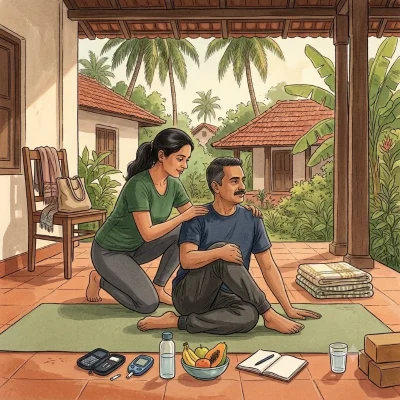
What is going on. Insulin, a hormone from the pancreas, lets sugar move from the blood into the cells. When blood sugar stays high for long, the result is diabetes mellitus. Source In type 2 diabetes, the common kind, the cells resist insulin or the pancreas cannot make enough. The risks include excess weight, inactivity, family history, poor diet, chronic stress, poor sleep and PCOS, and it builds up slowly over years. Source Type 1 diabetes is a different condition, in which insulin treatment is essential.
What you may notice. Often nothing for years, which is why blood tests matter. Later: thirst, passing urine often, tiredness, cuts that heal slowly.
Practices (MDNIY protocol, 45 minutes). Source
- Kriyās, only if taught: kuñjala once a week, agnisāra twice a week, nauli. See kuñjala.
- Sūkṣma vyāyāma for the chest, belly and waist (vakṣasthala, udara and kaṭi śakti vikāsaka).
- Āsanas: Tāḍāsana, Trikoṇāsana, Ardha Cakrāsana, Paścimottānāsana, Uṣṭrāsana, Bhujaṅgāsana, Dhanurāsana, Makarāsana, Pavanamuktāsana, Setu Bandhāsana, Sarvāṅgāsana, a simple Matsyāsana and Śavāsana. The Common Yoga Protocol adds Vakrāsana, which it says stimulates the pancreas and helps in managing diabetes. Source
- Prāṇāyāma: nāḍī śodhana and bhrāmarī, five rounds each.
- Relaxation and meditation: a deep relaxation technique, then Om meditation or mindfulness meditation.
What to avoid. Changing your medicine yourself. Long fasting before practice if you take insulin or sugar-lowering tablets: ask your doctor how to time practice and meals. With diabetic eye disease or high blood pressure, ask before head-down poses such as Sarvāṅgāsana. If your feet have lost feeling, check them after practice.
See a doctor for very high or very low readings; shakiness, sweating or confusion during or after practice (possible low sugar); a wound that will not heal; or changes in your vision.
Caution · diabetes
Yoga supports blood-sugar control alongside medicine, diet and regular tests. Keep a quick source of sugar nearby while you practise, and practise under a teacher until you know how your body responds.
Back pain and posture
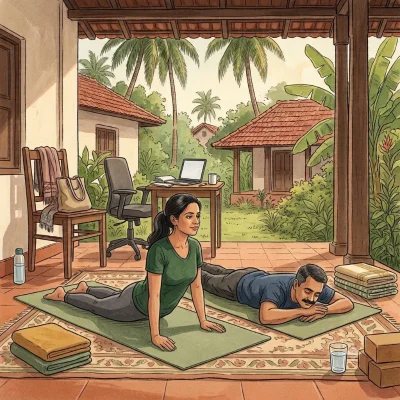
What is going on. Most low back pain is not caused by serious damage but by sprains, strains, minor injuries or an irritated nerve: bending awkwardly or for long, lifting wrongly, sitting badly for hours, driving hunched, overuse. Excess weight, smoking, pregnancy, stress and age add to the risk. Some cases come from a slipped disc, osteoporosis, spondylitis or narrowing of the spinal canal, which need a doctor’s care. Source
What you may notice. Tension, soreness and stiffness in the lower back. Pain running from the back through the buttock into a leg suggests sciatica; with a slipped disc there may be weakness too. Source
Practices (MDNIY). Source
- Om chanting and prayer, then simple spinal movements and kaṭi śakti vikāsaka 1 to 5, the waist-strengthening series.
- Āsanas: Tāḍāsana, Ūrdhva Hastottānāsana, Kaṭicakrāsana, Ardha Cakrāsana, Koṇāsana, Uttānapādāsana, Setu Bandhāsana, Uṣṭrāsana, Vakrāsana, Mārjarī (cat stretch), a simple Matsyāsana, Bhujaṅgāsana, Śalabhāsana, Makarāsana, Śavāsana.
- Prāṇāyāma: nāḍī śodhana, sūryabhedana and bhrāmarī. Special practice: yoga nidrā; then dhyāna.
- Posture habits: a chair with lower-back support, changing position often, lifting with the object close and without twisting, sleeping on the side on a firm surface, flat cushioned shoes.
Notice the shape of the list: gentle back bends and strengtheners, no deep forward folds.
What to avoid. The Common Yoga Protocol’s cautions: no Pādahastāsana with disc disorders; no Trikoṇāsana with a slipped disc or sciatica; no Vakrāsana or Śaśāṅkāsana in acute back pain; no Pavanamuktāsana with sciatica or severe back pain; Ardha Halāsana one leg at a time with lower back pain; Śalabhāsana cautiously in severe low back pain. Source With a slipped disc, IGNOU keeps to relaxing postures, prāṇāyāma and meditation. Source
See a doctor for pain after a fall or accident; pain down a leg with numbness or weakness; any trouble controlling bladder or bowel; back pain with fever or weight loss; pain that wakes you at night.
Caution · back pain
Get the cause diagnosed first: the same pose can help a strain and harm a disc. Move slowly, stop if pain spreads or sharpens, and build strength over weeks, not days.
Thyroid: hypo and hyper
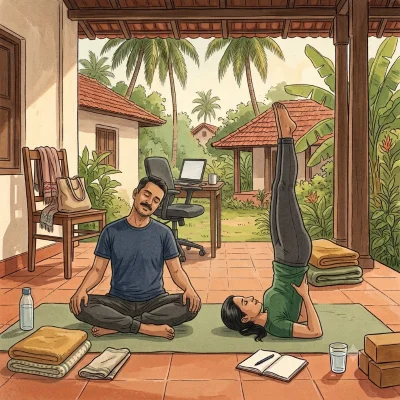
What is going on. The thyroid sits in the neck on either side of the windpipe. Its hormones, thyroxine (T4) and triiodothyronine (T3), regulate the basal metabolic rate, the body’s speed of living. Iodine is essential to make them. Source
Hypothyroidism · underactive
Too little hormone: the body slows down. Iodine deficiency is one cause, with a swollen gland (goitre); in adult women it may make periods irregular, and in pregnancy it can affect the baby’s development. Source Common signs: tiredness, weight gain, feeling cold, constipation, dry skin.
Practice leans gently energising: The Yoga Institute suggests Bhujaṅgāsana, Uṣṭrāsana and Trikoṇāsana. Source
Hyperthyroidism · overactive
Too much hormone: the body races. One form, Graves’ disease, brings an enlarged gland, bulging eyes, a raised metabolic rate and weight loss. Source Common signs: fast heartbeat, weight loss, feeling hot, trembling hands, anxiety.
Practice leans calming: The Yoga Institute suggests Setu Bandhāsana, Dṛḍhāsana (a relaxing pose from the Institute’s own series) and Śavāsana. Source
For both. The Yoga Institute calls stress one of the main factors in thyroid disorders, and recommends ujjāyī prāṇāyāma, Śavāsana and quiet relaxation for both types, with a diet rich in fibre, seasonal fruit and green vegetables. It also says to check with your physician and your teacher before starting. Source Nāḍī śodhana and bhrāmarī, calming practices found in every protocol on this page, suit both.
What to avoid. Treating the two the same: the practice that lifts a sluggish hypothyroid body can overstimulate a racing hyperthyroid one. With hyperthyroidism, it is wiser to leave fast, heating practice (rapid Sūrya Namaskāra, kapālabhāti, bhastrikā) until your doctor says the condition is controlled. With any neck problem, no Sarvāṅgāsana or Halāsana. Never stop your thyroid tablets because you feel better.
See a doctor for a swelling in the neck, a racing or irregular heartbeat, unexplained weight change, or if you are planning a pregnancy: thyroid levels matter for the baby.
Caution · thyroid
Yoga supports the stress and energy side of thyroid disease; the hormone level is managed with your doctor through blood tests and medicine. Know which type you have before you choose a practice.
PCOS and hormonal imbalance
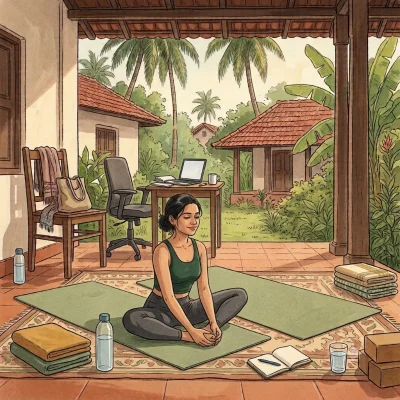
What is going on. In polycystic ovary syndrome (PCOS), the ovaries make more male hormones (androgens) than usual. Ovulation, the monthly release of an egg, becomes irregular, and small cysts form. Insulin resistance often drives it: high insulin makes the body produce still more male hormones. Genes, poor diet, inactivity and high stress can trigger or worsen it. Vikaspedia separates PCOD, where the ovaries hold many immature eggs, from PCOS, a more serious metabolic disorder; it is also a common reason for difficulty in conceiving. Source
What you may notice. Irregular or missed periods, weight gain around the belly, unwanted hair on the face or body, acne, thinning hair, mood swings. Source
Practices. Lifestyle comes first: losing even 5 to 10 per cent of body weight can help make periods regular, and regular activity such as walking or yoga helps control insulin. Source The Yoga Institute suggests poses that gently compress and massage the abdomen, such as Naukāsana, Matsyāsana, Hastapādāṅguṣṭhāsana and Pavanamuktāsana; prāṇāyāma; and Śavāsana to lower stress. It adds regular sleep and meal times, eating slowly, and not smoking. Source Bhadrāsana eases abdominal pain during periods, says the Common Yoga Protocol. Source Research is under way in India too: the National Institute for Research in Reproductive Health, Mumbai, has studied yoga for women with PCOS facing infertility. Source
What to avoid. Crash diets and over-training, which add stress. During periods, especially heavy ones, keep to relaxing postures. Do not stop prescribed medicines.
See a doctor if periods stop for months or are very heavy, if you are trying to conceive without success, or if unwanted hair grows quickly. PCOS needs a proper diagnosis: other conditions can look like it.
Caution · PCOS
Yoga supports weight, insulin and stress, the levers you can move yourself. It works best with your gynaecologist’s treatment, not instead of it.
Headache and migraine
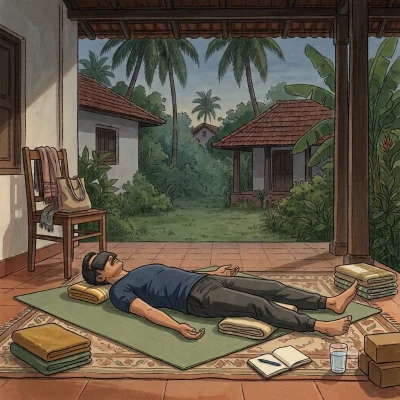
What is going on. Most everyday headaches are tension-type: tight muscles in the neck, shoulders and scalp, often with stress, poor sleep, long screen hours or missed meals. Migraine is different: a recurring headache disorder, one of the most common there is, and only about half of people taking medicine for it get real relief. Source
What you may notice. Tension headache: a dull, band-like pressure. Migraine: throbbing pain, often on one side, sometimes with nausea and sensitivity to light and sound, lasting hours.
The AIIMS study. Researchers at the All India Institute of Medical Sciences, New Delhi, gave 114 adults with episodic migraine either medicine alone or medicine plus yoga: an hour of breathing, relaxation and postures, supervised three days a week for a month, then five days a week at home for two months. In the yoga group, headaches fell from 9.1 to 4.7 a month, about 48 per cent, against 12 per cent with medicine alone, and pill use fell by 47 per cent. The headaches were self-reported and the study lasted three months, so longer studies are needed. Published in Neurology, 2020. Source
Practices. No official Indian protocol for headache was found, so these are gentle, widely used practices with Common Yoga Protocol notes. Source
- Neck and shoulder sūkṣma vyāyāma, done slowly with the breath; the protocol says these keep the neck and shoulders healthy.
- Śaśāṅkāsana, which the protocol says reduces stress and anxiety; Śavāsana or yoga nidrā.
- Nāḍī śodhana and bhrāmarī, whose humming, the protocol says, soothes the nervous system.
- Regular sleep, regular meals, enough water; a headache diary to find your triggers.
What to avoid. Kapālabhāti: the Common Yoga Protocol lists migraine among its contraindications. Source During an attack, skip practice and rest in a dark, quiet room. While the head aches, avoid head-down poses and anything strenuous.
See a doctor urgently for a sudden, severe headache unlike any before; a headache after a head injury; headache with fever and a stiff neck; or with weakness, confusion, slurred speech or loss of vision. See a doctor soon for new headaches after the age of 50, or headaches that keep getting worse.
Caution · headache
Yoga works as an add-on in migraine, as the AIIMS study shows: keep your prescribed treatment, and let your doctor rule out other causes first.
Asthma and respiratory health
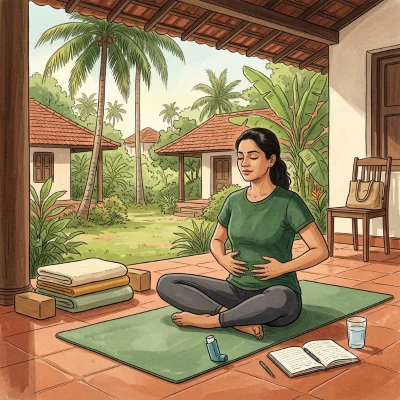
What is going on. Asthma is a long-term inflammation of the airways that makes them over-sensitive. When triggered, the muscles around them tighten, their lining swells and thick mucus collects, so the air struggles to move. Common triggers: tobacco smoke, colds and flu, dust mites, pollen, mould, pet dander, exercise, polluted air, sudden weather changes, some medicines and emotional stress. Source
What you may notice. Wheezing, breathlessness, a tight chest and cough, with breathing out hardest. Attacks last from an hour to several hours. Source
Practices (MDNIY protocol, 45 minutes). Source
- Kriyās: jala neti twice a week; kapālabhāti followed by deep breathing.
- Loosening: sthūla and sūkṣma vyāyāma for the throat, the mind and the memory.
- Āsanas: Tāḍāsana, Ardha Cakrāsana, Trikoṇāsana, Gomukhāsana, Mārjarī, Uṣṭrāsana, Makarāsana, Bhujaṅgāsana, Setu Bandhāsana, Matsyāsana, Śavāsana.
- Prāṇāyāma: bhastrikā, sūryabhedana and nāḍī śodhana, three rounds each; then quick relaxation and Om meditation.
- Diet (MDNIY via Vikaspedia): warm water and drinks; avoid cold foods, ice cream and heavy, oily, mucus-forming food. Source
What to avoid. Any practice during an attack: use your reliever as prescribed. Kapālabhāti and bhastrikā are forceful; learn them from a teacher, do them only when the chest is clear, and skip them with heart disease or high blood pressure, as the Common Yoga Protocol advises for kapālabhāti. Source The Yoga Institute adds: keep warm, avoid a direct breeze on the face, and cover the face in dust. Source
Get emergency help if your reliever does not help, if you cannot speak in full sentences, or if lips or nails turn bluish. A severe attack that does not respond to the usual treatment (status asthmaticus) is a medical emergency. Source
Caution · asthma
Keep your inhaler on the mat beside you, every time. Yoga supports calmer, slower breathing between attacks; it does not stop an attack that has started.
Digestive issues: acidity, constipation, IBS-type complaints
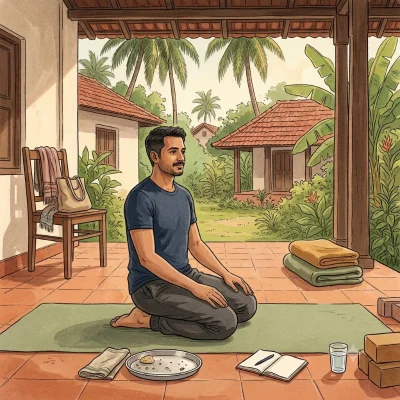
What is going on. Yoga ties digestion closely to the mind: an agitated mind disturbs prāṇa, and food is not digested well (see prāṇa, the bridge). Three common complaints:
- Acidity: burning in the upper belly. When it becomes a peptic ulcer, the causes include H. pylori infection, painkillers (NSAIDs), smoking, alcohol, too much caffeine, and acute and chronic stress. Source
- Constipation: hard or infrequent stools, often from too little fibre, water and movement.
- IBS-type complaints: cramps, bloating, and bowels that swing between loose and hard, often worse with stress. Irritable bowel syndrome is a diagnosis a doctor makes after ruling out other causes.
Practices.
- After meals: Vajrāsana, which the Common Yoga Protocol calls good for digestion. Source
- For constipation and gas (Common Yoga Protocol): Pavanamuktāsana relieves constipation, flatulence and bloating; Śaśāṅkāsana, Bhujaṅgāsana, Setu Bandhāsana and Ardha Halāsana help relieve constipation; Uttānapādāsana helps with indigestion and flatulence.
- For burning and acidity (Ministry of Ayush): nāḍī śuddhi, śītalī and śītkārī, the cooling breaths, to reduce burning and relieve stress, with meditation and deep relaxation. Source
- For IBS-type complaints: no official Indian yoga protocol was found. Stress-calming practice is the sensible core: yoga nidrā, bhrāmarī, nāḍī śodhana, and meals at regular times.
- Food: moderate, fresh, sāttvic meals, eaten slowly; the stomach never filled to the brim.
What to avoid. With a peptic ulcer, IGNOU keeps to relaxing postures, prāṇāyāma and meditation. Source The Common Yoga Protocol rules out Bhujaṅgāsana, Śalabhāsana and Setu Bandhāsana with ulcers, and kapālabhāti with a gastric ulcer. Source Kuñjala is not for ulcers or hyperacidity (ṣaṭkarma safety). Never practise on a full stomach.
See a doctor for black or bloody stools, vomiting blood, difficulty swallowing, weight loss without trying, severe or persistent pain, or a lasting change in bowel habit.
Caution · digestion
Burning, cramps and bowel changes can have serious causes: get a diagnosis before treating them as “just acidity”. Yoga supports digestion and the stress behind it alongside your doctor’s care.
Pregnancy: before, during and after
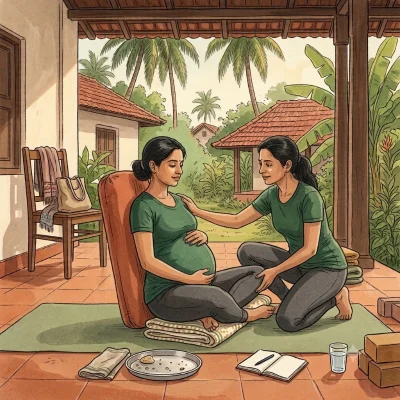
Before conception. The wish to conceive, with the pressures of modern life, can bring high stress and anxiety, and chronic stress can disturb hormonal balance. Vikaspedia lists Supta Baddha Koṇāsana (reclining bound angle), Paścimottānāsana and Viparīta Karaṇī (legs up the wall) as poses often recommended to support reproductive health, with prāṇāyāma, meditation and restorative yoga, ideally with a therapist who specialises in reproductive health. Source If PCOS or a thyroid problem is part of the picture, follow those notes too.
During pregnancy. The government guidelines (Ministry of Women and Child Development, via Vikaspedia) say yoga can help reduce stress, improve sleep, strengthen the pelvic floor and ease back ache, nausea and headaches. Their rules: Source
- Modify poses to make room for the growing belly; choose easier versions.
- Aim for stability and strength, not flexibility and endurance.
- A light snack or juice before practice is fine: blood sugar can dip more easily in pregnancy.
- Avoid poses that compress the womb (forward bends, closed twists) or overstretch the belly (deep back bends). Twist only open, from the head to the waist.
- Avoid inversions such as shoulder, head and hand stands; Naukāsana; and lying on the belly (Bhujaṅgāsana, Śalabhāsana, Dhanurāsana).
- No kapālabhāti or other straining kriyā, no bhastrikā, no breath retention. Do practise slow breathing: deep yogic breathing, anuloma viloma, ujjāyī and bhrāmarī.
- Do not raise the arms overhead if you feel dizzy standing. Keep awareness of the pelvic floor in every practice.
MDNIY’s 45-minute protocols, trimester by trimester, are summarised in the journey below. Source One honest note: the second-trimester list includes Viparīta Karaṇī with wall support and Śaśāṅkāsana, which sit uneasily with the general rules above. Do them only if your prenatal teacher includes them for you, with the knees wide in Śaśāṅkāsana. Likewise, from the second trimester keep lying flat on the back brief, or recline on a bolster; if you feel dizzy or breathless on your back, roll onto your left side.
After birth. Your doctor decides when you begin; do not set the date yourself. MDNIY describes the postnatal period as the six weeks after childbirth, while the womb and pelvic organs return to their pre-pregnant state. Source So after a normal delivery, gentle breathing and relaxation can come first, and fuller practice waits until about six weeks, once your doctor clears you. After a caesarean the wait is longer: an Indian postnatal guide places gentle yoga at about 6 to 12 weeks with your obstetrician’s approval, avoiding deep twists and heavy abdominal work until the scar is comfortable, Source and IGNOU keeps most practices other than relaxation, prāṇāyāma and meditation for three to six months after abdominal surgery. Source MDNIY’s protocol for breastfeeding mothers then rebuilds gently, with prone poses only in simple or modified forms. Source
Animation · the pregnancy journey
Five stages, one careful path
Follow the light from before conception to after birth. Each stage shows what suits, what to modify and what to avoid.
Stage 1 of 5 · Before conception: lower stress and build steady, moderate habits.
Before conception
Suits
- regular, moderate practice
- Supta Baddha Koṇāsana, Paścimottānāsana, restorative poses
- prāṇāyāma and meditation for stress
Modify
- with PCOS or thyroid problems, follow those notes too
- during fertility treatment, ask before any vigorous practice
Avoid
- exhausting practice and crash diets
- late nights, smoking and junk food
See your doctor before trying to conceive, especially with diabetes, thyroid disease or PCOS.
First trimester · months 1 to 3
Suits
- neck, shoulder, knee and ankle loosening
- Tāḍāsana, Vṛkṣāsana, Daṇḍāsana, Sukhāsana, Śavāsana
- sectional breathing; nāḍī śodhana, bhrāmarī, śītalī; dhyāna
Modify
- shorter sessions when tired or nauseous
- a light snack before practice
- Vṛkṣāsana near a wall
Avoid
- kapālabhāti, bhastrikā, breath retention
- inversions, lying on the belly, deep twists
- jumping and overheating
Confirm the pregnancy with your doctor and get clearance before you start or continue yoga.
Second trimester · months 4 to 6
Suits
- Trikoṇāsana, Kaṭicakrāsana, Vīrabhadrāsana, Prasārita Pādottānāsana
- Baddha Koṇāsana, Mārjarī with the breath, Mālāsana, an open seated twist
- nāḍī śodhana, ujjāyī, śītalī; dhyāna
Modify
- a wall or chair for balance
- Śaśāṅkāsana and Bālāsana with knees wide
- Viparīta Karaṇī at a wall only if your prenatal teacher includes it
- keep lying on the back brief; recline on a bolster
Avoid
- lying on the belly; closed twists
- back bends that overstretch the belly; Naukāsana
- forceful breathing and breath retention
Keep up your antenatal check-ups and tell your doctor what you practise.
Third trimester · months 7 to 9
Suits
- Tāḍāsana, Trikoṇāsana, Ardha Pārśvakoṇāsana
- Upaviṣṭha Koṇāsana, a gentle side stretch over one leg, Mārjarī
- Supta Baddha Koṇāsana propped on a bolster; Śavāsana on the left side; nāḍī śodhana, bhrāmarī, śītalī; Om or so’ham meditation
Modify
- props everywhere; shorter holds
- rest on the left side if lying back feels wrong
- stop if breathless
Avoid
- anything that strains or compresses the belly
- arms overhead if dizzy
- inversions and forceful breathing
Stop and call your doctor for bleeding, fluid leaking, pain, contractions, dizziness or less movement from the baby.
After birth
Suits
- sectional breathing; nāḍī śodhana, ujjāyī, bhrāmarī
- after clearance: Bhadrāsana, Mārjarī, Śaśāṅkāsana, Setu Bandhāsana, one-leg Pavanamuktāsana, Śavāsana
- meditation
Modify
- prone poses only in simple, modified forms
- after a caesarean, wait longer and protect the scar
Avoid
- strong core work and deep twists before healing
- kapālabhāti and bhastrikā until your doctor clears you
Begin only after your doctor clears you at the postnatal check-up.
Caution · pregnancy
- Practise only with your doctor’s agreement, and with a teacher trained in prenatal yoga.
- No kapālabhāti, bhastrikā or breath retention; no inversions unless a qualified prenatal teacher says so; no deep twists or lying on the belly; keep lying flat on the back short after the first trimester.
- Stop at once for bleeding, fluid leaking, pain, contractions, dizziness, breathlessness or reduced movement of the baby, and call your doctor.
- After birth, wait for your doctor’s clearance, and longer after a caesarean.
Quick revision
Test yourself
What are ādhi and vyādhi, and which text teaches them?
Ādhi is affliction of the mind; vyādhi is disease of the body. The Yoga Vāsiṣṭha names them as the two causes of suffering, and says the disturbed mind is a cause of physical disease: long-standing ādhi passes through prāṇa into the body as vyādhi.
What are the two kinds of ādhi in IGNOU’s account?
Sāmānya (ordinary) ādhi, which gives rise to psychosomatic disease, and sāra (essential) ādhi, the deep root responsible for birth and death.
What is the difference between ādhija and anādhija vyādhi?
Ādhija vyādhi is born of ādhi, the disturbed mind: stress-born, psychosomatic illness. Anādhija vyādhi is not born of ādhi: injury, infection or poisoning, with external causes, where medicine comes first.
Which sūtra lists the five kleśas? Name them.
YS 2.3: avidyā (ignorance), asmitā (the sense of “I”), rāga (attachment), dveṣa (aversion) and abhiniveśa (clinging to life).
Which obstacle comes first in YS 1.30, and what does YS 1.31 add?
Vyādhi, disease. YS 1.31 lists what accompanies the obstacles: pain, dejection, trembling of the body and disturbed breathing in and out.
In the integrated approach of yoga therapy, which practices work at each kośa?
Annamaya: āsana, sūkṣma vyāyāma, kriyā, diet. Prāṇamaya: breathing practices and prāṇāyāma. Manomaya: relaxation, meditation, chanting, bhakti, yama and niyama. Vijñānamaya: self-study, notional corrections, happiness analysis. Ānandamaya: karma yoga.
What warning does HYP 2.16 give?
Prāṇāyāma done correctly removes all diseases; practice done wrongly gives rise to them.
Hypothyroidism or hyperthyroidism: which calls for calming practice?
Hyperthyroidism, the overactive gland, in which the body races. Hypothyroidism, the underactive gland, in which the body slows, calls for gently energising practice.
Name five things to avoid during pregnancy.
Any five of: kapālabhāti, bhastrikā, breath retention, inversions, lying on the belly, closed or deep twists, forward bends that compress the womb, back bends that overstretch the belly, Naukāsana.
In the AIIMS migraine study, what happened to headache frequency in the yoga group?
It fell from 9.1 to 4.7 headaches a month, about 48 per cent, against 12 per cent with medicine alone. Yoga was given as an add-on to medicine, not instead of it.
Sources
Where this comes from
- Prescribed books (named, not quoted; explained in my own words): B.K.S. Iyengar, Light on Yoga (āsana courses and āsanas for ailments); Hatha Yoga Pradipika, with commentary by Swami Muktibodhananda, Bihar School of Yoga / Yoga Publications Trust, Munger (HYP 2.16); Swami Satyananda Saraswati, Asana Pranayama Mudra Bandha, Bihar School of Yoga / Yoga Publications Trust, Munger (how the āsanas, prāṇāyāmas and kriyās named here are done, and their contraindications); Patañjali’s Yoga Sūtra (YS 1.12, 1.30, 1.31, 2.3, 2.16, 2.28, 2.46); Swami Harshananda, Ṣaḍdarśana: the six systems of Hindu philosophy, Ramakrishna Math (the three guṇas of Sāṅkhya).
- Classical texts. Yoga Sūtra 1.12, 1.30, 1.31, 2.3, 2.16, 2.28, 2.46; Haṭha Yoga Pradīpikā 2.16 (numbered as in Swami Muktibodhananda’s Bihar School edition, which the NIOS lesson also follows; some editions number this chapter differently); Bhagavad Gītā 6.17; Taittirīya Upaniṣad, chapters 2 and 3; Yoga Vāsiṣṭha (ādhi and vyādhi; cited without a verse number, which I could not verify). Verse texts: IIT Kanpur Heritage, YS 1.30, 1.31, 2.3, 2.16, 2.46, BG 6.17.
- IGNOU eGyanKosh, Unit 19: Yoga therapy, mental health and well-being (pañcakośa and disease, Yoga Vāsiṣṭha, kleśas and antarāyas, integrated approach, precautions).
- NIOS, Physical Education and Yog, Lesson 21: Pranayam (HYP 2.16).
- Morarji Desai National Institute of Yoga: yoga protocols: diabetes mellitus, bronchial asthma, pregnant women, lactating mothers, mental health; Yoga for women of reproductive age (postnatal period); yoga therapy centres, yoga in CGHS, yoga therapy department.
- Ministry of Ayush, Common Yoga Protocol (benefits and cautions of each practice).
- Vikaspedia (Government of India): Pancha kosha; concept of health and disease in yoga (Ministry of Ayush: ādhija and anādhija vyādhi, four phases); yogic management of low back pain and of bronchial asthma (MDNIY); yoga for pregnant women (Ministry of Women and Child Development); yogic practices on the path to parenthood; peptic ulcer, naturopathy and yoga (Ministry of Ayush); yoga and prevention of type 2 diabetes; structured yoga module for diabetes; PCOD and PCOS.
- NCERT Biology, Class 11, chapter 22, Chemical coordination and integration (thyroid, insulin), via SATHEE, IIT Kanpur.
- Yoga Certification Board, Yoga Wellness Instructor syllabus, Unit 3.
- Kaivalyadhama, The legacy. S-VYASA, research, campus and M.Sc. programme (Integrated Approach of Yoga Therapy).
- The Yoga Institute, Mumbai: yoga for thyroid, yoga for PCOS, yoga for asthma.
- Medical Dialogues, AIIMS study of yoga as add-on therapy in migraine (Kumar, Bhatia, Sharma et al., Neurology, 2020).
- India Science, Technology and Innovation portal, NIRRH study of yoga in PCOS.
- The Week, India’s new yoga protocols for lifestyle diseases, 2026.
- Mamily, postnatal yoga after a caesarean.