
1.13 Concept and principles of ṣaṭkarma
Ṣaṭkarma: six acts of cleansing
In one line
Ṣaṭkarma are six haṭha yoga practices that clean the body’s passages, so that āsana, and above all prāṇāyāma, work on a clear system.

Ṣaṭ means six and karma means action, so ṣaṭkarma is “the six actions”. They are also called ṣaṭkriyā, the six processes, or śodhana kriyā, purifying processes. NIOS describes them as six actions done mainly to purify and clean particular organs of the body. Source In my classes they are placed under the annamaya kośa, the physical body, and they come first in a session: kriyās, then the warm-up and āsanas.
The Haṭha Yoga Pradīpikā (HYP), the fifteenth-century manual of haṭha yoga by Svātmārāma, names the six:
धौतिर्बस्तिस्तथा नेतिस्त्राटकं नौलिकं तथा ।
कपालभातिश्चैतानि षट्कर्माणि प्रचक्षते ॥dhautir bastis tathā netis trāṭakaṃ naulikaṃ tathā | kapālabhātiś caitāni ṣaṭkarmāṇi pracakṣate ||
Dhauti, basti, neti, trāṭaka, nauli and kapālabhāti: these are called the six actions. HYP 2.22
The verse just before it says who needs them:
मेदश्लेष्माधिकः पूर्वं षट्कर्माणि समाचरेत् ।
अन्यस्तु नाचरेत्तानि दोषाणां समभावतः ॥medaśleṣmādhikaḥ pūrvaṃ ṣaṭkarmāṇi samācaret | anyas tu nācaret tāni doṣāṇāṃ samabhāvataḥ ||
A person with excess fat or phlegm should first practise the six actions. Others, whose doṣas are in balance, need not. HYP 2.21
Notice the condition. Medas is fat and śleṣma is phlegm. The doṣas are the three humours of Āyurveda and haṭha yoga, vāta, pitta and kapha (more in the nutrition unit). The HYP does not ask everyone to do the kriyās: they come first for someone carrying excess fat or phlegm. IGNOU reads the verse the same way. Source Verse text and numbers: HYP chapter 2, and NIOS for 2.22. HYP verse numbers on this page follow the Bihar School edition, with Swami Muktibodhananda’s commentary; some editions differ by a verse or two.
The Gheraṇḍa Saṁhitā (GS), the other great haṭha manual, lists the same six at GS 1.12, with two changes: it calls nauli laulikī, and it puts it before trāṭaka. It also sees things differently. GS calls the body a ghaṭa, a pot, and makes its cleansing (śodhana) the first of seven steps of training, for every practitioner. So the two texts disagree: the HYP keeps ṣaṭkarma for those who need it; the GS puts it first for all. Source
The six at a glance
| Kriyā | What it cleans | How, in one line |
|---|---|---|
| Dhauti धौति | the mouth, food pipe and stomach | washing the upper digestive tract, most often with salted water brought back up (kuñjala) |
| Basti बस्ति | the large intestine | drawing water up through the anus and letting it out; today an enema apparatus is often used |
| Neti नेति | the nasal passages | salted water in one nostril and out of the other, or a soft thread through the nose and out of the mouth |
| Trāṭaka त्राटक | the eyes | gazing without blinking at a small point, such as a lamp flame, until the eyes water |
| Nauli नौलि | the abdominal organs | isolating the central belly muscles after a full exhalation and rolling them from side to side |
| Kapālabhāti कपालभाति | the frontal sinuses and airways | quick, active breaths out by pulling the belly in, each followed by a passive breath in |
What each one cleans follows Kaivalyadhama’s list (mouth and food pipe, large intestine, nasal passages, eyes, abdominal organs, and the frontal area of the head) Source; the methods follow NIOS. Source
Animation · the six kriyās
One wheel, six cleansings
Tap a petal, or use the arrow keys, to see where each kriyā works.
Dhauti धौति
Cleans the food pipe and the stomach
Washing the upper digestive tract, most often by drinking lukewarm salted water and bringing it back up (vamana dhauti, also called kuñjala).
Types and sub-types
Each kriyā has several forms. These are the ones the texts and Indian manuals name.
Dhauti · four kinds in GS 1.13
- Antar dhauti, inner washing: vātasāra (with air), vārisāra (with water; today’s śaṅkha prakṣālana), vahnisāra (with “fire”, the navel pumped back towards the spine) and bahiṣkṛta (air drawn in and passed out below).
- Danta dhauti: the roots of the teeth, the root of the tongue, the ears and the hollow of the forehead.
- Hṛd dhauti, the chest region: with a plant stalk (daṇḍa), by vomiting (vamana) and with a cloth (vāsa).
- Mūla śodhana: cleaning the rectum.
Neti
Jala neti with water and sūtra neti with a thread or catheter. IGNOU adds dugdha neti with milk and ghṛta neti with ghee. The classical texts describe the thread.
Basti
Jala basti with water and, in the GS, śuṣka basti, a dry form done by contracting and relaxing the anus. The HYP gives only the water method.
Nauli
Madhya nauli (muscles held in the centre), dakṣiṇa nauli (to the right) and vāma nauli (to the left); rolling through all three is the churning.
Trāṭaka
Gazing at a lamp flame (jyoti trāṭaka), a black dot or the Oṁ symbol.
Kapālabhāti · three in the GS
Vātakrama with air, vyutkrama with water in through the nose and out of the mouth, and śītkrama with water in through the mouth and out of the nose. The HYP gives one, the bellows breath.
Sources: dhauti types and sub-types, nauli, trāṭaka and kapālabhāti: NIOS and IGNOU; GS verse numbers, basti and the HYP–GS differences: JAIMS review.
Principles: how to practise any kriyā
- Learn it in person. The HYP asks that these practices be guarded, so that no one takes them up without the right guidance. Source Read today: learn from a teacher, not from a book or a screen. NIOS says the same. Source
- Early morning, on an empty stomach, after emptying the bladder and bowels. Source
- Clean, lukewarm water, boiled or filtered, warm enough to feel comfortable on the back of the hand, with salt until it tastes like tears. Source
- Never force. “Do not strain” is the rule in the Ayush protocol. Source Stop at pain, bleeding or dizziness.
- Light food afterwards: after kuñjala, khichdi with ghee and nothing spicy that day. Source
Why they matter in sādhana
They prepare for prāṇāyāma. HYP 2.36: once the six actions have cleared away excess fat, phlegm and other impurities, practise prāṇāyāma, and it succeeds without strain. Source A clear nose and a quiet belly make the long, smooth breath of prāṇāyāma possible.
They purify the body and the nāḍīs. NIOS: ṣaṭkarma cleans the subtle body through the physical one, balances the three doṣas, and brings the two main flows of prāṇa into harmony, iḍā through the left nostril and piṅgalā through the right. Source The Bihar School of Yoga calls them physical and mental purification techniques. Source
They build awareness. Water moving through the nose, the belly’s sharp pull: each kriyā makes you feel a part of the body you rarely notice. You can think of them as śauca, the first niyama (cleanliness, YS 2.32), carried inside.
Exam trap: ṣaṭkriyā is not kriyā yoga. Patañjali’s kriyā yoga (YS 2.1) is tapas, svādhyāya and īśvara praṇidhāna: discipline, self-study and surrender. See Sādhana Pāda on the concept map.
P1.1 Ṣaṭkarma practical · jala neti and sūtra neti
Neti: washing the nose
In one line
Water goes in through one nostril and out of the other while you breathe through the mouth. Jala neti uses salted water; sūtra neti uses a soft thread or catheter.
Animation · jala neti
Where the water goes
- neti pot
- water in through the upper nostril
- septum, the thin wall between left and right
- the two sides meet here, behind the septum
- water out through the lower nostril
- breathe through the mouth
- the same head, seen from the front
Head tilted, seen from the side: water goes in through the upper (left) nostril, round behind the septum where the two sides of the nose meet, and out of the lower (right) nostril, while you breathe through the mouth.
Jala neti, with water
You need a neti pot with a nozzle (copper, steel or plastic all work) Source, clean water and salt, and a basin or sink.
The salt water. Use water that has been boiled, or filtered, and let it cool until lukewarm: pour a little on the back of your hand, and it should feel comfortable. Add rock salt until the water tastes like tears. Source In numbers, The Yoga Institute uses a quarter to half a teaspoon of salt in a glass of lukewarm water (two of its pages differ) Source, which comes to roughly half to one teaspoon for half a litre. Avoid cold water, very hot water and too much salt. Source
- Stand with the feet apart and bend forward from the hips over a basin, or sit in Kāgāsana, the crow squat.
- Tilt the head to one side, so that one nostril is higher than the other. To pour into the left nostril, tilt the head to the right.
- Open the mouth and breathe through it, calmly, for the whole practice.
- Fit the nozzle snugly into the upper nostril and raise the pot. The water flows out of the lower nostril, and mucus comes out with it. Keep the body relaxed.
- Repeat with the other nostril.
- Dry the nose (below).
Drying the nose. Never leave water in the nose: it can cause an infection. Source NIOS has you do kapālabhāti straight after jala neti, so the last water comes out and the nostrils open fully, and then rest for a while in Śaśāṅkāsana. Source IGNOU clears the nose with bhastrikā-style breaths instead. Source Blow out gently, one nostril at a time. Source If you feel dizzy while drying, do it standing upright. Source
How often. NIOS teaches it in the morning, on an empty stomach. Source Schools differ on frequency: The Yoga Institute suggests it as part of the daily routine Source, while MDNIY’s yoga protocol for high blood pressure lists jala neti twice a week. Source Let a teacher set the rhythm for you.
What it supports. Indian manuals describe neti as clearing mucus and dust from the nose, and as helpful for a running nose, cough and sinus congestion. Source The Yoga Institute adds allergies and a fresher feeling in the eyes. Source HYP 2.30 praises it in larger terms: it cleans the head, sharpens the sight and removes the ailments above the collarbones. Source Take these as support for easy breathing, not as cures. For a sinus, ear or eye problem, see your doctor.
Sūtra neti, with a thread

This is the older method, and the one the texts describe:
सूत्रं वितस्ति सुस्निग्धं नासानाले प्रवेशयेत् ।
मुखान्निर्गमयेच्चैषा नेतिः सिद्धैर्निगद्यते ॥sūtraṃ vitasti susnigdhaṃ nāsānāle praveśayet | mukhān nirgamayec caiṣā netiḥ siddhair nigadyate ||
Pass a smooth, well-oiled thread one span long into the nostril and draw it out through the mouth. The perfected ones call this neti. HYP 2.29
A vitasti is a span: about nine inches, or twelve finger-widths. Source Traditionally the thread was waxed cotton; today a soft rubber catheter from a medical shop is used. Source
- Sit in Kāgāsana. Make sure the catheter is clean, soft and smooth.
- Slide it gently into the more open nostril, using both hands to feed it through.
- When the tip reaches the throat, reach in with the index and middle fingers, catch it, and draw it slowly out of the mouth.
- Hold one end in each hand and pull gently to and fro three or four times, then draw it out through the mouth. Repeat on the other side.
Steps from IGNOU. Never force the catheter. Stop at any pain, bleeding or strong gagging. Sūtra neti must be learned in person.
Caution · neti
- Do not do jala neti with an ear or throat infection. Source
- Skip it when the nose is blocked or you have a heavy cold, and with an unhealed wound on the face. Source
- With high blood pressure, take care while drying the nose. Source
- If you have frequent nosebleeds, or have had surgery on the nose, sinuses or ears, ask your doctor before trying any neti.
P1.1 Ṣaṭkarma practical · vamana dhauti (kuñjala)
Kuñjala: washing the stomach
In one line
On an empty stomach, drink lukewarm salted water until the stomach is full, then bring it back up. This is vamana dhauti, “cleansing by vomiting”, better known as kuñjala or kuñjal kriyā.

Where it sits. Vamana means vomiting. In the Gheraṇḍa Saṁhitā, vamana is one of the three hṛd dhautis, the cleansings of the chest region, beside cleaning with a plant stalk and with a cloth. The GS describes drinking water after a meal up to the throat and throwing it out again. Source Today’s kuñjala is done instead in the early morning, on an empty stomach. NIOS calls it the most commonly practised dhauti; it cleans the mouth, the food pipe and the stomach. Source The HYP describes a related method, gaja karaṇī, “the elephant’s action”: bringing up what is in the stomach by drawing apāna, the downward-moving prāṇa, upward (HYP chapter 2). Source
- Early morning, on an empty stomach, after emptying the bladder and bowels. Wash your hands and cut your nails.
- Prepare lukewarm water with a little salt, about as salty as tears. Indian manuals prepare between one and three litres.
- Sit in Kāgāsana and drink glass after glass, quickly and without stopping, until the stomach is full and you feel the urge to vomit.
- Stand and bend forward from the waist. Rest the left hand on the stomach and gently rub the back of the tongue with the index and middle fingers of the right hand.
- As soon as the water comes, take the fingers out and let it flow. Repeat until the stomach is empty and no more water comes.
- Rest. Eat something light, such as khichdi with ghee, after about half an hour, and nothing spicy that day: no chillies, no tea or coffee.
Steps from NIOS, IGNOU and the NIOS teachers’ manual; The Yoga Institute uses one litre Source. NIOS suggests once a week.
Not to be confused with. Śaṅkha prakṣālana (vārisāra dhauti) sends salted water all the way through the intestines and out below, with a set of āsanas between glasses; kuñjala brings it back up from the stomach. Source Vyāghra kriyā, “the tiger’s practice”, is a separate kriyā: the stomach is emptied the same way, but some hours after a meal, of food that has not digested. It is not part of this syllabus.
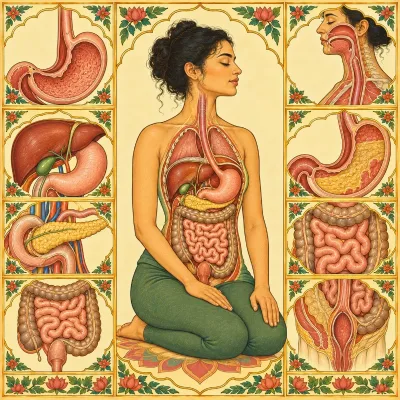
What it supports. Indian manuals say kuñjala helps keep a healthy person healthy, clears phlegm from the throat, freshens the breath and gives relief from excess bile and hyperacidity. Source Source The sources disagree about acidity, though: the NIOS teachers’ manual and The Yoga Institute list hyperacidity as a reason not to practise it. With acidity, ask your doctor and your teacher first.
Caution · kuñjala
- Do not practise with high blood pressure, heart disease or stomach ulcers. Source
- Also avoid it with hyperacidity, colitis, and eye conditions with weak blood vessels. Source Source
- With a hernia, or within three to six months of abdominal surgery, leave it out. Source
- Do not practise it in pregnancy. With any condition not listed here, ask your doctor first, and always learn it under a teacher.
P1.1 Ṣaṭkarma practical · kapālabhāti (vātakrama)
Kapālabhāti: the skull-shining breath
In one line
Short, strong breaths out, made by pulling the belly in, each followed by a breath in that happens by itself. Exhale actively; inhale passively.
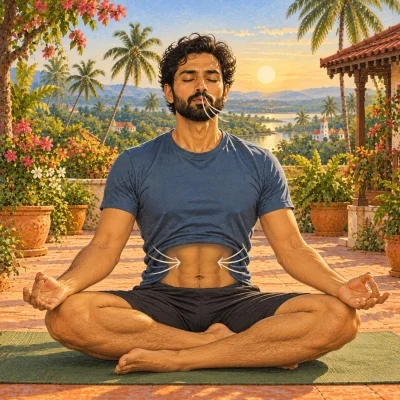
Kapāla is the skull and bhāti means light, or shining: the practice that makes the head shine, leaving it bright and clear. Source
भस्त्रावल्लोहकारस्य रेचपूरौ ससम्भ्रमौ ।
कपालभातिर्विख्याता कफदोषविशोषणी ॥bhastrāval lohakārasya recapūrau sasambhramau | kapālabhātir vikhyātā kaphadoṣaviśoṣaṇī ||
Breathing out and in quickly, like a blacksmith’s bellows: this is known as kapālabhāti, and it dries up the disorders of phlegm. HYP 2.35
Three methods in the GS. The HYP gives one method, the bellows. The Gheraṇḍa Saṁhitā gives three: vātakrama, with air; vyutkrama, drawing water in through the nose and letting it out of the mouth; and śītkrama, sucking water in through the mouth with a hissing sound and letting it out through the nose. Source The syllabus asks for vātakrama. One detail for the exam: the GS describes vātakrama as breathing in through one nostril and out through the other, quickly and without holding the breath. Source The method taught today, and in the Ayush Common Yoga Protocol, uses both nostrils with active exhalations and passive inhalations. That is the HYP bellows. GS verse numbers for the three methods differ between editions, so cite them as GS chapter 1.
In the prescribed books. The Bihar School edition of the Hatha Yoga Pradipika explains the verse above in Swami Muktibodhananda’s commentary, and B.K.S. Iyengar’s Light on Yoga describes kapālabhāti among its prāṇāyāmas. The Ministry of Ayush’s Common Yoga Protocol, the sequence for the International Day of Yoga, includes it. Source IGNOU notes that it is very close to bhastrikā; the prāṇāyāma unit sets the two side by side.
Animation · kapālabhāti
The belly is the pump
20 of 20 strokes
Round 1 of 3
Active exhale · passive inhale
Sharp peak: active, forceful breath out Slow slope: passive breath in Gentle waves: deep breath, then rest
Each stroke is a short, strong breath out as the belly snaps in, then a passive breath in as it lets go. After 20 strokes, the beginner’s count, breathe in deeply, breathe out slowly, and rest with normal breathing.
Step by step
- Sit in a meditative posture, such as Sukhāsana, Padmāsana or Vajrāsana. Close the eyes and relax the whole body.
- Breathe in deeply through both nostrils.
- Breathe out with a quick, forceful contraction of the abdominal muscles, and relax. The breath in follows by itself.
- Keep the chest and shoulders still: the movement is in the belly.
- Continue: active breath out, passive breath in. The protocol completes 30 rapid breaths; beginners can do up to 20. Then breathe in deeply and breathe out slowly. That is one round.
- Rest, still, after each round. Do three rounds, and increase the count only gradually, over time.
Steps from the Ayush Common Yoga Protocol. The protocol sets no speed: start slowly, and let it stay easy. Practise on an empty stomach. NIOS says the breath is not held in kapālabhāti Source, though its teachers’ manual adds a hold after each round; as a beginner, follow the protocol and do not hold.
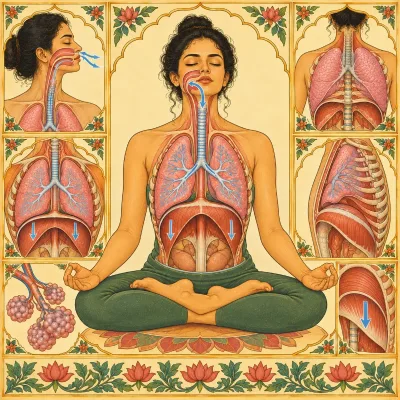
What it supports. The Ayush protocol says kapālabhāti purifies the frontal air sinuses and helps with cough; it lists it as useful for colds, rhinitis, sinusitis, asthma and bronchial infections, and says it strengthens the nervous system and tones the digestive organs. Source It is a supporting practice, not a treatment: with asthma or any lung condition, keep working with your doctor.
Caution · kapālabhāti
The Ayush protocol says to avoid it with heart conditions, high blood pressure, giddiness or vertigo, chronic nosebleeds, epilepsy, migraine, stroke, hernia or a gastric ulcer, in pregnancy and during menstruation. Source After abdominal surgery, wait three to six months. Source It heats the body: NIOS advises against long practice in summer. Source
1.13 Principles of ṣaṭkarma · safety
Safety: who should wait, and when to stop
In one line
Learn each kriyā in person, practise it gently, and stop at the first sign that something is wrong. With any medical condition, yoga complements treatment: work with your doctor.
Who should not practise
| Practice | Avoid it with |
|---|---|
| Jala and sūtra neti | an ear or throat infection; a blocked nose or heavy cold; an unhealed wound on the face. Ask a doctor first after surgery on the nose, sinuses or ears, or with frequent nosebleeds. |
| Kuñjala | high blood pressure; heart disease; stomach ulcers, colitis or hyperacidity; eye conditions with weak blood vessels; a hernia; recent abdominal surgery; pregnancy. |
| Kapālabhāti | heart conditions; high blood pressure; giddiness or vertigo; chronic nosebleeds; epilepsy; migraine; stroke; hernia; gastric ulcer; pregnancy; menstruation; recent abdominal surgery. |
Gathered from the sources in each section above: NIOS, IGNOU, the Ayush Common Yoga Protocol, The Yoga Institute and Art of Living.
When to stop
- Neti: pain, burning, a headache, bleeding, or water going into the ear. Stop, blow out gently and dry the nose.
- Kuñjala: chest pain, blood in the water, or retching that will not settle. Stop and get medical help.
- Kapālabhāti: dizziness, tingling, faintness or strain. Stop, breathe normally and rest.
Why a teacher
Every Indian source here says the same thing: practise under an expert, or on your own only once you are competent. Source A teacher checks the salt and warmth of the water, your head position, your breath, and whether a kriyā suits you at all. Kaivalyadhama, for one, teaches ṣaṭkarma in on-campus workshops. Source
After practice
- Dry the nose fully after neti.
- Rest after kuñjala and eat light, sattvic food: khichdi, nothing spicy, no tea or coffee that day.
- After kapālabhāti, sit still for a while with the eyes closed.
- Leave about fifteen minutes before tea, coffee, juice or a bath, and half an hour before a meal. Source
Using yoga alongside treatment for a condition is covered in the yoga therapy unit.
Quick revision
Test yourself
What does ṣaṭkarma mean, and which verse lists the six?
“Six actions”: six cleansing practices. HYP 2.22 lists them: dhauti, basti, neti, trāṭaka, nauli and kapālabhāti. GS 1.12 has the same six, calling nauli laulikī.
According to HYP 2.21, who should practise ṣaṭkarma first?
Someone with excess fat (medas) or phlegm (śleṣma). Those whose three doṣas are balanced need not. The GS, by contrast, makes cleansing the first step for everyone.
Name the four kinds of dhauti in the Gheraṇḍa Saṁhitā.
Antar dhauti, danta dhauti, hṛd dhauti and mūla śodhana (GS 1.13).
Kuñjala belongs to which kind of dhauti?
Vamana dhauti, one of the three hṛd dhautis (with daṇḍa and vāsa dhauti).
In jala neti, which way do you tilt the head to pour into the left nostril, and how do you breathe?
Tilt to the right, so the left nostril is upper. Breathe through the open mouth throughout.
What should follow jala neti?
Drying the nose: kapālabhāti (NIOS) or bhastrikā-style breaths (IGNOU) to clear the last water, then rest in Śaśāṅkāsana.
In kapālabhāti, which part of the breath is active?
The breath out, by a quick contraction of the abdominal muscles. The breath in is passive.
Name the three kapālabhātis of the Gheraṇḍa Saṁhitā.
Vātakrama (with air), vyutkrama (water in through the nose, out of the mouth) and śītkrama (water in through the mouth, out of the nose).
Give four conditions in which the Ayush protocol says to avoid kapālabhāti.
Any four of: heart conditions, high blood pressure, giddiness or vertigo, chronic nosebleeds, epilepsy, migraine, stroke, hernia, gastric ulcer, pregnancy, menstruation.
Is ṣaṭkriyā the same as Patañjali’s kriyā yoga?
No. Kriyā yoga (YS 2.1) is tapas, svādhyāya and īśvara praṇidhāna. Ṣaṭkriyā are the six haṭha cleansing practices.
Sources
Where this comes from
- Prescribed books. Hatha Yoga Pradipika, with commentary by Swami Muktibodhananda (Bihar School of Yoga / Yoga Publications Trust, Munger): chapter 2 sets out all six kriyās, and HYP verse numbers here follow this edition. B.K.S. Iyengar, Light on Yoga (kapālabhāti among the prāṇāyāmas). Patañjali’s Yoga Sūtra (YS 2.1, 2.32). Explained here in my own words.
- Classical texts. Haṭha Yoga Pradīpikā 2.21, 2.22, 2.29, 2.30, 2.35, 2.36; Gheraṇḍa Saṁhitā 1.12, 1.13 and the rest of chapter 1.
- NIOS, Physical Education and Yog, Lesson 19: Shatkarma and Lesson 18: Hatha Yog.
- NIOS, Yoga Teachers’ Training Programme, practical manual (kuñjala, jala neti, kapālabhāti).
- IGNOU eGyanKosh, Unit 3: Shat-karma (cleansing techniques), and Unit 19: Yoga therapy, mental health and well-being.
- Ministry of Ayush, Common Yoga Protocol (kapālabhāti: technique, benefits, cautions).
- Morarji Desai National Institute of Yoga, Yogic practices for high blood pressure.
- Yoga Certification Board, syllabus: the practical lists sūtra and jala neti, vamana dhauti (kuñjala) and kapālabhāti (vātakrama).
- P. Patidar and K. Yadav, a review of ṣaṭkarma in the HYP and GS, Journal of Ayurveda and Integrated Medical Sciences, 2023 (verse numbers, sub-types, HYP–GS differences).
- Karuna Yoga Vidya Peetham, Bengaluru, Haṭha Yoga Pradīpikā chapter 2 (text of 2.21, 2.22, 2.36).
- Kaivalyadhama, Shuddhi kriya (shatkarma).
- Bihar School of Yoga, Hatha yoga.
- The Yoga Institute, Mumbai: jala neti, yoga for asthma, vaman dhauti.
- Art of Living, jal neti.