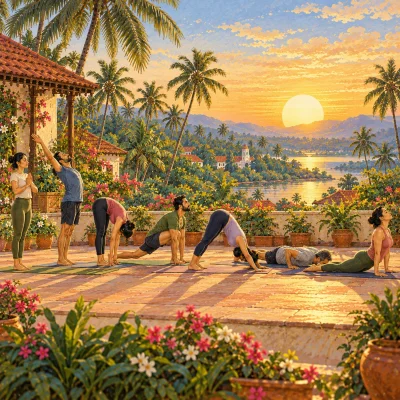
1.12 · P1.2 Yogic sūkṣma vyāyāma
Sūkṣma vyāyāma: waking up every joint
In one line
Sūkṣma vyāyāma is a set of small, slow movements for each joint, from the neck down to the ankles, done with the breath and with full attention. It loosens the joints and brings blood into the smallest vessels before āsana.

What the words mean
Sūkṣma means subtle or fine. Vyāyāma means exercise. Its partner word, sthūla, means gross or large: what anyone can see without paying attention (see the class notes of 11 October). NIOS describes sūkṣma vyāyāma as mild, easy exercises with deep effects, meant to move every joint in a comfortable, smooth and balanced way before āsana. Source
The Ministry of Ayush’s Common Yoga Protocol (CYP), the sequence taught for the International Day of Yoga, calls these practices Sadilaja / Cālana kriyā, the loosening practices. In its words, they help increase microcirculation, and they can be done standing or sitting. Source
Where the series comes from
The best-known series was set out by Swami Dhirendra Brahmachari in his book Yogic Sūkṣma Vyāyāma. Its practices carry names such as Grīvā Śakti Vikāsaka: grīvā is the neck, and śakti vikāsaka means “developer of strength”. The Yoga Certification Board lists his book, and an MDNIY monograph on the same series, as references for the practical exam. Source The CYP’s textual notes trace its loosening practices to his book and to an older haṭha text, the Haṭhatattvakaumudī. Source
The Bihar School has its own joint-by-joint set. In Swami Satyananda Saraswati’s Asana Pranayama Mudra Bandha, one of the prescribed books, it is the first part of the Pavanamuktāsana series, called the anti-rheumatic group: gentle movements done sitting, from the toes up to the neck. Its shoulder rotation has the same name as in the CYP, Skandha Cakra. Source
Five principles
Slow
Rhythmic, never jerky
Safe, repetitive movements. The CYP says plainly: do not hold the body tight or jerk it.
Breath
Each movement has a breath
Usually: breathe out as you bend, twist or lower; breathe in as you rise or return.
Awareness
Mind on the joint
NIOS names three features: breath awareness, attention on the joint that moves, and breath timed with the movement.
Comfort
Only as far as is easy
Move “as far as possible” but “do not over strain” (CYP). Work to your own capacity.
Why it matters in sādhana
Sādhana is steady, regular practice. In my class the order was clear: kriyās first, then sthūla and sūkṣma vyāyāma, then āsana, with relaxation as part of the āsana practice (class notes, 11 October). Three reasons:
- Safety. Joints that have moved through their range are ready for āsana. Going straight into hard or twisting postures without warming up raises the risk of injury to muscles and tissues.
- Circulation. At the fingers and toes the blood moves through very fine vessels, the microcirculation. The CYP says these practices “help to increase microcirculation”.
- Attention. The body is gross; the attention you bring to each joint is subtle. Sūkṣma vyāyāma is the first training of that attention, and the habit carries into āsana, prāṇāyāma and meditation.
Animation · Joint map
Tap a joint to see it move
Choose a joint, or let the tour visit each one.
The practices, step by step P1.2
These follow the CYP for the neck, shoulders, trunk and knees, and NIOS for the wrists, elbows and ankles. Begin standing in Samasthiti, the alert posture: feet a few inches apart, arms by the sides. The CYP notes this is also called Tāḍāsana.
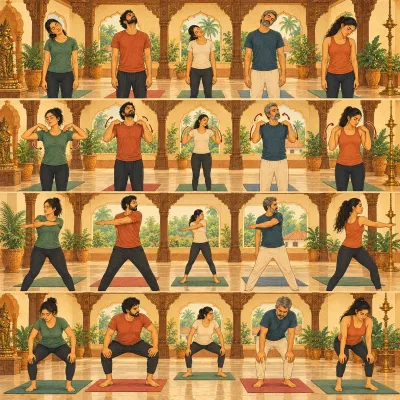
Neck: Grīvā Śakti Vikāsaka (CYP)
Hands on the waist, shoulders relaxed and still. Three rounds of each stage.
- Forward and back. Breathe out and lower the head, bringing the chin toward the chest. Breathe in and lift the head, bending it back only as far as is comfortable.
- Side to side. Breathe out and bend the head to the right, ear toward the shoulder, without raising the shoulder. Breathe in to centre. Repeat to the left.
- Turning. Breathe out and turn the head to the right until the chin is in line with the shoulder. Breathe in to centre. Repeat to the left.
- Rotation. Breathe out, chin to chest. Breathe in as the head circles up and back; breathe out as it comes down. One full circle clockwise, then anticlockwise.
Shoulders (CYP)
- Shoulder stretch. Feet together, arms by the sides. Breathe in and raise both arms sideways above the head, palms open, fingers together. Breathe out and lower them the same way.
- Skandha Cakra, shoulder rotation. Place the fingertips of each hand on the same shoulder. Draw large circles with the elbows: let them touch in front of the chest as they come forward, stretch back, and brush the sides of the trunk as they come down.
- Breathe in as the elbows rise, breathe out as they come down. Two rounds front to back, then two in reverse.
Wrists and elbows (NIOS)
- Wrists. Stretch the arms straight forward at shoulder level, parallel to the floor. Make tight fists, palms down. Move the fists up and down from the wrists, ten rounds. Many teachers also circle the fists both ways.
- Elbows. Arms straight down by the sides, palms forward, fists closed. Bend at the elbows to bring the fists up toward the shoulders, then straighten them down again. NIOS suggests twenty times.
- Breathe normally throughout.
Trunk: Kaṭi Śakti Vikāsaka (CYP)
- Stand with the feet about 2–3 feet apart. Raise both arms to shoulder level in front, palms facing each other, arms parallel.
- Breathe out and twist to the left, so the right palm comes to the left shoulder. Breathe in and return to the centre.
- Breathe out and twist to the right, so the left palm comes to the right shoulder. Breathe in and return.
- That is one round; do two more, slowly, with the breath. Relax in Samasthiti.
Knees (CYP, with the NIOS seated version)
- Half squat (CYP). Breathe in and raise the arms forward to shoulder level, palms down. Breathe out and bend the knees into a half squat, arms and thighs parallel to the floor. Breathe in and straighten. Breathe out and lower the hands. Three rounds.
- Knee bending, seated (NIOS). Sitting with the legs straight, hold the right thigh from below. Bend the knee to bring the thigh near the chest and the heel near the buttock, then straighten the leg with the heel just off the floor. Ten rounds a side, normal breathing.
- Knee rotation, seated (NIOS). Hold the right thigh with interlocked hands, knee bent to 90°, and circle the lower leg from the knee, five times each way. Then the left.
In my class, knee bending forward and backward joined the warm-up on 6 September.
Ankles (NIOS)
- Sit with the legs stretched out, feet about six inches apart, hands behind you, fingers pointing back. Lean back a little; keep the spine and neck upright.
- Bending. Slowly point the feet forward toward the floor, then pull them back toward the knees, holding each end for a few seconds. Ten times.
- Rotation. Separate the legs about a foot. Rotate both feet from the ankles together, in opposite directions, so the big toes touch on the inward turn. Ten rounds, then change direction. Normal breathing; this can also be done sitting on a chair.
The names in the YCB syllabus
The Yoga Certification Board lists the micro-circulation practices by their Sanskrit names. Śakti vikāsaka in each means “developer of strength”. Source
| Movement | Practice names | Key word |
|---|---|---|
| Neck | Grīvā Śakti Vikāsaka (I–IV) | grīvā, neck |
| Shoulder | Bhuja Vallī Śakti Vikāsaka; Pūrṇa Bhuja Śakti Vikāsaka | bhuja, arm; pūrṇa, whole |
| Trunk | Kaṭi Śakti Vikāsaka (I–V) | kaṭi, waist |
| Knee | Jaṅghā Śakti Vikāsaka; Jānu Śakti Vikāsaka | jaṅghā, leg; jānu, knee |
| Ankle | Pāda-mūla Śakti Vikāsaka; Gulpha-pāda-pṛṣṭha-pāda-tala Śakti Vikāsaka | gulpha, ankle; pāda, foot |
Take care
- Neck pain: go gently, especially when taking the head back. Elderly people and people with chronic cervical spondylitis may avoid the neck practices (CYP).
- Trunk twist: heart patients should do it with care. Avoid it with severe back pain, vertebral or disc problems, and during menstruation (CYP).
- Knees: avoid the half squat during acute arthritis (CYP).
- With any chronic disease, pain or heart problem, ask a doctor or a yoga therapist before you start (CYP).
1.12 · P1.2 Yogic sthūla vyāyāma
Sthūla vyāyāma: the whole body warms up
In one line
Sthūla vyāyāma uses large, brisk, whole-body movements, such as jogging on the spot and big bends, to warm the large muscles, raise the circulation and build stamina. Sūkṣma works joint by joint; sthūla works the body as one.
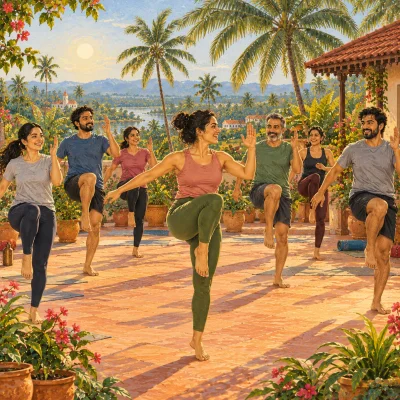
The Yoga Certification Board pairs the two: sūkṣma vyāyāma are the micro-circulation practices, sthūla vyāyāma the macro-circulation practices. For sthūla it names two: Sarvāṅga Puṣṭi (sarva-aṅga, all the limbs; puṣṭi, nourishment) and Hṛd Gati, also called Engine Dauṛ, the “engine run”. Source
NIOS describes sthūla vyāyāma as practices that loosen the joints and prepare the body for āsana, and notes it has been called the locomotive exercise, because the movement resembles a locomotive. Its aims: loosen the joints, make the spine flexible through repeated stretching and relaxing, shake off lethargy, and build stamina. It prepares the spine for its five movements: bending forward, bending back, bending sideways, twisting, and lengthening. Source In my class, sthūla vyāyāma meant the bigger movements of the warm-up: arm rotations, raising the knees, hip rotations (11 October).
The practices P1.2
NIOS
Jogging on the spot
Loose fists on the chest, shoulders relaxed. Four stages, about 20 counts each, with slow jogging in between: slow jogging on the toes; backward, heels toward the buttocks; forward, knees up toward the chest; sideways, heels flicked out. Build speed gradually and keep moving until all four are done.
NIOS
Mukha dhauti
After jogging: bend forward with the hands on the thighs, breathe in through the nose and blow the air out forcefully through the mouth. Then stand and relax. It releases the strain of jogging.
NIOS
Bending back and forward
Arms overhead, palms facing out. Breathe in and bend back; breathe out and bend forward. Start slowly and build speed, bending from the lower waist; never past your limit.
NIOS
Twisting
Feet about a metre apart, arms out at shoulder height. Twist to one side, the leading arm straight and the eyes on its fingertips, the other hand to the chest; return with a breath in. Twist above the waist only, knees straight.
NIOS
Side bending
Feet about a metre apart, arms out. Breathing out, bend to the right, the right hand sliding toward the right heel, eyes on the raised left palm. Breathe in to come up. Four or five times a side.
Ayush module
Sarvāṅga Puṣṭi
Feet wide, about twice shoulder width. Fists closed with the thumbs inside, arms overhead, crossed at the wrists. Stretch up with a breath in, fold forward with a breath out, then circle the trunk slowly: across to one side, up and back, over to the other side and down between the feet. About ten slow rounds each way. Source
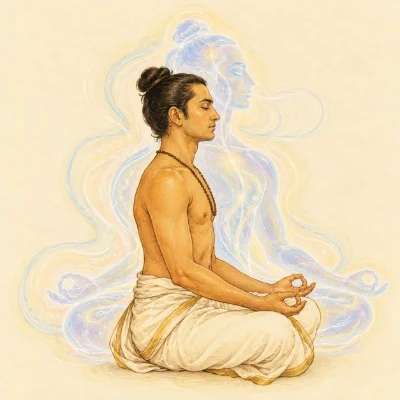
Sūkṣma and sthūla side by side
| Sūkṣma vyāyāma | Sthūla vyāyāma | |
|---|---|---|
| Word | subtle, fine | gross, large |
| YCB calls it | micro-circulation practices | macro-circulation practices |
| Works on | one joint at a time: neck, shoulders, trunk, knees, ankles | the whole body and the big muscles |
| Pace | slow, steady | brisk, building speed gradually |
| Breath | one breath per movement | rhythmic; a forceful breath out in mukha dhauti |
| Examples | neck bending, Skandha Cakra, Kaṭi Śakti Vikāsaka | jogging, bends and twists, Sarvāṅga Puṣṭi, Hṛd Gati |
| Leaves you | loose, attentive, calm | warm, energised, ready |
Take care
- Increase speed slowly, never beyond your limit (NIOS). Stop if you feel dizzy or very breathless.
- With heart disease, high blood pressure or chronic pain, ask your doctor or a yoga therapist first (CYP), and ask your teacher for a gentler version without jogging or fast bends.
- Practise on an empty or light stomach, on a mat, in loose cotton clothes (CYP).
1.12 · P1.4 Sūrya Namaskāra with mantra
Sūrya Namaskāra: twelve steps, twelve names of the sun
In one line
Sūrya Namaskāra, the salutation to the sun, is a round of twelve linked postures, each done with one breath and, in the mantra form, one name of the sun. It moves the whole spine and body, steadies the breath, and gives thanks to the sun that sustains life.
Sūrya is the sun; namaskāra is a salutation. NIOS calls the sun the source of every creation on the planet and a symbol of spiritual consciousness, and the practice a chance to give thanks for life. Source The Bihar School of Yoga traces it to the Vedic period, when the sun was worshipped as a powerful symbol of spiritual consciousness, and describes its twelve postures as weaving together to generate prāṇa, subtle energy. Source
Why it matters, in four words:
- Body. Forward and backward bends alternate, stretching the spine and the muscles of the legs, back, chest and arms (NIOS).
- Breath. Every position has its own breath: in as you open or rise, out as you fold.
- Prāṇa. Movement, breath and attention together build and steady the body’s energy.
- Devotion. Each name of the sun is a quality to remember: friendship, light, strength, nourishment.
In a session it comes between the loosening practices and the āsanas, and it is usually done at sunrise, facing the sun. Source That Ayush yoga module opens it with this prayer from the Īśa Upaniṣad:
हिरण्मयेन पात्रेण सत्यस्यापिहितं मुखम् । तत्त्वं पूषन्नपावृणु सत्यधर्माय दृष्टये ॥hiraṇmayena pātreṇa satyasyāpihitaṁ mukham | tat tvaṁ pūṣann apāvṛṇu satya-dharmāya dṛṣṭaye ||
The face of truth is hidden by a golden lid. O Pūṣan, nourishing sun, uncover it, so that I, who hold to truth, may see. Īśa Upaniṣad 15 (numbering differs between recensions)
Animation · The wheel of twelve
One round of Sūrya Namaskāra
Position 1 of 12
Praṇāmāsana
Prayer pose
Breathe out
ॐ मित्राय नमः
Om Mitrāya Namaḥ
Salutation to the friend of all.
Feet together, palms joined at the chest. Settle, and breathe out.
With its bīja: Om hrāṁ Mitrāya Namaḥ
Press Play, or choose a position on the wheel.
The twelve positions P1.4
This is the Bihar School sequence, as Swami Satyananda Saraswati teaches it in Asana Pranayama Mudra Bandha. The Yoga Institute’s twelve steps use the same breathing. Source The twelve names of the sun are from the Ayush yoga module; the short meanings are my own wording. Source
| # | Position | Breath | Mantra | Meaning |
|---|---|---|---|---|
| 1 | Praṇāmāsana, prayer pose: feet together, palms joined at the chest | Out | ॐ मित्राय नमः Om Mitrāya Namaḥ | to the friend of all |
| 2 | Hasta Utthānāsana, raised arms pose: arms up, a gentle backbend | In | ॐ रवये नमः Om Ravaye Namaḥ | to the shining one |
| 3 | Pādahastāsana, hand to foot pose: fold forward, palms beside the feet | Out | ॐ सूर्याय नमः Om Sūryāya Namaḥ | to the one who stirs all into activity |
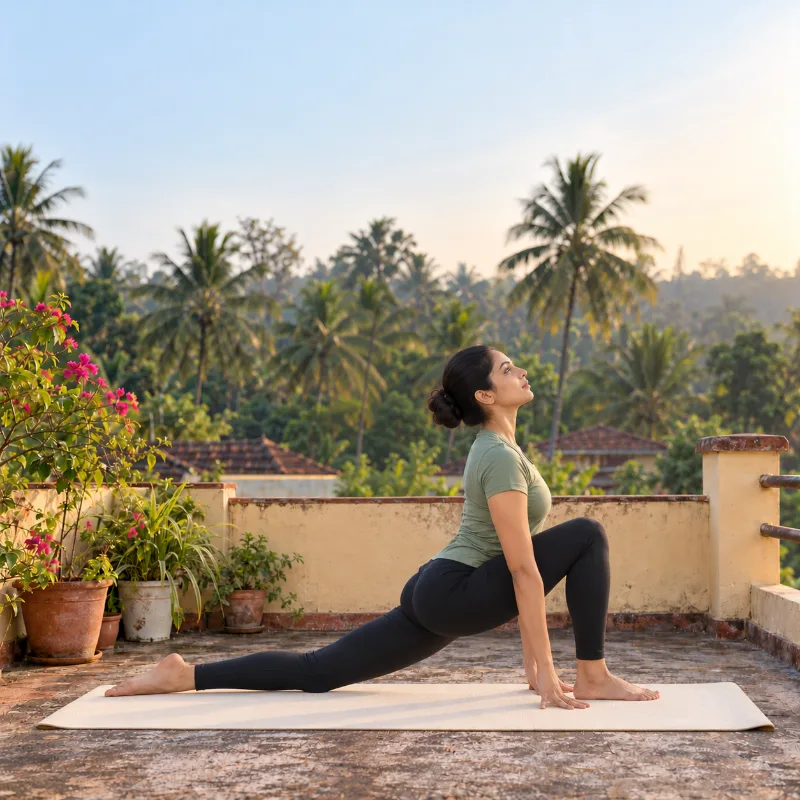
| 4 | Aśva Sañcalanāsana, equestrian pose: right leg back, knee down, look up | In | ॐ भानवे नमः Om Bhānave Namaḥ | to the one who gives light |
| 5 | Parvatāsana, mountain pose: both feet back, hips high, heels toward the floor | Out | ॐ खगाय नमः Om Khagāya Namaḥ | to the one who moves through the sky |
| 6 | Aṣṭāṅga Namaskāra, salute with eight parts: toes, knees, hands, chest and chin on the floor, hips raised | Hold out | ॐ पूष्णे नमः Om Pūṣṇe Namaḥ | to the one who nourishes and gives strength |
| 7 | Bhujaṅgāsana, cobra pose: slide forward, lift the chest | In | ॐ हिरण्यगर्भाय नमः Om Hiraṇyagarbhāya Namaḥ | to the golden womb, the cosmic self |
| 8 | Parvatāsana again | Out | ॐ मरीचये नमः Om Marīcaye Namaḥ | to the lord of rays, of the dawn |
| 9 | Aśva Sañcalanāsana: right foot forward between the hands, left knee down | In | ॐ आदित्याय नमः Om Ādityāya Namaḥ | to the son of Aditi, the cosmic mother |
| 10 | Pādahastāsana: left foot forward, fold | Out | ॐ सवित्रे नमः Om Savitre Namaḥ | to the power that awakens and gives life |
| 11 | Hasta Utthānāsana: rise, arms overhead | In | ॐ अर्काय नमः Om Arkāya Namaḥ | to the one worthy of praise |
| 12 | Praṇāmāsana: palms back to the chest | Out | ॐ भास्कराय नमः Om Bhāskarāya Namaḥ | to the maker of light, who leads to wisdom |
Aṣṭāṅga Namaskāra is named for its eight points of contact: the two feet, two knees, two hands, the chest and the chin. Positions 8 to 12 retrace 5 to 1. Many teachers lead with the right leg in one round and the left leg in the next, so both sides work equally.
The bīja mantras
A bīja is a seed: a one-syllable sound with no dictionary meaning, chanted for its vibration. In the bīja form, six seeds are placed before the twelve names, and the six come round twice. NIOS pairs them like this: Om hrāṁ Mitrāya Namaḥ, Om hrīṁ Ravaye Namaḥ, and so on, starting again at position 7. Source The Bihar School teaches its Sūrya Namaskāra with both the sūrya and the bīja mantras. Source
ह्रां · ह्रीं · ह्रूं · ह्रैं · ह्रौं · ह्रःhrāṁ · hrīṁ · hrūṁ · hraiṁ · hrauṁ · hraḥ
There are other ways to chant. Art of Living suggests one name at each step, or one name for a whole round, so that twelve rounds use all twelve names. Source The Yoga Institute treats the chanting as optional. Source
Other versions
Indian schools do not all use the same twelve steps. NIOS and the Ayush yoga module count from Hasta Utthānāsana and add Caturaṅga Daṇḍāsana or Tulāsana (a straight plank) and Śaśāṅkāsana; the Ayush module also teaches a faster ten-step round. Source Art of Living places Daṇḍāsana (plank) at step 5 and ends in Tāḍāsana. The idea is the same in each: alternate bends, one breath per movement. For the exam, learn the version your teacher demonstrates, and know that others exist.
How to practise
- Early morning, on an empty stomach, facing the rising sun if you can (NIOS).
- Breathe in on upward and backward bends, and out on forward bends (NIOS).
- Start with a few slow rounds. After each round close your eyes and rest; NIOS suggests feeling the light of the sun entering the body.
- Go only as far as your body allows, never beyond your capacity.
Who should avoid or modify it
- High blood pressure, heart conditions, vertigo, recent surgery or injury, hernia, abdominal inflammation, sciatica or a slipped disc: avoid full rounds, or modify them only with a teacher’s guidance. Source
- Back and joint problems: NIOS says not to practise with spinal or joint problems.
- Knee pain, heart or kidney problems, low back pain, retinopathy, or weak older people: the Ayush module advises avoiding it and doing a chair version instead.
- Pregnancy: avoid it unless a qualified teacher and your doctor approve a modified practice.
- Menstruation: views differ. Art of Living says it can be skipped; The Yoga Institute says gentle rounds may be fine for some. Follow your teacher and your own body. Source
- For any medical condition, yoga complements treatment; it does not replace it. Work with your doctor.
1.14 · P1.3 Yogāsana
Āsana: a posture that is steady and easy
In one line
An āsana is a body position held steady and at ease (Yoga Sūtra 2.46). Done with the breath and with attention, it trains the body and the mind together, and prepares a steady seat for prāṇāyāma and meditation.
Meaning and definitions
NIOS explains that āsana means to sit; the same word is used for the mat you sit on. In yoga it means a posture. Source Āsana is the third of the eight limbs of Patañjali’s Aṣṭāṅga Yoga, the Yoga darśana that Swami Harshananda’s Ṣaḍdarśana presents as one of the six systems. Patañjali gives the whole definition in three words:
स्थिरसुखमासनम् ॥ ४६ ॥sthira-sukham āsanam
A posture is steady (sthira) and comfortable (sukha). Yoga Sūtra 2.46
प्रयत्नशैथिल्यानन्तसमापत्तिभ्याम् ॥ ४७ ॥prayatna-śaithilyānanta-samāpattibhyām
It becomes so by loosening effort and letting the mind rest in the endless. Yoga Sūtra 2.47
ततो द्वन्द्वानभिघातः ॥ ४८ ॥tato dvandvānabhighātaḥ
From that, the pairs of opposites, heat and cold, pleasure and pain, no longer strike you. Yoga Sūtra 2.48
The very next sūtra (2.49) begins prāṇāyāma: once the posture is mastered, the breath can be regulated. Source The haṭha texts put āsana first of all:
हठस्य प्रथमाङ्गत्वादासनं पूर्वमुच्यते । कुर्यात्तदासनं स्थैर्यमारोग्यं चाङ्गलाघवम् ॥haṭhasya prathamāṅgatvād āsanaṁ pūrvam ucyate | kuryāt tad āsanaṁ sthairyam ārogyaṁ cāṅga-lāghavam ||
Āsana is taught first because it is the first limb of haṭha yoga. Practise it for steadiness, health and lightness of the body. Haṭha Yoga Pradīpikā 1.17. These notes follow the verse numbers of the Bihar School edition, with Swami Muktibodhananda’s commentary; some other editions number this verse 1.19.
How many āsanas are there? NIOS retells the tradition: as many as there are species of living beings, 84 lakh; of these, 84 are counted as important, and the Gheraṇḍa Saṁhitā (chapter 2) describes 32 in detail. Source For Patañjali, āsana mainly meant the meditative seat; haṭha yoga added many more postures (Haṭha yoga).
What Light on Yoga stresses
B.K.S. Iyengar’s Light on Yoga, first published in 1966, teaches each āsana step by step with photographs. The method that grew from it gives emphasis to precision and alignment in all postures. Source In plain words: place each part of the body with care, from the feet up, and watch it with full attention. When the body is placed well, it becomes steady; when the body is steady, the mind follows. An āsana done this way is not gymnastics but a training of attention, which is what Patañjali’s sthira sukham asks for.
Types of āsana
By purpose
Cultural, meditative, relaxative
Meditative: Padmāsana, Siddhāsana, Vajrāsana, Sukhāsana. Relaxative: Śavāsana, Makarāsana. Cultural: all the rest, which build and tone body and personality (NIOS). Source MDNIY groups them much the same way: for meditation, for relaxation, and for preventing disease and promoting health. Source
By position
Standing, sitting, prone, supine
Standing on the soles of the feet; sitting on the buttocks; prone, lying face down on the belly; supine, lying face up on the back (NIOS). Many lists add inverted and balancing āsanas.
By movement
How the spine moves
Forward bends, backward bends, side bends and twists, plus inversions and balances. A balanced practice includes each, and follows a bend with its counter-pose.
By motion
Dynamic and static
Dynamic: repeated movement with the breath, as in vyāyāma and Sūrya Namaskāra. Static: come into the pose and hold it still with normal breathing. MDNIY describes āsanas as postures that steady the mind through static stretching. Source
Animation · Āsana families
The practical syllabus, sorted two ways
Standing on the feet
Sitting on the seat
Prone face down
Supine face up
Cultural build and tone
Meditative seats for stillness
Relaxative rest
By body position: standing on the feet, sitting on the seat, prone on the belly, supine on the back. Tap a chip to open its pose card.
The practical syllabus P1.3
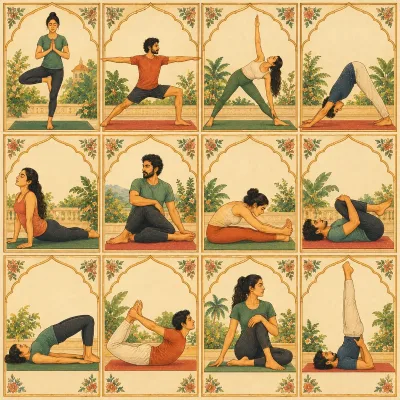
The chips above are the full list: 7 standing, 12 sitting, 4 prone and 10 supine. Each opens its card in the āsana library, with steps, benefits and precautions. Two notes:
- Ūrdhva Hastottānāsana. MDNIY describes it as a standing side bend: fingers interlocked overhead, bending from the waist to one side, then the other. Source The library card shows the related raised-arms pose, Hastottānāsana. Check which one your teacher expects.
- “Ashwasthasana”. This name is unclear in the syllabus. It may be Aśvatthāsana, the peepal-tree pose, but no Indian source I could find, including the Yoga Certification Board syllabi, describes a pose by this name, so it is not described here. If you are studying the same syllabus, ask your teacher which pose is meant.
Principles of practice
Before:
- An empty or light stomach; bladder and bowels empty (CYP).
- A clean, calm, airy place; a mat or folded blanket; light, loose cotton clothes (CYP, NIOS).
- Not when exhausted, ill, hurried or acutely stressed (CYP).
- The golden rule from class: practise daily at the same time, in the same place, facing the same direction.
During:
- Breath. Breathe through the nose unless told otherwise, and never hold the breath unless the practice asks for it (CYP). In a held pose, breathe normally (NIOS).
- Awareness. Move slowly, aware of the body and the breath (CYP).
- No strain. No jerks, no force; work to your capacity (CYP).
- Hold, then release. Come into the final position, stay steady and easy for a while, and come out as slowly as you went in.
- Counter-pose. Follow a bend with its opposite: a resting forward bend after backbends, or a backbend such as Matsyāsana after the shoulder stand. Source
- Sequence. The CYP moves from standing to sitting, then prone, then supine postures, and ends in Śavāsana.
After: rest in Śavāsana. Wait 20–30 minutes before bathing or eating (CYP).
Significance in sādhana
- Steadiness. A body that can stay still and at ease is the base for everything that follows (YS 2.46).
- Health and lightness. The Haṭha Yoga Pradīpikā names steadiness, health and lightness of the body as the fruits of āsana (HYP 1.17).
- Prāṇa. NIOS: as steadiness grows, prāṇa moves freely and the body becomes supple.
- Mind. MDNIY calls āsanas psycho-physical, “not mere physical exercises”. A steady pose brings a steadier mind, and the pairs of opposites trouble you less (YS 2.48).
- The next step. Prāṇāyāma follows once the seat is mastered (YS 2.49), and meditation needs a seat you can forget. See prāṇāyāma and dhyāna.
Take care
Every āsana has its own contraindications; read the precautions on each pose card. With chronic disease, pain or heart problems, consult a physician or yoga therapist before you begin, and ask a yoga expert about practice during pregnancy and menstruation (CYP). Yoga supports health; it does not replace medical treatment.
Exam practice
Quick revision
What is the difference between sūkṣma and sthūla vyāyāma?
Sūkṣma (subtle) vyāyāma moves one joint at a time, slowly and with the breath; the YCB calls these micro-circulation practices. Sthūla (gross) vyāyāma moves the whole body briskly, as in jogging, bends and Sarvāṅga Puṣṭi; the YCB calls these macro-circulation practices.
Name the four loosening practices of the Common Yoga Protocol. What do they improve?
Neck bending (Grīvā Śakti Vikāsaka), shoulder movement (including Skandha Cakra), trunk movement (Kaṭi Śakti Vikāsaka) and knee movement. The CYP says they help increase microcirculation.
Whose series of sūkṣma vyāyāma uses names like “Grīvā Śakti Vikāsaka”, and what does śakti vikāsaka mean?
Swami Dhirendra Brahmachari’s, from his book Yogic Sūkṣma Vyāyāma. Śakti vikāsaka means developer of strength; grīvā is the neck.
List the twelve positions of Sūrya Namaskāra (Bihar School) with their breath.
1 Praṇāmāsana (out), 2 Hasta Utthānāsana (in), 3 Pādahastāsana (out), 4 Aśva Sañcalanāsana (in), 5 Parvatāsana (out), 6 Aṣṭāṅga Namaskāra (hold out), 7 Bhujaṅgāsana (in), 8 Parvatāsana (out), 9 Aśva Sañcalanāsana (in), 10 Pādahastāsana (out), 11 Hasta Utthānāsana (in), 12 Praṇāmāsana (out).
Give the twelve mantras of Sūrya Namaskāra in order.
Om Mitrāya, Ravaye, Sūryāya, Bhānave, Khagāya, Pūṣṇe, Hiraṇyagarbhāya, Marīcaye, Ādityāya, Savitre, Arkāya, Bhāskarāya, each followed by Namaḥ.
What are the bīja mantras, and how are they used?
Six seed syllables, hrāṁ, hrīṁ, hrūṁ, hraiṁ, hrauṁ, hraḥ, placed before the names of the sun (Om hrāṁ Mitrāya Namaḥ, and so on). The six repeat, so positions 7–12 use them again.
Which parts of the body touch the floor in Aṣṭāṅga Namaskāra?
Eight parts: two feet (toes), two knees, two hands, the chest and the chin. The hips stay raised.
Define āsana according to Patañjali, and say what the next two sūtras add.
Sthira-sukham āsanam (YS 2.46): a posture is steady and comfortable. YS 2.47: it is perfected by loosening effort and resting the mind in the endless. YS 2.48: then the pairs of opposites do not disturb.
What does the Haṭha Yoga Pradīpikā say about āsana?
HYP 1.17 (Bihar School numbering; 1.19 in some editions): āsana is described first because it is the first limb of haṭha yoga, and it gives steadiness, health and lightness of the body.
Classify āsanas by purpose, with two examples of each.
Meditative: Padmāsana, Vajrāsana. Relaxative: Śavāsana, Makarāsana. Cultural (all the rest): for example Bhujaṅgāsana, Trikoṇāsana.
Sources
Where this comes from
- Prescribed books used here: Swami Satyananda Saraswati, Asana Pranayama Mudra Bandha (Bihar School of Yoga / Yoga Publications Trust, Munger) for the Sūrya Namaskāra sequence and the Pavanamuktāsana series; Hatha Yoga Pradipika, with commentary by Swami Muktibodhananda (Bihar School of Yoga / Yoga Publications Trust, Munger), whose verse numbers these notes follow; B.K.S. Iyengar, Light on Yoga; Swami Harshananda, Ṣaḍdarśana: the six systems of Hindu philosophy (Ramakrishna Math); Patañjali’s Yoga Sūtra. Explained here in my own words, without quotations.
- Classical texts: Yoga Sūtra 2.46–2.49; Haṭha Yoga Pradīpikā 1.17 (Bihar School numbering); Gheraṇḍa Saṁhitā, chapter 2; Īśa Upaniṣad 15.
- Ministry of Ayush, Common Yoga Protocol: general guidelines, loosening practices, sequence and textual references.
- MDNIY, Yogāsana booklet and Yogic practices for healthy living chart, on yoga.ayush.gov.in.
- Yoga Certification Board, Yoga Wellness Instructor syllabus: sūkṣma and sthūla practice names, practical references.
- NIOS Yoga, Level A: Yogic sūkṣma vyāyāma, Sthūla vyāyāma, Sūrya Namaskār; Level B: Āsanas (types, bīja mantras); Physical Education and Yog: Āsana.
- Ayush, Yoga-based lifestyle module for diabetes mellitus on Vikaspedia: Sarvāṅga Puṣṭi, the twelve names of the sun, cautions.
- Bihar School of Yoga, Asana and pranayama: origin and purpose of Sūrya Namaskāra; YOGA magazine, February 2018: Pavanamuktāsana series 1, the anti-rheumatic group.
- The Yoga Institute, Surya Namaskar steps and who should avoid or modify.
- Art of Living, Surya Namaskar mantras, 108 Surya Namaskar, Fish pose.
- Swami Vivekananda, Patañjali’s Yoga Aphorisms, chapter II (sūtra text).
- Ramamani Iyengar Memorial Yoga Institute, About Iyengar Yoga.
- My class notes: 6 September, 20 September, 11 October.