Yoga Theory
Patañjali and the Yoga Sūtras
We began with the story of the birth of Ṛṣi Patañjali, the compiler of the Yoga Sūtras.
Aṣṭāṅga Yoga: the eight limbs
- Yama
- Niyama
- Āsana
- Prāṇāyāma
- Pratyāhāra
- Dhāraṇā
- Dhyāna
- Samādhi
Each limb has a short explanation in the open library.
The four pādas (chapters) of the Yoga Sūtras
- Samādhi Pāda
- Sādhana Pāda
- Vibhūti Pāda
- Kaivalya Pāda
We also met the term citta-bhūmi, the levels or states of the mind.
Homework
Listen to the Viṣṇu Sahasranāma and try to chant along. Inhale as a line begins and exhale by the end of it. Try Anuloma-Viloma while listening. At the end, simply listen to the stotra peacefully.
Yoga Practical
A steady, comfortable seat
Warm-up
One new step joins the general warm-up routine: knee bending, forward and backward, done after the alternate toe-touch.
Sthira sukham āsanam
“The posture should be steady and comfortable” (Yoga Sūtra 2.46). For prāṇāyāma, that means a sitting position you can hold still and at ease. Four were demonstrated:
- Sukhāsana
- Padmāsana
- Vajrāsana
- Svastikāsana
The first standing āsana: Tāḍāsana
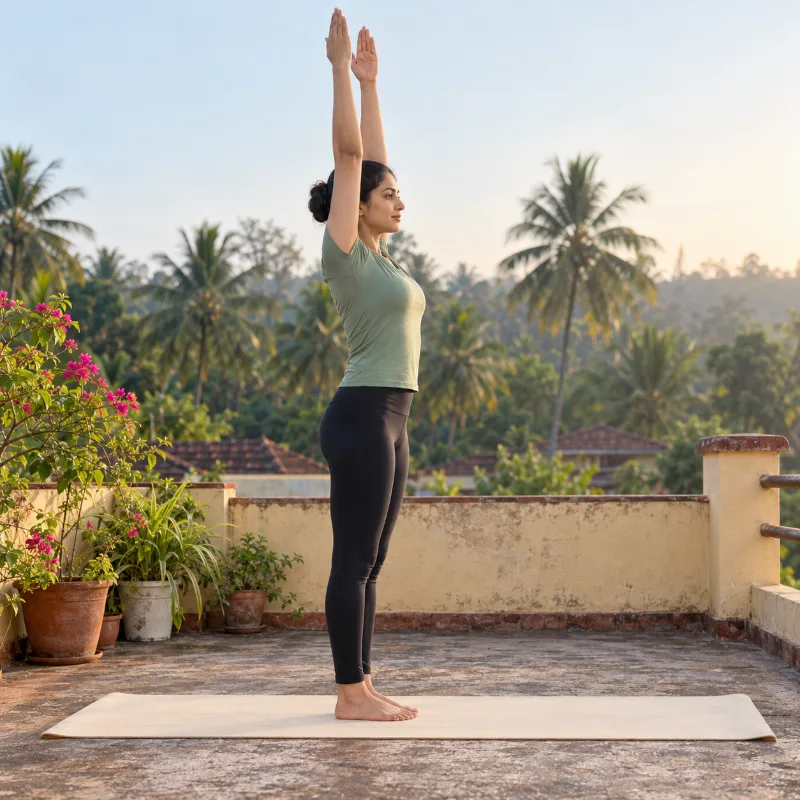
Tāḍāsana, the mountain pose, is the base for most standing āsanas: steady and strong like a mountain, building balance and awareness.
How to do it
- Stand with your feet together or slightly apart, spine upright.
- Spread your weight evenly over both feet.
- Firm your thighs, lift your kneecaps a little and engage your core.
- Let your arms hang by your sides, palms facing forward.
- Relax your shoulders slightly back and open your chest.
- Breathe slowly and deeply, feeling grounded.
- For a deeper stretch, inhale and raise your arms overhead, parallel or palms together.
- Hold for 30 seconds to a minute with steady breathing.
- Exhale, lower your arms and release gently.
Benefits
- Improves posture: keeps the spine straight and reduces slouching.
- Builds balance and stability, and improves body alignment.
- Encourages better circulation.
- Strengthens the thighs, knees and abdominal muscles.
- Calms the nervous system, eases stress and fatigue, and improves focus.
Precautions
- Low blood pressure: standing still for long can cause dizziness, so avoid long holds.
- Vertigo or balance problems: practise near a wall for support.
- Knee or back pain: don’t lock your knees, and engage your core for support.
- Severe headache or insomnia: avoid prolonged practice.
Homework
Practise the warm-up routine on alternate days: Monday, Wednesday and Friday.
Yoga Philosophy
What “yoga” means
The root of the word yoga is yuj: to join, to connect two things together.
Two definitions
- Yujyate anena iti yogaḥ: yoga is that which connects individual consciousness to universal consciousness.
- Yogaś citta-vṛtti-nirodhaḥ (Yoga Sūtra 1.2): yoga is the cessation of the modifications of the mind.
Homework
Find out the difference between manas, citta and buddhi.
Human Anatomy & Physiology
How the body is organised
Anatomy: the study of body structure
- Macroscopic (gross) anatomy
- Microscopic anatomy
- Developmental anatomy
Physiology: the study of body functions
- Systemic physiology
- Comparative physiology
- Medical physiology
Levels of structural organisation
Chemical → cell → tissue → organ → organ system → organism
Regional names
Head, neck, trunk, upper limb, lower limb.
The 11 organ systems
- Integumentary
- Skeletal
- Muscular
- Nervous
- Endocrine
- Cardiovascular
- Lymphatic / immune
- Respiratory
- Digestive
- Urinary / excretory
- Reproductive