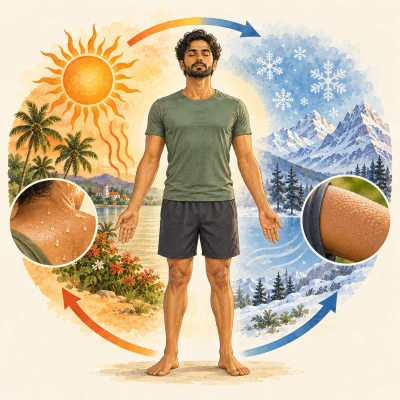
2.1 Introduction to the human body
The body, from one cell to one person
In one line
The body is built in levels: cells group into tissues, tissues into organs, organs into systems, and the systems work together as one living person. Anatomy studies the structure; physiology studies how it works.
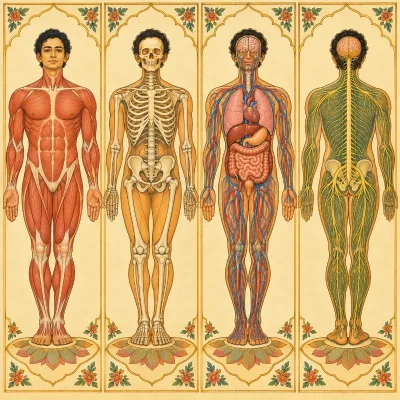
Two words first. Anatomy is the study of the body’s structure: what is where, and what it is made of. Physiology is the study of its functions: how each part works, and how the parts work together. Both came up on the first day of my class; see the notes of 6 September.
Levels of organisation
IGNOU’s physiology course counts seven levels, from the smallest up. Source
- Atoms: carbon, hydrogen, oxygen, nitrogen, phosphorus, and traces of others such as sodium and calcium.
- Molecules: atoms joined together, from water to glucose, proteins, fats and DNA.
- Cells: the smallest unit that is alive, the structural and functional unit of the body. There are about 200 kinds of cell in the human body.
- Tissues: cells of similar structure working as a team. There are four kinds: epithelial (coverings and linings), connective (bone, cartilage, blood and the tissue that binds organs), muscular and nervous.
- Organs: several tissues arranged for one special job. The heart pumps; the stomach digests.
- Organ systems: organs working together, such as the heart and blood vessels in the cardiovascular system.
- Organism: all the systems in harmony, one living person.
My class notes write the same ladder in six steps, counting atoms and molecules together as the “chemical” level: chemical → cell → tissue → organ → organ system → organism. One organ can serve two systems. The pancreas makes digestive juice and also hormones, so it belongs to both the digestive and the endocrine system. Source
Regions and cavities
The body’s regions are the head, neck, trunk, upper limbs and lower limbs. The trunk has two parts, the chest (thorax) and the abdomen. Inside, the organs sit in protected spaces called cavities:
| Cavity | Walls | Holds |
|---|---|---|
| Cranial cavity | the cranium, 8 bones of the skull | the brain |
| Vertebral (spinal) canal | the hollow centre of the vertebrae | the spinal cord |
| Thoracic cavity (chest) | ribs, sternum and spine; the diaphragm is its floor | heart, lungs, trachea, oesophagus |
| Abdominal cavity | the muscles of the abdominal wall, below the diaphragm | stomach, liver, pancreas, intestines |
| Pelvic cavity | the bones of the pelvis | urinary bladder, rectum, reproductive organs |
The diaphragm, a dome of muscle, separates the thoracic cavity from the abdominal cavity, and it is the main muscle of breathing. Source The cranium has 8 bones, and the spinal cord runs through the central canal of the vertebrae. Source
The eleven organ systems
My class listed eleven systems (notes of 6 September). The syllabus looks closely at six of them, in the next section.
| System | Main parts | Main work |
|---|---|---|
| Integumentary | skin, hair, nails, sweat and oil glands | covers and protects; senses touch; helps control temperature |
| Skeletal | bones, cartilage, joints, ligaments | support, protection, movement with the muscles |
| Muscular | skeletal, smooth (visceral) and cardiac muscle | movement, posture, heat |
| Nervous | brain, spinal cord, nerves, sense organs | fast control by nerve signals |
| Endocrine | pituitary, thyroid, adrenals, pancreas and other glands | slower, longer control by hormones |
| Cardiovascular | heart, blood vessels, blood | transport of oxygen, food, hormones, wastes and heat |
| Lymphatic / immune | lymph vessels and nodes, thymus, spleen, white blood cells | returns tissue fluid to the blood; defends against infection |
| Respiratory | nose, pharynx, larynx, trachea, bronchi, lungs | takes in oxygen, removes carbon dioxide |
| Digestive | the alimentary canal and its glands | breaks food down and absorbs it |
| Urinary / excretory | kidneys, ureters, bladder, urethra | filters the blood; removes wastes; balances water and salts |
| Reproductive | ovaries and uterus, or testes and ducts | produces new life; the gonads also make sex hormones |
The yogic view. The Taittirīya Upaniṣad (chapter 2) describes the person as five sheaths (kośas), one inside the other. The physical body is the outermost, the annamaya kośa, the sheath made of food; inside it lie the sheaths of prāṇa, mind, intellect and bliss. Source Everything on this page belongs to that first sheath, the one yoga starts with. See Pañcakośa on the concept map, and how yoga therapy uses the five sheaths.
2.2 Basic structure and functions of the body systems
Six systems at work
In one line
The musculoskeletal system gives frame and movement; the respiratory system trades gases; the cardiovascular system transports; the digestive system brings in fuel; and two systems control the rest: the nervous system fast, by signals, and the endocrine system slowly, by hormones.
Animation · Body systems explorer
Six systems, one body
Musculoskeletal
206 bones · 3 kinds of muscle
Key parts: bones, cartilage, joints, ligaments (bone to bone), tendons (muscle to bone), skeletal muscles.
- Gives the body its frame and shape.
- Protects organs: skull, rib cage, spine.
- Moves the body: muscles pull on bones across joints.
- Holds posture; working muscles also make heat.
Respiratory
12–16 breaths a minute at rest
Key parts: nose, pharynx, larynx, trachea, bronchi, bronchioles, alveoli, lungs, diaphragm, intercostal muscles.
- Brings oxygen in and carries carbon dioxide out.
- Gas exchange happens in the alveoli, by diffusion.
- The larynx makes the voice.
Cardiovascular
4 chambers · about 72 beats a minute · 120/80 mm Hg
Key parts: heart, arteries, veins, capillaries, blood.
- Carries oxygen, food, hormones and heat to every cell.
- Carries carbon dioxide and wastes away.
- Two circuits: heart to lungs and back, heart to body and back.
Nervous
brain + spinal cord = the CNS
Key parts: brain, spinal cord, nerves; their unit is the neuron.
- Senses changes inside and outside the body.
- Decides, and sends commands to muscles and glands.
- Fast control, in fractions of a second; reflexes.
Digestive
alimentary canal about 8–10 m long
Key parts: mouth, pharynx, oesophagus, stomach, small and large intestine, rectum, anus; salivary glands, liver, pancreas.
- Breaks food down, by chewing and churning and by enzymes.
- Absorbs nutrients through the villi of the small intestine.
- Removes what is not digested.
Endocrine
hormones: slower, longer-lasting control
Key parts: hypothalamus, pituitary, pineal, thyroid, parathyroids, thymus, adrenals, pancreas, gonads.
- Glands release hormones straight into the blood.
- They regulate growth, metabolism, blood glucose, calcium, the stress response, the sleep rhythm and reproduction.
Musculoskeletal: 206 bones form the frame. Muscles can only pull: watch the arm and thigh muscles shorten and relax, moving the bones at the joints.
Musculoskeletal system
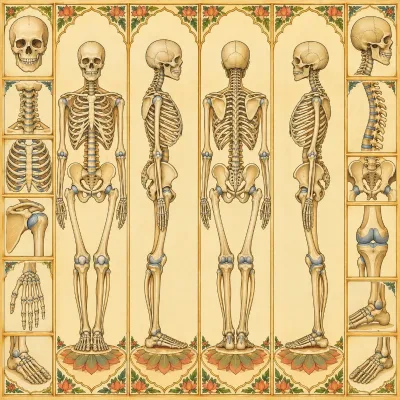
The adult skeleton has 206 bones and a few cartilages. Bone is a hard connective tissue, its matrix stiffened with calcium salts; cartilage is slightly pliable. The skeleton has two divisions: Source
- Axial skeleton, 80 bones, along the body’s axis: the skull (22 bones: 8 cranial and 14 facial), the vertebral column, the sternum and the ribs. The count includes the U-shaped hyoid in the throat and the three tiny ear ossicles (malleus, incus, stapes) in each middle ear.
- Appendicular skeleton, the other 126: the bones of the limbs and of the girdles that join them to the trunk.
- Vertebral column, 26 vertebrae: cervical 7, thoracic 12, lumbar 5, then the sacrum (1, fused) and the coccyx (1, fused). It protects the spinal cord and supports the head.
- Ribs, 12 pairs.
- Joints are of three kinds: fibrous (no movement, like the sutures of the skull), cartilaginous (a little movement, like the joints between vertebrae) and synovial (free movement, like the shoulder, hip and knee).
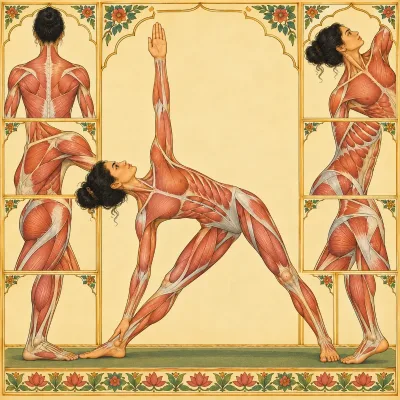
Muscle comes in three kinds: skeletal muscle (striped under the microscope, under our will, attached to bones), visceral or smooth muscle (not striped, not under our will, in the walls of hollow organs such as the gut and blood vessels) and cardiac muscle (striped but involuntary, found only in the heart). Source Āsana is skeletal-muscle work, from the loosening practices to the held postures on our āsana page.
Respiratory system
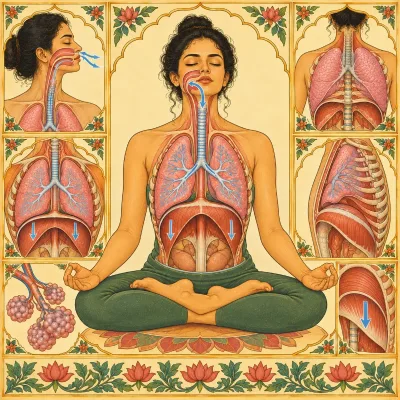
Air enters through the nostrils and passes the pharynx (a passage shared by food and air), the larynx (the cartilage box that makes sound) and the trachea, which divides into the bronchi, the bronchioles and at last the tiny air sacs, the alveoli. Bronchi, bronchioles and alveoli together make up the two lungs, each wrapped in a double membrane, the pleura. Source
- Breathing in starts when the diaphragm contracts and flattens; the external intercostal muscles lift the ribs. The chest grows and air flows in. Breathing out at rest is mostly those muscles relaxing.
- Gas exchange takes place in the alveoli, by diffusion: oxygen into the blood, carbon dioxide out of it.
- Rate: a healthy adult breathes about 12–16 times a minute at rest, moving about 500 mL of air in each quiet breath (the tidal volume), or 6–8 litres a minute. Source Textbooks differ a little: an IGNOU unit gives 14–18 a minute. Source
Why it matters for yoga: the diaphragm and the rib muscles are the very muscles that sectional breathing trains.
Cardiovascular system
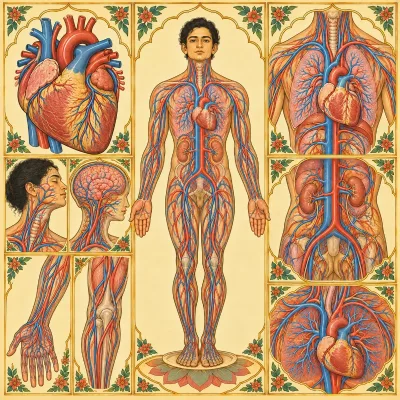
The human heart has four chambers: two small upper atria and two larger lower ventricles, divided by walls (septa) and guarded by valves: the tricuspid valve on the right, the bicuspid (mitral) valve on the left, and the semilunar valves where blood leaves for the lungs and the body. Source
- Double circulation. The right ventricle pumps blood to the lungs (pulmonary circulation); it comes back, rich in oxygen, to the left atrium. The left ventricle pumps it to the whole body (systemic circulation); it comes back to the right atrium.
- Heart rate. A patch of special tissue, the sino-atrial node, is the pacemaker. The heart normally beats 70–75 times a minute, on average 72.
- Cardiac output, the blood each ventricle pumps in a minute, averages about 5 litres.
- Blood pressure. Normal is about 120/80 mm Hg: 120 is the systolic (pumping) pressure, 80 the diastolic (resting) pressure. Repeated readings of 140/90 or more mean hypertension. Source
- Control. The heart beats on its own, but a centre in the medulla oblongata adjusts it: sympathetic nerves speed it up, parasympathetic nerves slow it down.
Nervous system
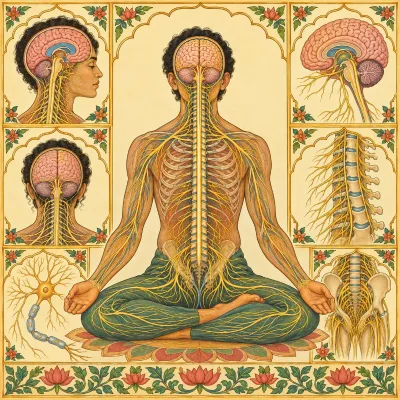
The central nervous system (CNS) is the brain and the spinal cord. The peripheral nervous system is all the nerves that link them with the body. Its somatic part carries commands to the skeletal muscles; its autonomic part runs the involuntary organs and smooth muscle, and is itself divided into the sympathetic and parasympathetic systems. The unit of the whole system is the neuron, a cell with a cell body, branching dendrites and a long axon; one neuron passes its signal to the next across a gap, the synapse. Source
- Forebrain: the cerebrum (thinking, memory, the senses, voluntary movement), the thalamus (a relay centre) and the hypothalamus, which controls body temperature, hunger and thirst and links the brain with the hormones.
- Midbrain, between the forebrain and the hindbrain.
- Hindbrain: the pons; the cerebellum, which uses signals from the ear’s balance organs to keep you steady; and the medulla oblongata, with centres for breathing, heart and blood-vessel reflexes and gastric secretion. Source
- Nerves: 12 pairs of cranial nerves leave the brain Source, and 31 pairs of spinal nerves leave the spinal cord. Source
The two autonomic systems pull in opposite directions. The sympathetic system prepares the body for an emergency; the parasympathetic system restores normal conditions once it is over. Relaxation practices aim at the second state.
| Organ | Sympathetic (“fight or flight”) | Parasympathetic (“rest and digest”) |
|---|---|---|
| Pupils | widen | narrow |
| Heart | speeds up | slows down |
| Airways (bronchioles) | open up | narrow |
| Saliva | stops | flows |
| Stomach and intestine | slow down | speed up |
| Blood sugar | rises | no direct effect |
After NIOS Biology, lesson 17, table 17.1. Source
Digestive system
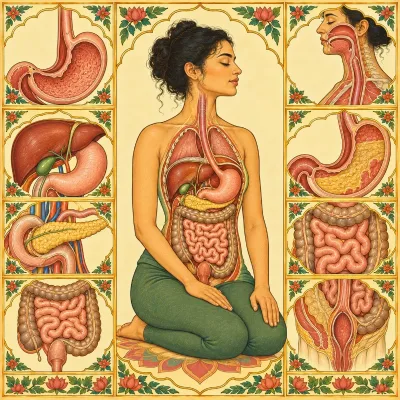
My class spent three weeks on digestion, so here is only the outline; the details are in the class notes.
- Two parts: the alimentary canal (mouth, pharynx, oesophagus, stomach, small intestine, large intestine, rectum, anus) and the accessory glands (the salivary glands, the liver with the gall bladder, and the pancreas). Notes of 27 September
- Lengths: oesophagus about 25 cm; small intestine about 6–7.5 m; large intestine about 1.5 m; the whole canal about 8–10 m. Nutrients are absorbed through the villi of the small intestine. Notes of 4 October
- From the mouth to the small intestine: saliva starts on starch, the stomach on protein, and bile and pancreatic juice finish the work in the duodenum. Notes of 11 October
Endocrine system
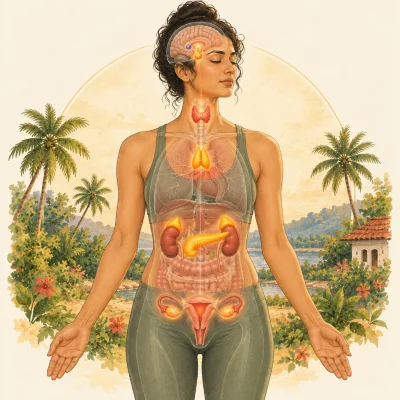
Endocrine glands have no ducts: they release hormones straight into the blood, which carries them to their target organs. Source Hormones act more slowly than nerve signals, and their effects last longer.
| Gland | Where | Main hormones | What they do |
|---|---|---|---|
| Hypothalamus | base of the forebrain | releasing and inhibiting hormones; makes oxytocin and vasopressin | controls the pituitary: the link between nerves and hormones |
| Pituitary | a bony cavity below the hypothalamus | growth hormone, prolactin, TSH, ACTH, LH, FSH; releases oxytocin and vasopressin | growth; directs the thyroid, adrenal cortex and gonads |
| Pineal | upper (dorsal) side of the forebrain | melatonin | the 24-hour rhythm of sleep and waking, and of body temperature |
| Thyroid | two lobes, one on each side of the trachea | thyroxine (T4) and T3; thyrocalcitonin | sets the basal metabolic rate; calcium balance |
| Parathyroids | four, on the back of the thyroid | parathyroid hormone (PTH) | raises blood calcium |
| Thymus | between the lungs, behind the sternum | thymosins | immunity; it shrinks in old age |
| Adrenals | on top of each kidney | medulla: adrenaline and noradrenaline; cortex: cortisol, aldosterone | “fight or flight”; glucose and stress; salt, water and blood pressure |
| Pancreas (islets of Langerhans) | below and behind the stomach | insulin (β-cells), glucagon (α-cells) | lower and raise blood glucose |
| Gonads | ovaries in women, testes in men | oestrogen and progesterone; androgens such as testosterone | sexual development and reproduction |
After NCERT Biology Class XI, chapter 19. Source
Numbers to remember
| Fact (healthy adult) | Value | Where from |
|---|---|---|
| Bones | 206 (axial 80, appendicular 126) | NCERT XI, ch. 17 |
| Vertebrae | 26: 7 + 12 + 5 + sacrum + coccyx | NCERT XI, ch. 17 |
| Ribs | 12 pairs | NCERT XI, ch. 17 |
| Breathing rate at rest | 12–16 a minute (IGNOU: 14–18) | NCERT XI, ch. 14 |
| Tidal volume | about 500 mL | NCERT XI, ch. 14 |
| Heart rate at rest | 70–75 a minute, average 72 | NCERT XI, ch. 15 |
| Cardiac output | about 5 L a minute | NCERT XI, ch. 15 |
| Blood pressure | 120/80 mm Hg; 140/90 or more is high | NCERT XI, ch. 15 |
| Body temperature | about 37 °C (98.6 °F), ± 0.5 °C | NIOS Biology, L18; IGNOU |
| Fasting blood glucose | about 70–100 mg/dL | IGNOU |
| Cranial / spinal nerves | 12 pairs / 31 pairs | NIOS; NCERT via SATHEE |
| Alimentary canal | about 8–10 m | class notes |
2.3 Homeostasis
Homeostasis: the art of staying the same
In one line
Homeostasis is the body keeping its inner conditions, such as temperature, blood glucose and blood pressure, steady within a narrow range while the world outside keeps changing. It does this with feedback loops.
The word is Greek: homoios, similar, and stasis, standing still. The body regulates its own functions to keep its internal conditions as stable as possible, because every cell needs the right temperature, the right chemistry and the right acidity around it to work. Source Steady does not mean fixed: each value moves a little around a normal level, its set point, and the body pulls it back.
The parts of a feedback loop
- Stimulus: a change in something the body watches, such as a rise in body temperature.
- Receptor (sensor): detects the change and reports it. For temperature, heat and cold receptors in the skin, and the hypothalamus itself, which senses the temperature of the blood.
- Control centre (integrating centre): compares the report with the set point and sends commands. Usually a part of the brain; for temperature, the hypothalamus.
- Effector: the muscle, gland or organ that carries out the command, such as the sweat glands.
- Response: the result, which feeds back on the stimulus. In negative feedback it reverses it.
IGNOU names stimulus, receptor, control centre and effector Source; NIOS names set point, sensor, integrating centre and effectors. Source Same loop, different words: learn both.
Animation · Homeostasis
The loop that holds you at 37 °C
sweatheat leaving the skinskin blood vessel: wide when hot, narrow when coldshivering
glucoseinsulinglucagona body cell: its gold core grows as it takes glucose in
- Stimulus a change: core temperature rises or falls
- Receptor heat and cold sensors in the skin and the hypothalamus
- Control centre the hypothalamus compares with the set point
- Effector sweat glands, skin blood vessels, skeletal muscles
- Response heat lost or made; back to about 37 °C
Move the outside temperature and watch the loop bring the core back to about 37 °C. Tap any station on the ring to read what it does.
Negative feedback: the body’s thermostat
Almost every loop in the body is negative feedback: the response reverses the change that set it off. NIOS puts it simply: negative feedback reverses a condition; positive feedback continues in the direction of the change. Source
Example 1
Body temperature
Set point about 37 °C, give or take 0.5 °C. Too hot: the skin’s vessels widen (vasodilation) and the sweat glands pour out sweat, which cools as it evaporates. Too cold: the skin’s vessels narrow (vasoconstriction), sweating stops, and the muscles shiver to make heat. Source
Example 2
Blood glucose
Set point about 70–100 mg/dL. Source After a meal the pancreas releases insulin: cells take up glucose and the liver stores it as glycogen. When glucose falls, glucagon makes the liver release glucose. Source As the level returns, insulin release is reduced. Source
Example 3
Blood pressure
Pressure sensors (baroreceptors) in the walls of certain arteries detect a change in pressure. Source A centre in the medulla oblongata answers through the autonomic nerves: parasympathetic signals slow the heart, sympathetic signals speed it up and strengthen it, and the pressure moves back toward normal. Source
Positive feedback: when the body wants more
Positive feedback is rare. Instead of reversing a change, it amplifies it, until some event ends the loop.
- Childbirth. The first contractions of labour push the baby against the cervix and stretch it. The signal reaches the brain, and the pituitary releases oxytocin, which makes the uterine muscle contract harder; that stretches the cervix more, which releases more oxytocin. The loop ends when the baby is born. Source NCERT calls the first mild contractions the foetal ejection reflex. Source
- Blood clotting. Each step of clotting triggers the next, faster and faster, until the clot plugs the cut. Source
Stress, and where yoga comes in
Stress pushes many loops at once. The hypothalamus starts two pathways: through the sympathetic nerves, the adrenal glands release adrenaline and noradrenaline (the fight-or-flight response); through the pituitary, the adrenal cortex releases cortisol, which raises the energy supply. Hans Selye, the scientist often called the father of stress research, described what happens when stress goes on and on, the general adaptation syndrome: an alarm reaction, a stage of resistance, and finally exhaustion, when the body’s resources run down and stress-related illness, such as high blood pressure, becomes more likely. Source
Yoga works on the other side of the balance. NCERT’s psychology textbook counts relaxation, deep breathing with muscle relaxation, and the yogic method of meditation among the techniques that reduce the symptoms of stress. Source The Common Yoga Protocol says Śavāsana relaxes the whole psycho-physiological system and is very useful in managing stress. Source In body language: slow breathing and deep rest shift the balance from the sympathetic toward the parasympathetic side, the “rest and digest” state in the table above. Yoga does not run the loops for you. It lowers the noise, so the body’s own controls can do their work. See relaxation techniques and yoga nidrā.
2.4 Sensory organs
The five senses, two maps
In one line
Each sense organ holds receptors that turn one kind of change into nerve signals: light for the eye, sound and movement for the ear, chemicals for the nose and tongue, touch, pressure, heat, cold and pain for the skin. The brain makes sense of the signals. Yoga adds a second map: each sense has its subtle object and its element, and the senses can be drawn inward.

Sense organs are the organs through which we detect changes in the world outside. Each has special sensory cells that receive a stimulus and send impulses along a nerve to the brain or the spinal cord; the brain sorts the impulses, interprets them, and sends out the response. Humans have five: the eyes, ears, nose, tongue and skin. Source
Sight
Eye
The wall of the eyeball has three layers: the tough white sclera, which becomes the clear cornea in front; the choroid, rich in blood vessels; and the retina, with rods for dim light and cones for bright light and colour. The iris sets the size of the pupil; the lens changes its curve to focus. Source
How it works: light is bent by the cornea and lens into an upside-down image on the retina; the retina’s cells turn it into signals that the optic nerve carries to the brain, which interprets them. Source Vision is sharpest at the yellow spot (fovea); where the optic nerve leaves there are no receptors, the blind spot.
Hearing and balance
Ear
Outer ear: the pinna and the ear canal. Middle ear: the eardrum (tympanic membrane), three tiny bones, the malleus, incus and stapes, and the Eustachian tube to the pharynx, which keeps the air pressure equal on both sides of the eardrum. Inner ear: the coiled cochlea (two and a half turns) for hearing, and the vestibule with three semicircular canals for balance. Source
How it works: sound waves shake the eardrum; the three bones pass the vibration to the cochlea’s fluid; hair cells in the organ of Corti turn it into impulses for the auditory nerve. For balance, the sensory hair cells of the semicircular canals and of the utriculus and sacculus respond to the movement and position of the head, and the cerebellum uses their signals to keep you steady. Source That is why balancing poses like Vṛkṣāsana are harder with the eyes closed: you take away one of the inputs.
Smell
Nose
The breath carries molecules into the nose, where they stimulate a patch of sensory lining (the olfactory epithelium). Source Its receptors, the olfactory receptors, send their signals to the brain. Source The nose is also where jala neti works.
Taste
Tongue
Taste needs direct contact: the substance must touch the sensory cells in the taste buds of the tongue. Source These gustatory receptors send their signals to the brain. Taste and smell work together, which is why food tastes flat when the nose is blocked. Source
Touch
Skin
The skin holds many kinds of nerve endings: some for touch (gentle pressure), some for deep pressure, and others for cold, heat and pain. NIOS adds the inner senses: hunger from receptors in the stomach wall, thirst from nerves in the pharynx, and fatigue in the muscles. Source
The yogic view: five senses, five subtle elements
Indian philosophy draws a second map. The Sāṅkhya darśana, which the Yoga darśana shares (Swami Harshananda’s Ṣaḍdarśana explains both), counts five jñānendriyas, organs of knowledge; five tanmātras, subtle elements, the pure essences of sound, touch, form, taste and smell; and five mahābhūtas, gross elements. In Sāṅkhya the sense is not the physical organ but its power: not the ear, but the power of hearing in the ear. The tanmātras are too subtle to perceive; they are known by inference, and the five gross elements arise from them. Source
| Organ | Jñānendriya (sense) | Tanmātra (subtle object) | Mahābhūta (element) |
|---|---|---|---|
| Ear | śrotra, hearing | śabda, sound | ākāśa, space (ether) |
| Skin | tvak, touch | sparśa, touch | vāyu, air |
| Eye | cakṣus, sight | rūpa, form and colour | agni or tejas, fire |
| Tongue | rasana, taste | rasa, taste | jala or ap, water |
| Nose | ghrāṇa, smell | gandha, smell | pṛthvī, earth |
The order of the rows is the order of creation in the Taittirīya Upaniṣad (2.1): from the Self arose space; from space, air; from air, fire; from fire, water; from water, earth. Space, the first and subtlest, has sound as its quality. Source Patañjali puts the senses and the elements together as “what is seen”:
प्रकाशक्रियास्थितिशीलं भूतेन्द्रियात्मकं भोगापवर्गार्थं दृश्यम् ॥prakāśa-kriyā-sthiti-śīlaṃ bhūtendriyātmakaṃ bhogāpavargārthaṃ dṛśyam
What is seen has the nature of light, activity and stability; it is made of the elements (bhūta) and the senses (indriya); and it exists for experience and for freedom.
Yoga Sūtra 2.18 · Source
Light, activity and stability are the three guṇas: sattva, rajas and tamas. So the senses are not the enemy in yoga. They are instruments, given for experience and, used well, for freedom.
Pratyāhāra: turning the senses inward
Pratyāhāra is the fifth of the eight limbs, the hinge between outer practice and inner practice.
स्वविषयासंप्रयोगे चित्तस्वरूपानुकार इवेन्द्रियाणां प्रत्याहारः ॥sva-viṣaya-asaṃprayoge citta-svarūpānukāra ivendriyāṇāṃ pratyāhāraḥ
When the senses do not engage with their objects and, as it were, follow the nature of the mind, that is pratyāhāra.
Yoga Sūtra 2.54 · Source
यदा संहरते चायं कूर्मोऽङ्गानीव सर्वशः । इन्द्रियाणीन्द्रियार्थेभ्यस्तस्य प्रज्ञा प्रतिष्ठिता ॥yadā saṃharate cāyaṃ kūrmo ’ṅgānīva sarvaśaḥ · indriyāṇīndriyārthebhyas tasya prajñā pratiṣṭhitā
When one draws the senses back from their objects on every side, as a tortoise draws in its limbs, that person’s wisdom is steady.
Bhagavad Gītā 2.58 · Source
Animation · The senses and the elements
Five doors, and the turning inward
- OrganEar
- Senseśrotra, hearing
- Tanmātraśabda, sound
- Elementākāśa, space
Ear → hearing (śrotra) → śabda, the subtle essence of sound → ākāśa, space. Tap any sense organ in the ring, or turn on pratyāhāra.
Pratyāhāra does not mean shutting the eyes tight or blocking the ears. The organs keep working; the attention stops running out after their objects and rests with the mind instead. You practise it whenever you move the attention from the noise around you to the breath, or around the body in yoga nidrā; ṣaṇmukhī mudrā, which closes the eyes, ears, nose and mouth with the fingers, makes it physical. It prepares the ground for dhāraṇā and dhyāna.
2.5 Impact of yogic practices on the body systems
What practice does to the body
In one line
Practised correctly and regularly, āsana supports strength, flexibility and posture; prāṇāyāma, calm and efficient breathing; ṣaṭkarma, clear airways; and the bandhas, control of the abdomen and the pelvic floor. These practices support health. They do not replace treatment.
The texts name the fruits first. The Haṭha Yoga Pradīpikā says why āsana comes first of all:
हठस्य प्रथमाङ्गत्वादासनं पूर्वमुच्यते । कुर्यात्तदासनं स्थैर्यमारोग्यं चाङ्गलाघवम् ॥haṭhasya prathamāṅgatvād āsanaṃ pūrvam ucyate · kuryāt tad āsanaṃ sthairyam ārogyaṃ cāṅga-lāghavam
Āsana is taught first because it is the first limb of haṭha yoga. Practise it for steadiness, health and lightness of the body.
Haṭha Yoga Pradīpikā 1.17. HYP verse numbers on this page follow the prescribed Bihar School edition with Swami Muktibodhananda’s commentary; editions that add verses on yama and niyama number this one 1.19.
The Gheraṇḍa Saṁhitā (1.10–1.11) gives one fruit to each limb: ṣaṭkarma purifies, āsana makes the body firm, mudrā makes it steady, and prāṇāyāma brings lightness (see the haṭha texts). B.K.S. Iyengar’s Light on Yoga, one of the prescribed books, gives the effects of each posture beside its technique, and Swami Satyananda Saraswati’s Asana Pranayama Mudra Bandha (Bihar School of Yoga) gives the benefits and the contra-indications of each practice in the same way. Today’s government manuals say the same in the language of the body systems. The Common Yoga Protocol, in its summary of research, says yoga is beneficial for physical fitness, musculoskeletal functioning and cardiovascular health, and helps in managing respiratory disorders, hypertension and many lifestyle-related disorders. Source
Practice × system
What the Indian manuals say each group of practices does for three systems. Tap a practice name to go to its unit.
| Practice | Respiratory | Circulatory | Musculoskeletal |
|---|---|---|---|
| Ṣaṭkarma cleansing |
Jala neti clears mucus and dust from the nose; NIOS lists it for a running nose, cough and sinusitis. Kapālabhāti clears the frontal sinuses and helps with colds and cough (CYP); the HYP (2.35) says it dries up disorders of phlegm. | Mostly cautions: kapālabhāti and kuñjala are not for heart disease or high blood pressure (CYP, NIOS), nor agnisāra for high blood pressure (NCERT). | Agnisāra strengthens the abdominal muscles (NCERT); nauli isolates and rolls them (NIOS). |
| Āsana postures |
Trikoṇāsana and Śalabhāsana help lung capacity; Uttāna Maṇḍūkāsana improves the movement of the diaphragm; Bhujaṅgāsana helps bronchial problems (CYP). | Ardha Uṣṭrāsana increases circulation to the head and heart region (CYP); Sūrya Namaskāra helps circulation (NIOS). Rest in Śavāsana relaxes the whole system (CYP). | Ardha Cakrāsana and Vakrāsana make the spine flexible; Trikoṇāsana strengthens the calf, thigh and waist muscles; the neck and shoulder movements keep those bones, muscles and nerves healthy (CYP). HYP 1.17: steadiness and lightness. |
| Prāṇāyāma breath regulation |
Yogic deep breathing improves lung capacity; nāḍī śodhana helps the respiratory system work better (NIOS). Prāṇāyāma improves control over the automatic breathing mechanism (NCERT). Nāḍī śodhana alleviates cough disorders (CYP). | Slow practices calm: nāḍī śodhana lowers stress and anxiety (CYP), and MDNIY’s protocol for high blood pressure uses nāḍī śodhana, bhrāmarī, śītalī and sītkārī. Fast or held practices (bhastrikā, long kumbhaka) are not for high blood pressure or heart disease (NIOS). | Trains the breathing muscles, the diaphragm and the intercostals between the ribs (NCERT), and a steady seat trains the back. |
| Bandha locks |
Jālandhara seals the throat while the breath is held; uḍḍīyāna is done with the lungs empty (NIOS). Both give fine control of the breath. | Mostly cautions: avoid all three bandhas with high blood pressure or heart disease (NIOS). | Uḍḍīyāna strengthens the abdominal muscles; mūla bandha tones the perineum (pelvic floor) (NIOS). Jālandhara is not for a stiff neck or cervical spondylosis. |
CYP: Ministry of Ayush, Common Yoga Protocol Source. NIOS: Physical Education and Yog, lessons 19 (ṣaṭkarma), 20 (āsana), 21 (prāṇāyāma), 22 (mudrā and bandha). NCERT: Health and Physical Education XI, chapter 6, and Biology XI, chapter 14. MDNIY: yogic practices for high blood pressure.
Reading these claims well
- “Supports”, not “cures”. Some older manuals use strong words. This page keeps to “helps” and “supports”, and so should a teacher. Where a manual says a practice is useful in asthma or diabetes, read it as: a practice that may help, alongside medical care.
- Slow calms, fast stimulates. Slow breathing and long exhalations lean toward the parasympathetic, “rest and digest” side of the nervous system; fast, forceful practices such as kapālabhāti and bhastrikā stimulate. That is why the same list of cautions keeps returning for high blood pressure and heart disease.
- Order matters. Loosening first, then āsana, then prāṇāyāma, then relaxation and meditation. The Haṭha Yoga Pradīpikā puts prāṇāyāma after a steady āsana (2.1), and ṣaṭkarma before prāṇāyāma for those who need it (2.21).
Cautions
- With high blood pressure, heart disease, giddiness or vertigo, a hernia, a stomach ulcer, epilepsy, or after recent surgery, avoid kapālabhāti, bhastrikā, long breath-holding and the bandhas, unless your doctor and a qualified teacher agree (CYP, NIOS).
- In pregnancy and during menstruation, leave these forceful practices and the bandhas out; the Common Yoga Protocol lists both among the cautions for kapālabhāti. In pregnancy, practise only with your doctor’s approval and under a teacher trained for it.
- Head-down and strong back-bending postures are not for everyone: avoid head-down positions with high blood pressure, glaucoma or a neck problem, and follow the cautions on each āsana.
- For any medical condition, yoga complements treatment. Work with your doctor, and do not stop prescribed medicines. More in Yoga therapy.
2.6 Introduction to psychology
Psychology, East and West
In one line
Psychology is the science of mental processes, experience and behaviour. Yoga has its own psychology, Patañjali’s: the mind-field (citta), its movements (vṛttis), the afflictions that colour them (kleśas), and the three qualities (guṇas) in everything.
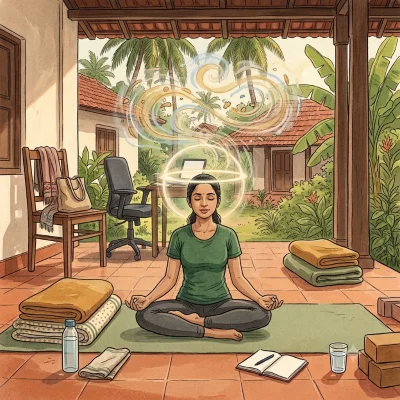
NCERT defines psychology as a science that studies mental processes, experiences and behaviour in different contexts. Mental processes are activities such as remembering, learning, perceiving and thinking. Experiences are subjective: only the person who has them can know them directly, like the pain of someone who is ill. Behaviour is what we do, from a blink to a decision, and much of it can be observed. Source
Branches of psychology
- Cognitive: attention, perception, memory, thinking, problem-solving.
- Biological: the links between behaviour and the brain, nervous system and hormones.
- Developmental: how we change from birth to old age.
- Social: how other people influence what we think, feel and do.
- Health: the role of psychology in health and illness; stress and coping.
- Clinical and counselling: causes, treatment and prevention of psychological disorders, and help with everyday problems.
- Educational: how people learn, and how to teach them; most useful to a yoga teacher.
- Industrial / organisational, environmental, sports, and more.
After NCERT Psychology XI, chapter 1. Source
Key concepts
Perception
Making meaning of what the senses report: organising and interpreting sensations so we recognise a face, a word, a bell. Source
Attention
Selecting a few stimuli from the many around us. It can be selective, sustained or divided. Dhāraṇā is trained attention.
Memory
Keeping and recalling information, in three stages: encoding, storage and retrieval; with sensory, short-term and long-term stores. Source In my class we practised sorting information to remember it: see the notes of 20 September.
Emotion
A feeling state with three parts: the inner experience, changes in the body (heart, breath, hormones) and outward expression.
Motivation
The needs and drives that start, direct and sustain behaviour. Maslow arranged needs in a hierarchy, from bodily needs up to self-actualisation. Source
Personality
A person’s characteristic, fairly stable ways of thinking, feeling and acting. NCERT notes two Indian typologies: the tridoṣa of the Caraka Saṁhitā and the three guṇas. Source
Stress
The pattern of responses to events that strain our resources: bodily, emotional, mental and behavioural. Selye’s three stages: alarm, resistance, exhaustion (see homeostasis). Source
Patañjali’s psychology
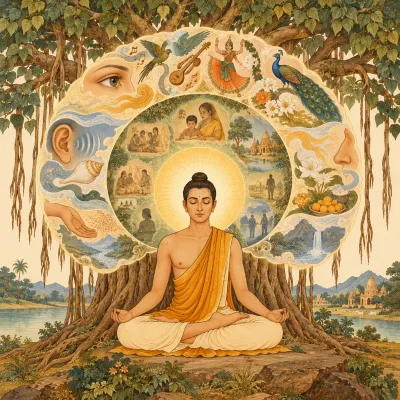
Citta is the whole field of the mind. In the Yoga darśana it covers the three inner organs of Sāṅkhya: buddhi, the intellect that decides; ahaṅkāra, the ego, the sense of “I”; and manas, the mind that receives the senses’ reports. Source Yoga’s definition is a definition in psychology:
योगश्चित्तवृत्तिनिरोधः ॥yogaś citta-vṛtti-nirodhaḥ
Yoga is the stilling of the movements (vṛttis) of the mind-field (citta).
Yoga Sūtra 1.2 · Source
Patañjali counts five vṛttis (YS 1.6) Source, and each has a modern counterpart:
| Vṛtti | Meaning (YS 1.7–1.11) | Modern psychology |
|---|---|---|
| Pramāṇa | valid knowledge, from perception, inference and reliable testimony | perception, reasoning, learning |
| Viparyaya | error: knowledge not based on the real form of a thing | illusion, misperception |
| Vikalpa | verbal imagination: words with no object behind them | imagination, abstract concepts |
| Nidrā | sleep: a vṛtti resting on the absence of content | sleep |
| Smṛti | memory: holding on to what was experienced | memory |
Every vṛtti is either painful (kliṣṭa) or not painful (akliṣṭa) (YS 1.5). The painful ones are rooted in the five kleśas, the afflictions:
अविद्यास्मितारागद्वेषाभिनिवेशाः पञ्च क्लेशाः ॥avidyāsmitā-rāga-dveṣābhiniveśāḥ pañca kleśāḥ
Ignorance, I-am-ness, attachment, aversion and clinging to life are the five afflictions.
Yoga Sūtra 2.3 · Source
| Kleśa | Patañjali’s sense (YS 2.4–2.9) | Close modern idea |
|---|---|---|
| Avidyā | taking the passing for the lasting, the impure for the pure, pain for pleasure, the not-self for the Self; the root of the other four | faulty appraisal; a distorted view of oneself and the world |
| Asmitā | “I-am-ness”: mistaking the instrument (the mind) for the seer | ego, over-identification with self-image |
| Rāga | attachment that follows pleasure | craving, approach motivation |
| Dveṣa | aversion that follows pain | avoidance, anger |
| Abhiniveśa | clinging to life, the fear of death, present even in the wise | the survival instinct; basic fear |
The third idea is the three guṇas, the qualities of nature. Sattva is clarity and light; rajas, activity and restlessness; tamas, inertia and dullness. They are present in every person in different degrees, and the one that dominates shapes behaviour, which is how NCERT’s textbook presents the guṇa typology of personality. Source The Gītā puts it this way:
सत्त्वं रजस्तम इति गुणाः प्रकृतिसम्भवाः । निबध्नन्ति महाबाहो देहे देहिनमव्ययम् ॥sattvaṃ rajas tama iti guṇāḥ prakṛti-sambhavāḥ · nibadhnanti mahā-bāho dehe dehinam avyayam
Sattva, rajas and tamas, the guṇas born of nature, bind the imperishable embodied self to the body, O mighty-armed one.
Bhagavad Gītā 14.5 · Source
The guṇas also mark the five states of the mind (citta bhūmis) that the commentators describe: kṣipta, restless, where rajas dominates; mūḍha, dull, where tamas dominates; vikṣipta, distracted, where sattva begins to prevail; ekāgra, one-pointed; and niruddha, fully stilled. Source See Citta bhūmi on the concept map.
Where the two meet. Modern psychology describes and measures the mind; Patañjali’s psychology adds a method to change it. Kriyā yoga (YS 2.1–2.2) weakens the kleśas, and their active forms are removed by meditation (dhyāna, YS 2.11). That is where this unit hands over to the meditation unit, and, for food and the guṇas, to sāttvika food.
Quick revision
Test yourself
List the levels of structural organisation of the body.
Chemical (atoms and molecules) → cell → tissue → organ → organ system → organism. The four basic tissues are epithelial, connective, muscular and nervous.
How many bones are there in the adult skeleton, and how are they divided?
206: the axial skeleton has 80 (skull, vertebral column, sternum, ribs) and the appendicular skeleton 126 (limbs and girdles). The vertebral column has 26 vertebrae: cervical 7, thoracic 12, lumbar 5, sacrum 1, coccyx 1. There are 12 pairs of ribs.
Give the normal resting values of breathing rate, heart rate, blood pressure and body temperature.
Breathing about 12–16 a minute (some books: 14–18); heart 70–75 beats a minute, average 72; blood pressure 120/80 mm Hg (140/90 or more is hypertension); temperature about 37 °C (98.6 °F).
Name the endocrine glands and one hormone of each.
Hypothalamus (releasing hormones), pituitary (growth hormone), pineal (melatonin), thyroid (thyroxine), parathyroids (PTH), thymus (thymosins), adrenals (adrenaline, cortisol), pancreas (insulin, glucagon), gonads (oestrogen and progesterone, or testosterone).
Define homeostasis and name the parts of a feedback loop.
Homeostasis is the body keeping its internal conditions steady within a narrow range. Loop: stimulus → receptor (sensor) → control centre (integrating centre) → effector → response, around a set point.
Explain negative feedback with body temperature, and give two examples of positive feedback.
Too hot: the hypothalamus triggers sweating and widening of the skin’s vessels; too cold: narrowing of the vessels and shivering. The response reverses the change. Positive feedback amplifies the change: oxytocin in childbirth, and blood clotting.
How do insulin and glucagon keep blood glucose steady?
Both come from the islets of Langerhans in the pancreas. Insulin (β-cells) lowers blood glucose: cells take it up and the liver stores it as glycogen. Glucagon (α-cells) raises it: the liver releases glucose.
Match the five senses to their tanmātras and elements.
Ear: śabda (sound), ākāśa (space). Skin: sparśa (touch), vāyu (air). Eye: rūpa (form), agni (fire). Tongue: rasa (taste), jala (water). Nose: gandha (smell), pṛthvī (earth).
What is pratyāhāra, and what image does the Gītā use for it?
The withdrawal of the senses from their objects, so that they follow the mind (YS 2.54). BG 2.58: like a tortoise drawing in its limbs.
Define psychology, and name the five vṛttis and the five kleśas.
Psychology studies mental processes, experiences and behaviour. Vṛttis (YS 1.6): pramāṇa, viparyaya, vikalpa, nidrā, smṛti. Kleśas (YS 2.3): avidyā, asmitā, rāga, dveṣa, abhiniveśa.
Sources
Where this comes from
- Prescribed books: B.K.S. Iyengar, Light on Yoga (on what the postures do for the body); Swami Harshananda, Ṣaḍdarśana: the six systems of Hindu philosophy, Ramakrishna Math (the Sāṅkhya and Yoga darśanas: senses, tanmātras, elements, guṇas); Patañjali’s Yoga Sūtra; Hatha Yoga Pradipika, with commentary by Swami Muktibodhananda (Bihar School of Yoga / Yoga Publications Trust, Munger), whose verse numbering this page follows (HYP 1.17, 2.1, 2.21, 2.35); Swami Satyananda Saraswati, Asana Pranayama Mudra Bandha (Bihar School of Yoga / Yoga Publications Trust, Munger), on the benefits and contra-indications of āsana, prāṇāyāma, mudrā and bandha. Named, not quoted: explained here in my own words.
- Classical texts: Yoga Sūtra 1.2, 1.5–1.11, 2.1–2.9, 2.11, 2.18, 2.54; Bhagavad Gītā 2.58, 14.5; Haṭha Yoga Pradīpikā 1.17, 2.1, 2.21, 2.35 (Bihar School numbering); Gheraṇḍa Saṁhitā 1.10–1.11; Taittirīya Upaniṣad, chapter 2 (2.1, the order of the elements; the five kośas).
- Verse texts: IIT Kanpur Gita Supersite (Heritage IITK), YS 1.2, 1.6, 2.3, 2.18, 2.54; BG 2.58, 14.5.
- NCERT Biology, Class XI: ch. 14, Breathing and exchange of gases; ch. 15, Body fluids and circulation; ch. 17, Locomotion and movement; ch. 18, Neural control and coordination; ch. 19, Chemical coordination and integration. Class XII: ch. 2, Human reproduction (parturition).
- NCERT Science, Class X: ch. 6, Control and coordination; ch. 10, The human eye. NCERT Health and Physical Education, Class XI, ch. 6, Yoga.
- NCERT Psychology, Class XI: ch. 1, What is psychology?, ch. 4, Sensory, attentional and perceptual processes, ch. 6, Human memory, ch. 8, Motivation and emotion. Class XII: ch. 2, Self and personality; ch. 3, Meeting life challenges.
- NIOS Biology (314): lesson 17, Coordination and control (sense organs, nerves, autonomic system); lesson 18, Homeostasis. NIOS Physical Education and Yog (373): lessons 19, 20, 21, 22.
- IGNOU (eGyanKosh): Homeostasis and organisation of body fluid compartments (levels of organisation); Homeostatic control system (feedback loops, set points); Introduction to human body systems; Sāṅkhya philosophy; Yoga philosophy (citta, citta bhūmis, kleśas); Taittirīya Upaniṣad.
- SATHEE (IIT Kanpur, Ministry of Education), NCERT Biology XI, Neural control and coordination: chapter text (eye and ear) and exercises (cranial and spinal nerves).
- Ministry of Ayush, Common Yoga Protocol (English booklet, hosted by the Ministry of External Affairs). MDNIY, yogic practices for the management of high blood pressure.
- Class notes: 6 September (organisation, eleven systems), 20 September (memory), 27 September, 4 October and 11 October (digestion).