The opening prayer
Yogena cittasya: the prayer to Patañjali
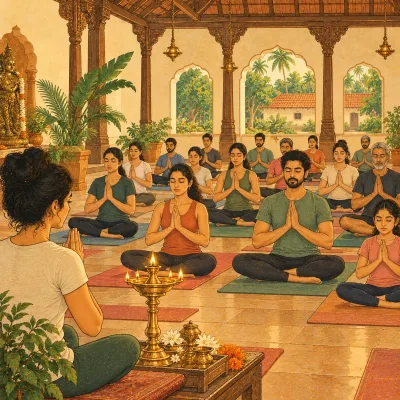
Singing the prayer together before practice calms the mind, focuses it, and sets a positive and respectful tone for yogābhyāsa, yoga practice. Learn it by heart, with correct pronunciation and its meaning.
योगेन चित्तस्य पदेन वाचां ।yogena cittasya padena vācāṃ
मलं शरीरस्य च वैद्यकेन ॥malaṃ śarīrasya ca vaidyakena
योऽपाकरोत्तमं प्रवरं मुनीनां ।yo’pākarottamaṃ pravaraṃ munīnāṃ
पतञ्जलिं प्राञ्जलिरानतोऽस्मि ॥patañjaliṃ prāñjalir ānato’smi
Meaning
I bow with folded hands to Patañjali, the excellent, foremost of sages, who removed the impurities of the mind through yoga, of speech through grammar and of the body through medicine. Source
Word by word
| yogena | through yoga |
| cittasya | of the mind |
| padena | through grammar (pada, words) |
| vācāṃ | of speech |
| malaṃ | impurity |
| śarīrasya | of the body |
| ca | and |
| vaidyakena | through medicine |
| yaḥ | he who |
| apākarot | removed |
| uttamaṃ | the excellent one |
| pravaraṃ | the foremost |
| munīnāṃ | of sages |
| patañjaliṃ | Patañjali |
| prāñjaliḥ | with folded hands |
| ānataḥ asmi | I bow |
Two forms of the third line are in use. The card from class, like the source above, has योऽपाकरोत्तमं (yo’pākarottamaṃ, with uttamaṃ, “the excellent one”). Other texts have योऽपाकरोत्तं (yo’pākarot taṃ, “to him”) Source. The meaning is the same. The other lines have 11 syllables each, and taṃ keeps the third line at 11 too. Chant the form your teacher uses.
Yoga Theory
Public speaking
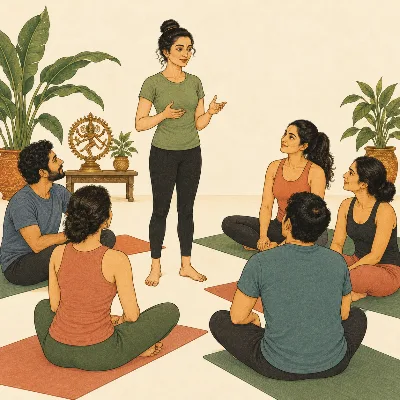
We revised the memory exercise from 20 September. Then each of us spoke for one minute on a topic of our choice.
Five rules for speaking to a group
- Stand straight, with your weight on both legs: the same steady stance as Tāḍāsana.
- Keep hand movements above elbow level.
- Make eye contact with your audience.
- Modulate your voice.
- Add something unique or interesting to catch the listener’s attention.
A yoga teacher speaks to a group in every class. This skill sits beside the habit from 20 September of remembering every student’s name.
Yoga Practical
Six standing and five sitting āsanas
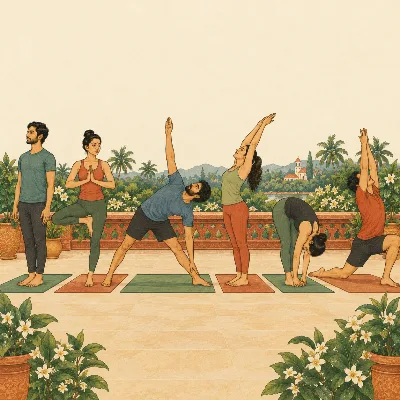
After the prayer and the warm-up, we learned six standing āsanas, each with its benefits and precautions. Full steps are in the āsana library.
Standing
- Tāḍāsana, mountain pose: the base for every standing āsana.
- Vṛkṣāsana, tree pose: a one-legged balance that builds balance and concentration.
- Trikoṇāsana, triangle pose: a side stretch for the spine, hips and waist.
- Hastottānāsana, raised arms pose: arms overhead and a gentle backbend.
- Hastapādāsana, hands to feet: a standing forward bend. The library’s closest entry is Pādahastāsana.
- Aśva Sañcalanāsana, equestrian pose: a low lunge, also part of the Sun Salutation.
Sitting
Five sitting āsanas were explained and practised:
- Vajrāsana, thunderbolt pose: the handout says it is traditionally practised after meals to help digestion.
- Sukhāsana, easy pose: one of the steady seats from 6 September.
- Ardha Padmāsana, half lotus: the handout’s choice when the knees or hips are not ready for the full lotus.
- Padmāsana, lotus pose: the classic seat for meditation and prāṇāyāma.
- Siddhāsana, accomplished pose: often taught as an easier alternative to Padmāsana.
Human Anatomy & Physiology
The digestive system
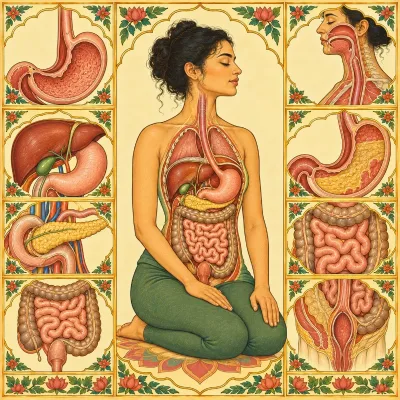
The digestive system breaks food down into simple substances the body can absorb. It is made of the alimentary canal and the glands that help it. Source
It has two parts.
1. The alimentary canal
The tube that food travels through, in order:
- Mouth and buccal (oral) cavity, with the teeth and tongue
- Pharynx
- Oesophagus
- Stomach
- Small intestine
- Large intestine
- Rectum and anus
2. Accessory organs
The glands that pour digestive juices into the canal: the salivary glands, the liver (with the gall bladder) and the pancreas. NCERT calls them the accessory digestive glands.
The yoga link
The same day’s āsanas tie in. The handout says Vajrāsana, Trikoṇāsana, Hastottānāsana and Pādahastāsana may support digestion, and the Common Yoga Protocol says Pāda-hastāsana improves digestion.
Yoga Philosophy
Two more definitions of yoga
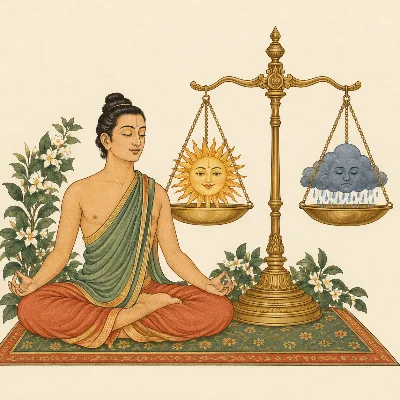
- Yogaḥ karmasu kauśalam: yoga is dexterity, skill in action. Bhagavad Gītā 2.50. Source
- Samatvaṃ yoga ucyate: yoga is equanimity, the balance between joy and sorrow. Bhagavad Gītā 2.48. Source
Four definitions so far
| Definition | Yoga is | From |
|---|---|---|
| Yujyate anena iti yogaḥ | union, from the root yuj, to join | 6 September |
| Yogaś citta-vṛtti-nirodhaḥ | the stilling of the movements of the mind | Yoga Sūtra 1.2, 6 September |
| Yogaḥ karmasu kauśalam | skill in action | Gītā 2.50, 27 September |
| Samatvaṃ yoga ucyate | equanimity | Gītā 2.48, 27 September |
Homework
Before the next class
- Repeat each stanza of the prayer three times, until you know it by heart.
- Practise the breathing exercises with the Viṣṇu Sahasranāma Stotra, or with a tanpura. The breathing pacer can help.
- Read about the factors that make public speaking effective.
- Draw the digestive system, and mark the alimentary canal and the accessory organs.
← Previous class: 20 September · Back to the library · Next class: 4 October →