Yoga Theory
The Pasaydan, and the shape of a speech
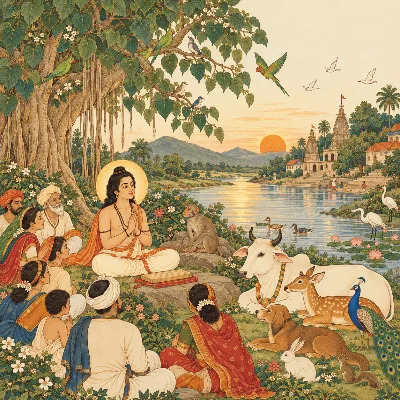
The class opened with the yoga prayer. Then we studied the opening lines of the Pasaydan.
Pasaydan: a prayer for everyone
The Pasaydan, literally a request for a boon, is the prayer that closes the Jñāneśvarī (Dnyaneshwari), Sant Jñāneśvar’s Marathi commentary on the Bhagavad Gītā. Source 1 Source 2
Sant Jñāneśvar, also called Dnyaneshwar Maharaj, is lovingly known as Mauli. In the Pasaydan he does not pray for himself: he prays for the well-being of every being.
आतां विश्वात्मके देवे । येणे वाग्यज्ञे तोषावे ।ātāṃ viśvātmake deve, yeṇe vāgyajñe toṣāve
तोषोनि मज द्यावे । पसायदान हे ॥toṣoni maja dyāve, pasāyadāna he
Now may God, the soul of the universe (viśvātmā), pleased with this offering of words (vāgyajña), grant me this gift. The gift he then asks for is for others: that those who do wrong be calmed and corrected and turn to good deeds, and that the whole world be uplifted and happy. Source 1 Source 2
Sir stressed that the Śānti Pāṭha we chant carries the same meaning as the Pasaydan: peace and well-being for all.
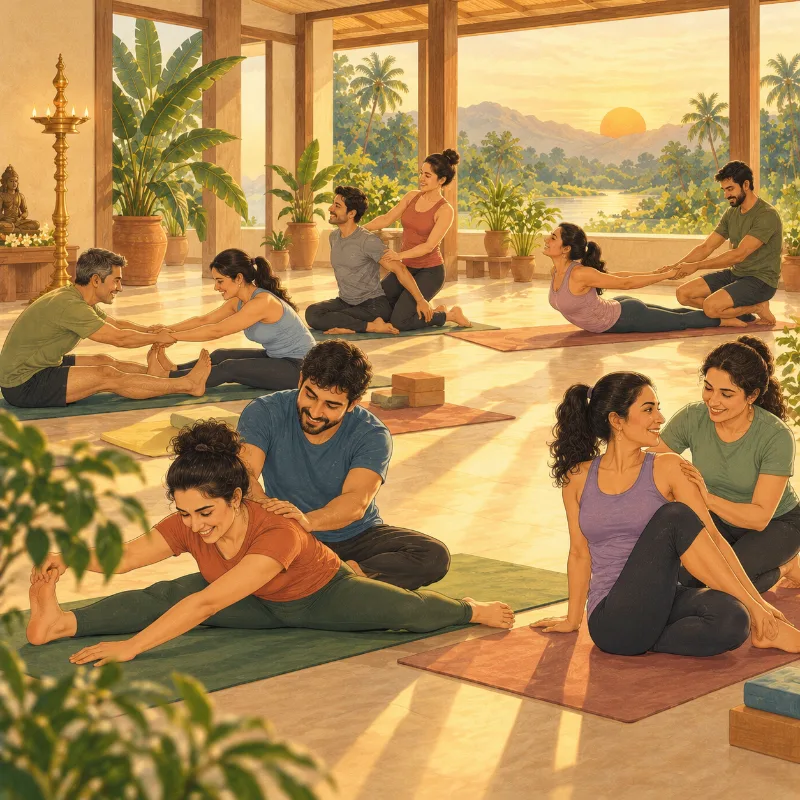
Partner stretches
Sir then led stretching exercises as a relaxation technique, done in pairs. New partner stretches followed on 11 October.
The three parts of a speech
Building on the public-speaking rules from 27 September, Sir explained the three important parts of a speech. The homework looks closely at the first of them, the opening.
Yoga Practical
Eight sitting āsanas
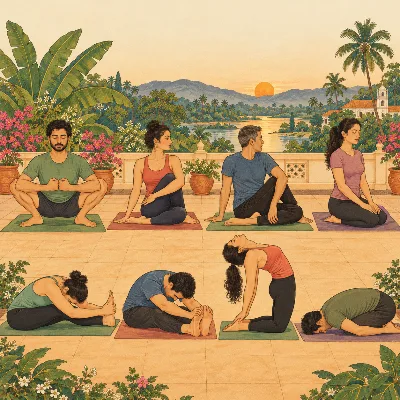
After the warm-up, Sir demonstrated eight sitting āsanas and explained why they are worth practising regularly. Full steps, benefits and precautions are in the āsana library.
- Maṇḍūkāsana, frog pose: a kneeling forward bend with the fists pressed into the belly.
- Vakrāsana, a simple seated spinal twist.
- Ardha Matsyendrāsana, a deeper seated twist, named after the sage Matsyendranāth.
- Vajrāsana, thunderbolt pose: the kneeling seat, traditionally practised after meals.
- Jānu Śīrṣāsana, head-to-knee pose: a seated forward bend over one leg.
- Paścimottānāsana, a seated forward bend that stretches the whole back of the body.
- Uṣṭrāsana, camel pose: a deep kneeling backbend that opens the chest.
- Śaśāṅkāsana, hare pose: a restful kneeling forward bend that calms the mind.
What they share
The handout says every one of the eight may support digestion and ease constipation, which ties in with the anatomy class the same day. The twists and forward bends also keep the spine flexible.
Four of them are also in the Common Yoga Protocol: Vajrāsana, Uṣṭrāsana, Vakrāsana and Śaśāṅkāsana (called Śaśakāsana there). Last week’s sitting āsanas were seats for meditation; these eight bend, twist and stretch.
Human Anatomy & Physiology
Digestion, continued: villi and the two intestines
We revised the digestive system from 27 September, including the accessory organs, and the lengths of the oesophagus and the whole alimentary canal.
How long is it?
| Oesophagus | about 25 cm |
| Small intestine | about 6 to 7.5 m: duodenum 25 cm, jejunum 2.5 m, ileum 3.5 m |
| Large intestine | about 1.5 m |
| The whole alimentary canal | about 8 to 10 m |
Approximate adult lengths; sources round them a little differently. Source 1 Source 2
Three nutrients to digest
Food is mostly carbohydrates, proteins and fats, and each is broken down step by step along the canal. Source
| Nutrient | Where digestion starts | Where it finishes |
|---|---|---|
| Carbohydrates | Mouth: salivary amylase breaks down about 30% of the starch. It stops working in the acid of the stomach. | Small intestine |
| Proteins | Stomach: protein is the stomach’s main work. | Small intestine |
| Fats | Small intestine: bile breaks fat into droplets and lipases digest it. | Small intestine |
Villi
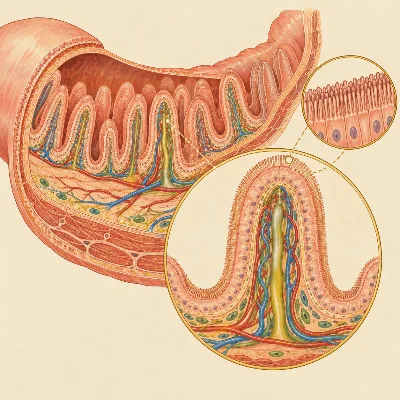
The inner wall of the small intestine is folded into millions of tiny finger-like projections called villi, and their surface carries even smaller microvilli. Together they increase the surface area enormously, so nutrients are absorbed fast. Each villus has a network of blood capillaries and a lymph vessel called the lacteal: sugars and amino acids pass into the blood, while digested fats travel through the lacteals. Source
Small and large intestine
| Small intestine | Large intestine | |
|---|---|---|
| Length | about 6 to 7.5 m | about 1.5 m |
| Parts | duodenum, jejunum, ileum | caecum, colon, rectum |
| Main job | finishes digestion and absorbs most nutrients through its villi | absorbs some water, minerals and certain drugs; no significant digestion |
| Also | receives bile and pancreatic juice in the duodenum | secretes mucus that helps hold the waste together |
Yoga Philosophy
The chariot, the calm mind and the five sheaths
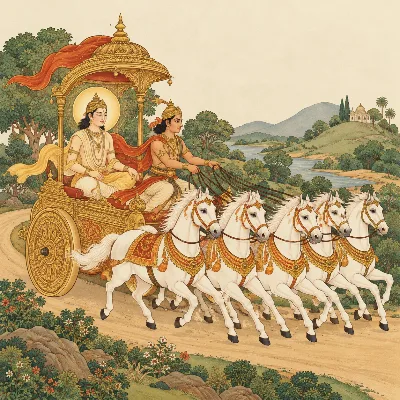
The chariot of the Kaṭhopaniṣad
The Kaṭhopaniṣad pictures a person as a chariot. The body carries the Ātman, the true self, and the buddhi steers. Source
आत्मानं रथिनं विद्धि शरीरं रथमेव तु ।ātmānaṃ rathinaṃ viddhi śarīraṃ ratham eva tu
बुद्धिं तु सारथिं विद्धि मनः प्रग्रहमेव च ॥buddhiṃ tu sārathiṃ viddhi manaḥ pragraham eva ca (1.3.3)
इन्द्रियाणि हयानाहुर्विषयांस्तेषु गोचरान् ।indriyāṇi hayān āhur viṣayāṃs teṣu gocarān (1.3.4)
| In the chariot | In us |
|---|---|
| The rider, master of the chariot (rathin) | The Ātman, the true self |
| The chariot (ratha) | The body (śarīra) |
| The charioteer (sārathi) | The buddhi, the intellect that decides |
| The reins (pragraha) | The manas, the mind |
| The five horses (haya) | The senses (indriya) |
| The roads they run on (gocara) | The objects of the senses (viṣaya) |
When the reins of the mind go slack, the horse-like senses go wayward after what is pleasant (preyas) instead of what is good (śreyas). Source This also answers the 6 September homework on how manas, citta and buddhi differ: here the mind holds the reins, and the buddhi decides where to go.
Another definition of yoga
Manaḥ praśamanopāyaḥ yoga ity abhidhīyate: yoga is the means of calming the mind: controlling and managing it with skill. Source
| Definition | Yoga is | From |
|---|---|---|
| Yujyate anena iti yogaḥ | union, from the root yuj, to join | 6 September |
| Yogaś citta-vṛtti-nirodhaḥ | the stilling of the movements of the mind | Yoga Sūtra 1.2, 6 September |
| Yogaḥ karmasu kauśalam | skill in action | Gītā 2.50, 27 September |
| Samatvaṃ yoga ucyate | equanimity | Gītā 2.48, 27 September |
| Manaḥ praśamanopāyaḥ yoga ity abhidhīyate | the means of calming the mind | Mahopaniṣad, 4 October |
Pañcakośa: the five sheaths
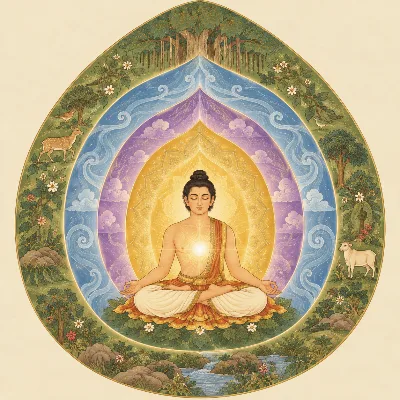
The Taittirīya Upaniṣad describes five layers, or sheaths (kośas), of our existence, from the outermost to the innermost. Source
- Annamaya kośa: the physical body, made of the food we eat
- Prāṇamaya kośa: the energy sheath of prāṇa, the bridge between body and mind
- Manomaya kośa: the mental sheath of thinking, feeling and emotion
- Vijñānamaya kośa: the intellectual sheath of higher thinking and intuition
- Ānandamaya kośa: the sheath of bliss, beyond body, mind and intellect
The outermost sheath is the body that anatomy studies; the breath sheath is where prāṇāyāma works; the mind and intellect sheaths are the manas and buddhi of the chariot.
Homework
Before the next class
- Listen to a motivational speaker, and study how they open the speech.
- Practise the warm-up every day, for at least 15 minutes.
← Previous class: 27 September · Back to the library · Next class: 11 October →