Yoga Philosophy
Darśana: that which helps us see
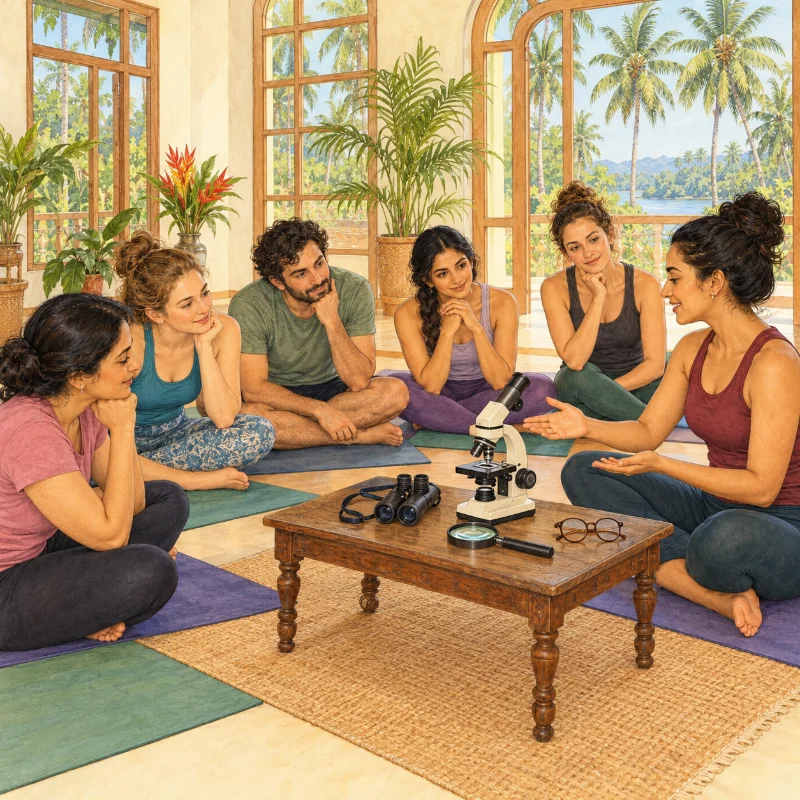
Madam began with instruments: a microscope, a telescope, a magnifying glass, spectacles. What are they all for? To see better. A microscope shows what is too small for the naked eye. A telescope shows what is very large but too far away, outside our visual field. A magnifying glass enlarges only a little: enough to read very small handwriting, not enough to see a microorganism. Spectacles correct our own vision.
दृश्यते अनेन इति दर्शनम्dṛśyate anena iti darśanam
That by which one sees is darśana. Like those instruments, a darśana is an instrument of vision. IGNOU traces the word to the Sanskrit root meaning “to perceive or to have a vision”. Source Indian philosophy is called Bhāratīya darśana; “philosophy” is only an approximate translation.
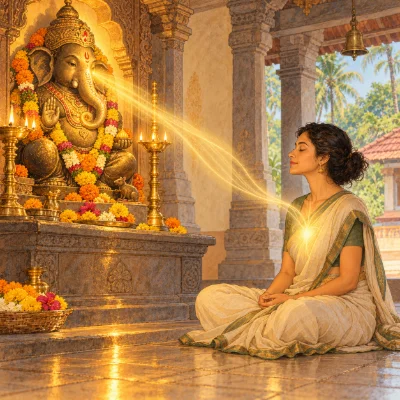
Why we go “for darśan”. We say we are going to the temple, or to see Ganapati at Chaturthi, for darśan. We never say that about visiting a relative. The difference: darśan helps us see something within us, or see things from a different perspective. Vision goes deeper than sight.
Too often we go to the temple to ask: ₹11 for this wish, ₹101 for a bigger one, then ₹501, ₹1,001. That is not why temples were built. A temple is a sacred, strongly positive space. There is a tradition that you should not leave a temple without sitting, even for two minutes. Sitting was the whole point: to sit quietly, meditate, and let the space change how you see what is in front of you.
A form to hold the mind
Dhāraṇā, the sixth limb, is holding the mind at one point; dhṛ means to hold. Tell a room to concentrate and the next question is “on what?” The board, the book, the wall? Concentrating in the abstract is hard. It is like a meeting: say “let’s meet tomorrow” without naming a place and everyone is confused; say “near the GST building” and everyone knows where to go. To reach the higher stages, dhyāna and samādhi, the mind first needs one point. That is what the mūrti, the form of God, was for.
The ultimate reality, Brahman, is nirākāra, without form, shape or gender, and nirguṇa, without qualities; not subject to time (kāla) and not affected by karma. It is not even “he” or “she”: we say “he” only for convenience. Look at the sky: can you point to where it starts and where it ends? God is like that, and you cannot concentrate on something with no start and no end. So forms were made, relatable to a person, a community or a place:
- Iṣṭa-devatā: your own chosen deity.
- Kula-devatā: the family deity.
- Grāma-devatā: the village deity, who protects the region.
If none of these forms works for you, make your own, or sit and concentrate on a tree; nobody will ask you why. That is the freedom this culture gives. These forms are devas and devatās. The goal is to realise the consciousness within, when the jīvātmā and the paramātmā become one: I am pure consciousness, and the body is only a vehicle, like the chariot, or car, from 4 October.
The Vedas: heard, chanted, remembered
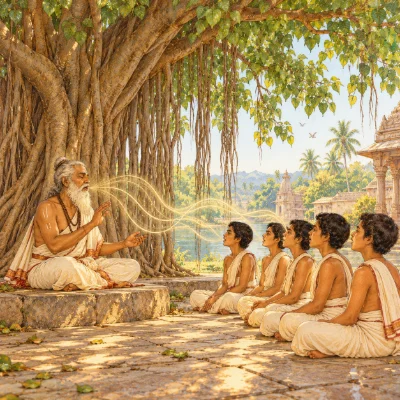
The four Vedas are the Ṛgveda, the Sāmaveda, the Yajurveda and the Atharvaveda. Tradition credits Vyāsa with compiling and arranging them, not with writing them. The Vedas are apauruṣeya: puruṣa is a human being, so apauruṣeya means not man-made, with no author. They are knowledge revealed to the ṛṣis in meditation. Veda and vidyā come from the same root, and Veda means vast knowledge. IGNOU: the Vedas are śruti, “that which is heard”, and apauruṣeya, “not authored by a human”, passed on orally; the popular view is that Vyāsa divided the hymns into four. Source
When the Vedas arose there was no writing: no paper, no ink. Writing came much later, on leaves, with colours from fruits and plants. So the Vedas were passed down orally, chanted in exact metres that everyone follows the same way, which makes them easy to remember and to pass on. Think of film songs: you may forget the lyrics, but you remember the tune. That is why so much of Indian knowledge, whether philosophy, science or any other subject, comes as a story or a song. A long lecture is forgotten by the time you get home; the story of Bhṛgu and Varuṇa is not.
Use it or lose it. Once people started writing, they started forgetting: it is in the book, you can look it up. We once knew 30 or 40 phone numbers by heart; now some people can’t remember their own. ChatGPT writes our leave letters. Saving time is good if you use your brain elsewhere, but if the only thing the brain processes is reels, it slowly loses its function. The body works the same way: patients who could not eat were still helped to keep using their swallowing muscles, because muscles that are not used stop working. And when we only type, we lose hand–mind coordination. The Vedas were never meant to be a textbook subject: you learned to chant them, reflected on them and applied them in your life.
The four aims of life: puruṣārtha
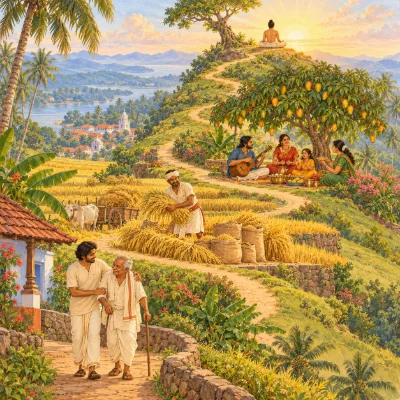
What is the purpose of life? The Vedic way of life answered it long ago: dharma, artha, kāma and mokṣa, the four puruṣārthas. IGNOU lists the same four, with mokṣa the highest, and adds that all six āstika darśanas accept them. Source
| Aim | What it means |
|---|---|
| Dharma | duty: acting rightfully |
| Artha | wealth, gained by doing your duty |
| Kāma | desire: with that wealth you follow your desires and do what you want |
| Mokṣa | freedom, reached when you pursue the other three along dharma, not adharma: rightly, properly, without harming anybody |
Dharma is not religion
Dharma, artha, kāma, mokṣa: is God mentioned anywhere? Dharma is to act rightfully, to do what is right in that situation whether I like it or not. Rāma was not excited to go to the forest; he went because as a son it was his duty to listen to his father. Sītā had not dreamt of a life in the forest; she went because she felt it was her duty as a wife. They did not go for an adventure, or for pictures with wild animals to post on Instagram. Yudhiṣṭhira was called Dharmarāja not because he was religious but because he was rightful.
The same holds for the chants. Saha nāvavatu is a śānti mantra for the student and the teacher: may we learn together. The teacher surrenders to the student, and the student back to the teacher. Sarve bhavantu sukhinaḥ: let everybody be happy, let everybody be healthy, let there be peace everywhere. Madam’s point: these chants are about how to live and learn together, not about belonging to a religion. Strictly, saha nāvavatu opens with “may He protect us both”, so it does ask for divine protection, but it names no particular god. It is the invocation of the Brahmānanda Vallī of the Taittirīya Upaniṣad. Source
So dharma is a way of life: how to live, and what responsibilities to follow. “My life, my rules” does not work in a society. You do something for yourself, for your family, for society and for your ancestors; we have just finished Pitṛ Pakṣa. There is personal dharma (vyakti dharma) and social dharma, and your duties change with your role. A teacher is a teacher inside the classroom; at home she is a daughter. A wife, a mother, a father, an employee and an employer each have different duties. The Vedas talk about fulfilling those duties rightly so that life has meaning, not just “I was born, I breathed for 50 years, and I was gone”.
“Religion” is a word from the West, with no exact equivalent in Indian languages, and translating dharma as religion is loose and wrong. Sanskrit is thousands of years older than English, and English still has no words for many Sanskrit ideas, so the closest word gets used.
How communities form. A running community, a yoga community, a community of organic living: people who believe in a similar idea come together for support, and if the cause matters to them, they bring in more people. If you find this diploma useful, you will bring in others too. Religions grew the same way: I believe in this God, four more people do, we come together, and soon we feel our God is the most powerful. That is ego, not God.
Madam’s own view: she is fond of nāstika people, because they see things clearly, without bias. Many of us believe out of fear, conditioned since childhood: what if something goes wrong? She has seen nāstikas become āstikas the right way. After studying, understanding and interpreting, they agree that there is a force bigger than us that we call God. Not a person sitting up in the clouds.
Trends are not seeking. Kainchi Dham, Neem Karoli Baba’s ashram, was a quiet place known to a few seekers, where you could stay a day or two and do sevā. After the new film about him (recommended on 27 September), the crowds came, with traffic jams for kilometres. Visiting will not bring mokṣa. FOMO, the fear of missing out, sends us to the restaurant everybody is going to, even when we are not interested in the food. Travel used to be about meeting people and exploring local things; now many people go because a place is viral on Instagram.
Everything is sacred. We first worshipped what we could see and touch: the sun, the moon, trees, leaves, flowers, the nature that nourishes us. Then we called that foolish, cut the trees and polluted everything. After a pūjā by the river, the flower garlands and incense packets go into the water. When we take divinity out of something, we take it for granted. In India nobody puts a foot on a book, because a book is Sarasvatī; yet on Instagram you will see people using books as yoga blocks, even standing on them in Tāḍāsana.
Āstika and nāstika: the Veda test
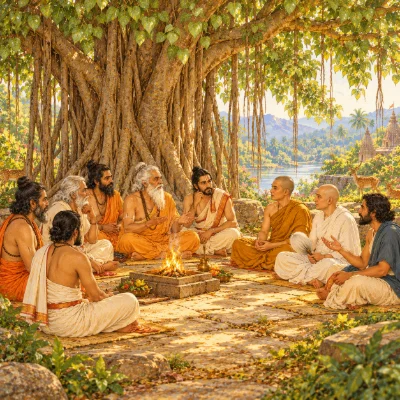
What do āstika and nāstika mean? The usual answer is a believer and a non-believer in God. One small change: in the darśanas, an āstika darśana accepts the authority of the Vedas, and a nāstika darśana does not. Belief in God does not decide it; one āstika darśana does not accept the concept of God at all. IGNOU: in common parlance āstika and nāstika would mean theist and atheist, but in the darśanas āstika means accepting the authority of the Vedas, and nāstika denying it. Source
What can we observe? Whether you believed in God or not, and whether you accepted the Vedas or not, this tradition held space for every perspective. Not accepting the Vedas did not take a school off the list of darśanas.
The six darśanas, in three pairs
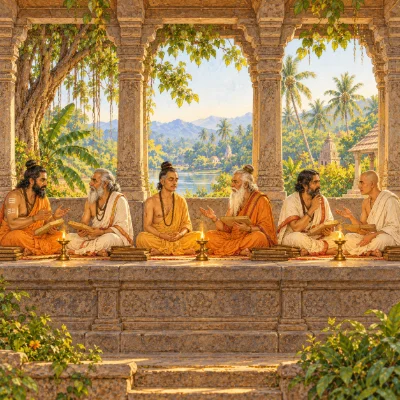
The āstika darśanas are six, so they are called the ṣaḍ-darśana (ṣaṭ is six). The two in each pair talk about different things but complement each other, so they are studied as a pair. The nāstika darśanas have no separate group name. There are three: the Buddhist (Bauddha), the Jaina and the Cārvāka. Source; for the pairs, IGNOU.
| Pair | Darśana | Associated with |
|---|---|---|
| 1 | Nyāya | Gautama (not Gautama Buddha) |
| Vaiśeṣika | Kaṇāda | |
| 2 | Sāṅkhya | Kapila |
| Yoga | Patañjali | |
| 3 | Mīmāṃsā | Jaimini |
| Vedānta | Bādarāyaṇa |
The knowledge was revealed to these ṛṣis, so we call them the authors. Patañjali is not the founder of yoga: he is the founder of the Yoga darśana, the one who systematised yoga in the Yoga Sūtras. Madam left the details for your history presentations. What each darśana teaches comes in the next class. IGNOU names the same six founders; it spells the first Gotama and gives the last as Bādarāyaṇa Vyāsa. Source
The Buddha and the middle way
At Siddhārtha’s naming ceremony, the man who cast his horoscope said the boy would either rule the whole world as a great king or give up everything and become a sannyāsī. His parents panicked. They never let him out of the palace, and he never saw pain or discomfort of any kind. He grew up, married and had a small child. When his father grew old and Siddhārtha was about to become king, he told his charioteer: how can I be king without seeing my kingdom? Take me out.
- He saw a man sitting under a tree, his face and hands covered in wrinkles. “He is old,” said the charioteer, and explained old age.
- He saw a man coughing and struggling: sickness, which slowly destroys the body’s functions.
- He saw four people carrying a man on their shoulders: death. You grow old, you fall sick, you die.
- He saw a man sitting calmly, with a radiant face and a gentle smile: a sādhu, a meditator, who had left family and wealth and was free of all bondage. That is why he was happy.
That night Siddhārtha left his sleeping wife and child and the kingdom, and went into the forest. He meditated for a long time and asked the people he met about life and death. He tried extremes, starving himself for days. In the end he realised that neither extreme helps, neither too many comforts nor starving yourself, and he taught the middle way, madhyamā pratipad. NCERT tells the same story: an old man, a sick man, a corpse and a homeless mendicant, and a path of moderation between severe penance and self-indulgence. NCERT · IGNOU
People who resonated with his teaching came together as a community, the way people who have been through the same hardship understand each other best. Buddha is a title, like “doctor”, not a name. The Buddha taught that all of life is suffering: birth, living and dying. He never called his teaching a religion; later, people organised it into Buddhism. In the same way the Bhagavad Gītā is not a Hindu book: anybody can read it, because it speaks to what we all do.
Mokṣa: breaking the cycle
You go from first standard to second, third, all the way to tenth. Imagine that after your tenth-standard exams you are sent back to first standard, and then again, and again. That is the cycle of birth and death: live a meaningless life, die, and come back to point one. Mokṣa is when the cycle ends and you are free.
पुनरपि जननं पुनरपि मरणं पुनरपि जननीजठरे शयनम् ।punarapi jananaṃ punarapi maraṇaṃ punarapi jananī-jaṭhare śayanam (Bhaja Govindam)
Born again, dying again, lying again in a mother’s womb. Madam called the Bhaja Govindam, the hymn known as Śaṅkarācārya’s, a request letter to God: please save me from this cycle, this saṃsāra. Source
Escape here is never meant in a negative sense, and never as suicide. The cycle is broken in a meaningful way, one that benefits you and the world. The Vedas and every teaching are about how to do that.
Where does Hinduism fit? A student asked. It does not fit neatly into one category of this framework. As with Buddhism, people later made a way of life into a religion. Hindu began as a geographical name, from the Sindhu river and the Indus valley. You are free to follow a way of life and to pray to whomever you want; the real question is whether you are living rightfully.
Homework
Before the next class
- Know the two groups of darśanas, āstika and nāstika, and which schools belong to each. The six darśanas come in more detail next class.
- History-of-yoga presentations: postponed (they were set for 25 October and 1 November). Madam wants her remaining classes for the syllabus, so the groups present later, even on a Sunday she is away, among yourselves. Don’t skip them: without history, the rest is hard to relate to. Patañjali’s place in that history is part of your presentation. See the talk: From a seal to Rajpath.
Class news: Madam is here until the end of November, so philosophy classes will be shorter from now on, to finish part of the syllabus before then. There is no philosophy class on the Diwali Sunday or the Sunday after it, which leaves two or three more classes with her.