Yoga Philosophy
Recap: what helps us see
The class opened with the last one. A darśana is something that helps us see properly. The darśanas fall into two groups, and the test is the authority of the Vedas, not belief in God: āstika and nāstika. The six āstika schools are the ṣaḍ-darśana: Nyāya (Gautama), Vaiśeṣika (Kaṇāda), Sāṅkhya (Kapila), Yoga (Patañjali), Mīmāṃsā (Jaimini) and Vedānta (Bādarāyaṇa). Each one needs four or five classes to explain even superficially, so Madam first asked a bigger question.
Why was philosophy born?
Science was born out of necessity and curiosity: necessity is the mother of invention. You need something, you find a way to do it, and when you do it in a systematic way, you call it science. Logic and reasoning on their own also belong to science. So what is philosophy for?
We talk loosely about “my life’s philosophy”. But what does philosophy actually discuss? God, karma, the purpose of life. You are born, you get an education, you get a job that pays a certain amount, you build a family, and one day you are gone; then you are born again and go through the same process. Is that the purpose of life? Or are we blindly living in the name of “going with the flow”?
Everybody wants to be happy
Ask the room what they want from life and the answers come: happiness, satisfaction, to leave a legacy. As kids we were told: study well, you will get a good job; a good job brings a lot of money. Does it all boil down to happiness? Is there anybody who does not want to be happy? Nobody raised a hand. Why do I eat this food, do this job, live with this person? Because I thought it would make me happy. Every action of ours is directed towards happiness, and not only in India: the whole world is looking for it, as in the film The Pursuit of Happyness.
Who taught us that? Society? Societies are very different: Goa from Karnataka, Tamil Nadu or Kerala, the south from the north, South Asia from the West. Yet everyone looks for happiness. A student said it: by default. Remember the pañcakośa: the innermost sheath is the ānandamaya kośa, the bliss sheath. It is present in everybody, and we are all trying to reach it. Nobody gave us an instruction manual that says “be happy”; we know it innately.
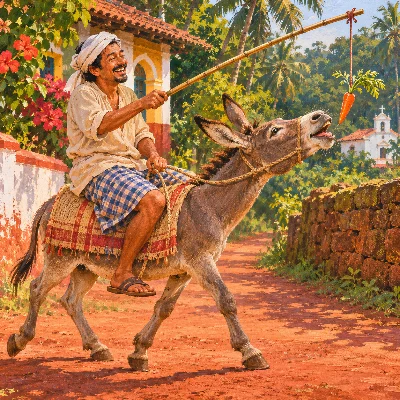
The carrot and the donkey. A man’s donkey would not walk. So he tied a carrot to the end of a long stick, sat on the donkey and dangled the carrot in front of it. The donkey thought every step brought it closer to the carrot, without realising the carrot was travelling with it. That is how happiness has been dangled in front of us to get us to do things: score these marks and I will buy you this. A barter.
And the definition keeps changing. At 7 or 8, happiness is a new bicycle. At 14 or 15, a boyfriend or a girlfriend. At 24 or 25, a campus placement. At 30 or 35, a car, a house, a bungalow. At 50, the success of your children. Would a bicycle make you happy today? If the definition goes on changing like this, we will never be happy. This is what philosophy discusses: what is the nature of the world, how did creation come about, why are we all searching for happiness, and how do we get caught in this cycle of birth and death? Questions bigger than life.
Try it · The carrot and the donkey
At 7 or 8, happiness is a new bicycle. Tap Walk on to grow up.
IGNOU says the same of Indian philosophy as a whole: it is human-centred, and it seeks to end human suffering and reach happiness in its highest form; the schools differ only in how they approach that goal. Source
Why we have rules
Let go of the big questions and you get “my life, my rules: I will do what I like”. Imagine the teacher walking in one Sunday and putting her feet on the table: it is my class, I can do what I want. Is that acceptable? Imagine every student coming at whatever time they like and demanding the class be taken. It would not work. So there is a timetable, a dress code that suits the space (you can’t practise yoga in party clothes), and a separate queue at a crowded temple for the elderly and for mothers with small children, because a 75-year-old in a 3 km queue will fall before 500 m. Norms and traditions exist so that people living in a group have less conflict, and the more diverse the group, the more they are needed. India is very diverse: even Konkani, spoken by a small community, has many accents across Goa and Karnataka. Traffic rules, laws, social rules and family roles all exist to make life simpler.
But don’t hold them too tightly. Class starts at 6. A rigid rule-follower punishes the student who walks in 20 minutes late, or keeps her out. But what if she had a health emergency, or a minor accident? Can I make an exception? The rules of life were made to make life easier, and we have caught hold of them so tightly that we complicate it. The protocol of life is the same: born, educated, a job, marriage, children, who get a job, marry, have children. At some point you need to break that cycle, and Indian culture had a format for it.
The four āśramas
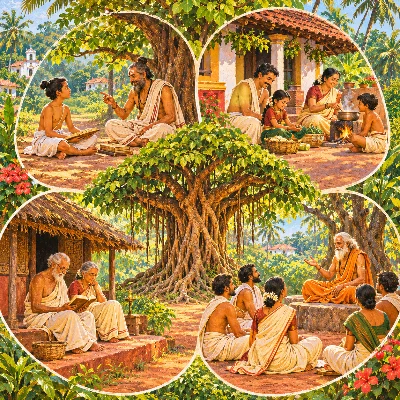
Life was lived in four phases, the four āśramas:
| Āśrama | What it was for |
|---|---|
| Brahmacarya | Education. In a narrow sense brahmacarya means sexual abstinence, but carya is to move (the same root as calnā): brahma-carya is moving towards Brahman, the higher consciousness. We gain knowledge not just to earn bread but to move upward, not to repeat first to tenth standard for ever. |
| Gṛhastha | The householder. The body has built-in needs: āhāra, nidrā, bhaya, maithuna, food, sleep, fear and sex. “You cannot uninstall these apps.” We can’t fulfil them like animals, so we form a family, to meet each other’s needs at every level, not only physical or emotional, and earn enough to keep it going. |
| Vānaprastha | Vana is forest. Once the children reach gṛhastha and take over the household, you cut yourself off from society and do spiritual practice: what was my life for, what did I learn, gain and lose? A time for reflection and realisation. |
| Sannyāsa | You come back to give: you teach the householders what you realised, and encourage them on to vānaprastha in their turn. |
Not a self-centred culture. In two phases, brahmacarya and vānaprastha, you are largely cut off from society and allowed to be “selfish”: to work on yourself. In gṛhastha you receive from society: somebody gave you a job and a salary, shops gave you food and clothes, a family agreed to a marriage. In sannyāsa you give back. A self-sustaining cycle: “this is how things were supposed to be”, and we broke the rules.
Madam thought brahmacarya then ran from about age 4 to 14 or 15. The textbook scheme gives roughly 25 years to each stage: student until about 25, householder from 25, vānaprastha from 50 and sannyāsa from 75. It describes sannyāsa as breaking off all attachment to the world to meditate, and calls the āśramas the concrete form of the four aims of life, a training that prepares a person for mokṣa. Source Madam’s emphasis on the sannyāsī as a teacher of householders is her reading of what that freedom is for.
Yoga is the intoxicant
We are becoming very self-centred: me, mine and myself. Imagine every mother saying, I will not feed or care for my child: would we survive as a society? To keep us together, philosophy is needed: the ability to think beyond our own self. Consumerism pushes the other way: skin care, hair care, self-care, and in the name of self-care they sell you anything.
Puppy yoga: a yoga session in a big hall with ten or twenty puppies let in to climb over you while you practise. Madam put the price at ₹3,000 to ₹5,000 for an hour. Beer yoga: a mat with a big mug of beer beside it, a sip after each pose. Yoga was a tool developed to liberate you, and we have reduced it to a circus. Yoga is supposed to be the naśā, the intoxicant itself; you don’t take an intoxicant with it. Why does this happen? Because in the name of “this makes me happy” we do senseless things, and the happiness is momentary.
The first bite: diminishing returns
Economics calls it the law of diminishing returns. Your favourite sweet, say kaju barfi: how many from a 3 kg box? Ten, if we overestimate you. A 2 kg tub of ice cream: maybe half a kilo. Why stop? Not because the stomach is full; say it could expand endlessly. Because the happiness is over: a saturation point. Love parathas? Eat them every day and in a week you want a break. Dal-chawal three days running and you are already complaining. No matter how much you like something, if it happens regularly, the happiness you get from it diminishes.
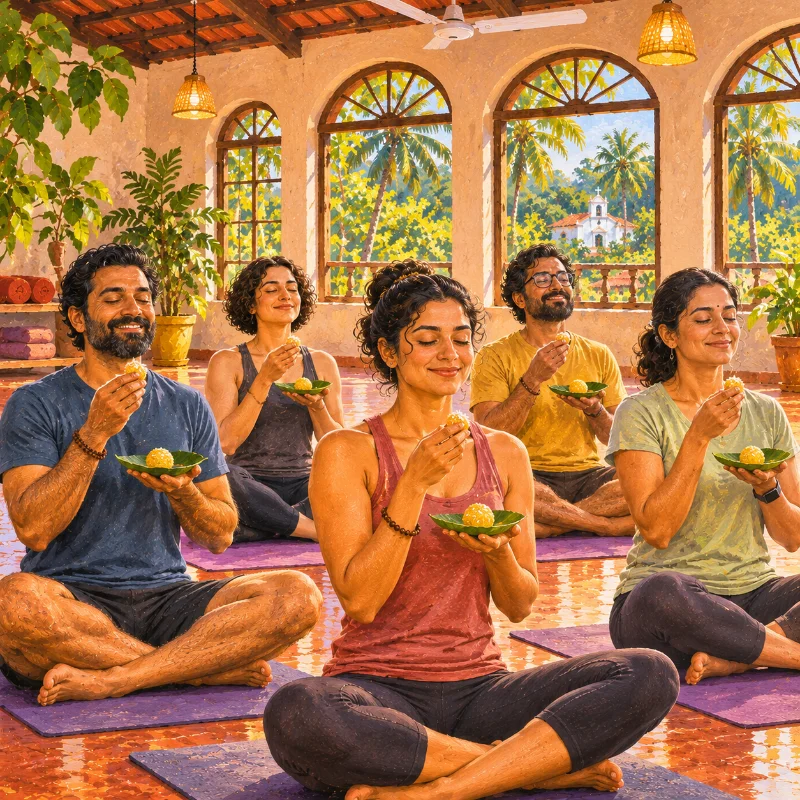
Try it. Madam led this with eyes closed. Pick a food you really love. You have not had a proper meal in 20 days. You are in a comfortable eatery, you order your favourite, and it arrives. Take the first bite: very tasty, beyond what you expected. From the second bite onwards you will not get the same feeling. It is only the first few spoons of ice cream that give the happiness; after that we eat because we have paid for it.
That is why we keep chasing new experiences: the same thing no longer gives the same kick. That first time is the moment you touched the ānandamaya kośa for two seconds and came back. Having tasted it, you want it constantly. Children in a park beg for “a little more time”; that is how the ānandamaya kośa works for us, like a park we may visit for seconds. You thought the degree would make you happy, and it did, for a day, before the workload took over. However passionate you are, the work still leaves you tired, asking why you are doing it. All of this is chasing that small glimpse of bliss.
Where happiness is
If happiness were in the material, the same material would make us happy every time. It doesn’t, so where is it? The mind reaches only as far as the manomaya kośa; the bliss sheath lies beyond it. The mind is a tricky thing: happy one moment, upset the next, worrying about something ten years away.
Think of the moments in your life when you were happy beyond words. What did you experience? Nothing. When you are very happy, you go blank. With the first bite, when you are very hungry, everything in the mind shuts down; you are not even thinking of the second bite. It is silence. Yoga was built on expanding and sustaining that silence: not only reaching the ānandamaya kośa, but staying there for some time. How to do it, and why, is what philosophy explains. (Compare the definition from 6 September: yoga is the stilling of the mind’s movements, citta-vṛtti-nirodha.)
The richest and most powerful people have every facility, and the most controversies. If money or power brought happiness, they would be happy. How many are? Sooner or later most of us say it: what is the point of having all this if we are not happy? Philosophy answers that in a systematic, logical way, not with fairy tales.
The six darśanas, in a line each
- Nyāya: logic and reasoning; nyāya itself means that.
- Vaiśeṣika: the nature of the world, how it was formed.
- Sāṅkhya: how we evolved; how manas, buddhi and ahaṅkāra came into the picture.
- Yoga: how to conquer all that.
- Mīmāṃsā: the procedures and way of life to follow.
- Vedānta: the soul, the body, the world and māyā.
IGNOU’s summary runs the same way: Nyāya is the science of reasoning; Vaiśeṣika specialises in physics, substances and their qualities, and holds to atomism; Sāṅkhya explains evolution from prakṛti and puruṣa; Yoga is the practical side of Sāṅkhya; Mīmāṃsā is about following Vedic rituals at the stages of life; Vedānta teaches, among other doctrines, the five sheaths. Source
None of them is rigid. Sāṅkhya does not accept God. Yoga does, yet the whole Yoga darśana is built on what Sāṅkhya says: Patañjali in effect says, Sāṅkhya is wonderful, I’ll take it as it is, but I want my God in it, and adds Īśvara. You can disagree and still complement each other. IGNOU: Yoga accepts Sāṅkhya’s three pramāṇas and its twenty-five principles, and accepts God, called Īśvara, free from karma, pain and pleasure. Source Nobody forces anybody to follow their philosophy. None of the six turned into a religion, the way Jainism and Buddhism did; there is no “Sāṅkhyism”. They were perspectives that the ṛṣis understood in transcendental states: agree if you want, disagree if you don’t. That is the beauty of Indian culture, and of yoga.
Pramāṇa: the right ways of knowing
Chronologically Vaiśeṣika came first and Nyāya later, but Nyāya is always discussed first. Before the details: every darśana talks about pramāṇa, the right means of gaining knowledge. (Not for the exam, Madam said; just soak it in, so the rest makes sense.) Yoga accepts three:
प्रत्यक्षानुमानागमाः प्रमाणानि ॥ १.७ ॥pratyakṣa-anumāna-āgamāḥ pramāṇāni (Yoga Sūtra 1.7)
- Pratyakṣa, direct perception: I walk into the class and see all of you. You are here.
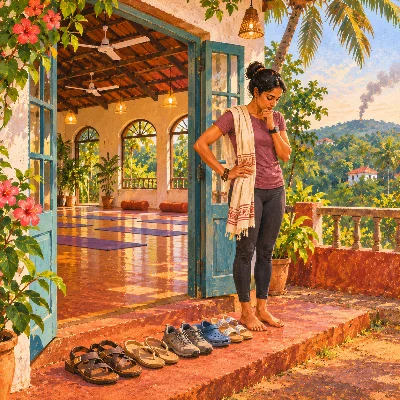
- Anumāna, inference: I walk in at the gate and see your footwear outside, and the lights and fans on. I have not seen you yet, but I infer the students are inside. Smoke in the distance: there is fire.
- Āgama, the word of a reliable source: what a trustworthy teacher or text tells you.
Other schools count more, such as upamāna, knowing by comparison, and call testimony śabda, the word of a reliable source; each darśana accepts its own set of tools. Mīmāṃsā, for one, goes up to six. IGNOU The University of Calicut renders the sūtra as insight arising from direct perception, conclusions, or learning based on reliable sources. Source In the Yoga Sūtras, pramāṇa is also the first of the five kinds of movement of the mind, the vṛttis. IGNOU
Understand the problem before the solution
Why do we need knowledge at all? Because we are stuck in a loop: born, die, born again, like the first-to-tenth-standard cycle from last week. Talk to any of us one by one and we each have at least ten or fifteen problems. Suffering. Who enjoys it? Nobody. And what is happiness? The end of suffering. But you cannot solve a problem you do not understand.
A child who won’t study. A 7- or 8-year-old shows no interest in studies. The usual responses: no play until you study, threats, wait till your father comes home, a beating, labels (“lazy”, “useless”, “look at your brother”), even shaming in front of relatives. The intention is always good; no parent wants their child unhappy. But what does the child record? This is an unsafe place; if I make a mistake I will be humiliated. So the child stops sharing, and by the teenage years the parents say, I don’t even know this kid. Mistakes will happen, to err is human, and out of guilt and shame the child hides them; that is where much deeper trouble begins. All that was needed was to pause and ask why. Is there a problem at school, with a teacher, with something else? To a child every colour, shape and face is new. Children are full of curiosity, and day by day, systematically, with the best intentions, we kill it.
We do the same with our own suffering. We are so busy escaping it that we never look at it. We attach our happiness to power, money or another person, who is often as miserable as we are. Unhappy with a partner, you divorce, and you are unhappy elsewhere, because you never found the source. You are scraping the surface. What is needed is not the knowledge that comes with degrees, but knowledge of yourself, of the world, of your own nature, and of how to lead life.
Nyāya and Vaiśeṣika, the twins
Nyāya calls it tattva, knowledge of reality: not just any knowledge, but right knowledge, and right knowledge is the only way to break the cycle of suffering. IGNOU: Nyāya specialises in the science of reasoning, but its grand claim is the supreme happiness, apavarga, through understanding sixteen concepts such as knowledge, soul, pain and doubt. Source
Nyāya takes support from Vaiśeṣika, which explains the nature of the world: what the elements are and how the world came into existence. Vaiśeṣika has a theory of atoms, aṇu, and Madam linked Kaṇāda’s name to kaṇa, the tiniest particle. Atoms come together to form the five great elements, and with space, time, the soul and the rest they make up what we call the world. One explains the world, the other how to gain right knowledge of it, both towards mokṣa: so they are the twins.
Sāṅkhya talks about the evolution of a human being. The notes stop there; it continues next class.